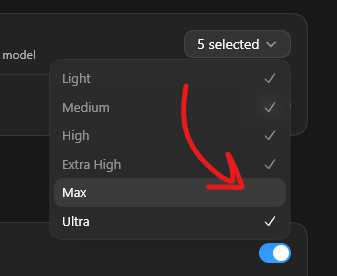
codex tip: 🌕Luna has its BEST mode hidden by default. Go to Settings -> Configuration -> turn on Max.
Congratulations, you just unlocked the world's best model today
AI skills are still being written like prompts.
That is why they work twice, fail somewhere else and collapse when the model, harness or context changes.
The best skills build machinery around the model so the outcome does not depend on whether the prompt happens to work.
This is the first piece I’ve read that treats skill engineering like actual engineering.
Read it before you write another SKILL.md.
I woudl like to interview an AI-native designer to show us how to build with design.md, components, and more vs. the typical process.
Who's the best person to talk to?
This is the correct take on Taste.
Taste involves way more than just aesthetics. Way more than obsession with details. Way more than “pushing your team”.
And Taste is also way more learnable than you’ve been led to believe.
A rural Arkansas school district was hemorrhaging $250,000 a year and couldn't keep teachers. So residents voted to take out a $5.4 million bond, upgrade every building in the district, and install 1,400 solar panels.
Three years later, the deficit flipped to a $1.8 million surplus.
The project wasn't just solar. Energy efficiency upgrades across all six schools, new lighting, HVAC systems, windows, and thermostats cut energy consumption by 1.6 million kilowatts annually.
The panels, some installed as a canopy at the school entrance and some on unused district land, generated enough excess electricity that the district started selling it back to the grid. Monthly utility bills dropped from $17,000 to $4,000.
The school board voted to put the savings into paychecks. Teachers saw raises averaging $2,000 to $3,000 a year, with some receiving up to $15,000 depending on tenure.
Batesville went from one of the lowest-paying districts in Arkansas to one of the highest-paying in its county. Resignations slowed and applications went up.
Taxpayers funded the upfront cost through the bond. The savings paid it back and then some. "Batesville has reduced the checks they write to utilities," said the energy company that managed the project, "and increased the checks they write to teachers."
At least 20 nearby districts have since copied the model. Nine thousand schools across the US now run on solar. Batesville was the first to route the savings directly into teacher salaries.
I'm now running GLM 5.2 as my default model in claude code + cursor, and it's cost me *checks notes*
$3.36
Today's ep of How I AI is my first reviewing an open weights model, @Zai_org's GLM 5.2 which (so far) is giving me Opus vibes without the opus $$$
I cover
- how to set up these models in cursor and cc via @OpenRouter API
- front end design sense
- performance on a long running autonomous task
The moment it won me over? When it put chatprd pink in my docs without me having to ask
A huge ty to our special sponsor @mercury - Radically different banking loved by over 300K entrepreneurs
Full ep on youtube: https://t.co/7IamdSypGU
You should basically never use Fable for coding, but instead use it as a planner/orchestrator.
Most of today's advanced models can implement a spec perfectly, and once done you can send the work to Fable to review.
This has been my most powerful flow so far.
You have Claude Fable for only a few days. Here's how to make the most of it.
Introducing /improve: use your most capable model to audit your codebase and write plans for cheaper models to execute later.
Studies your code, figures out bugs, perf, tech debt, missing tests, what to build and writes plans any agent can run.
They called them flying coffins. The men who volunteered to fly them knew exactly why.
The Allied gliders of D-Day were made of fabric stretched over a frame of wood and metal tubing. They had no engine. No armor. No weapons. No parachutes for the men inside. They were towed to France at 130 mph on the end of a 300-foot nylon rope attached to a C-47, and when the rope was cut, there was one chance to land.
One. No go-arounds. No second approach. Whatever was below you was where you were going.
What was below them was Normandy at night.
The Germans had spent weeks preparing. Under orders from Field Marshal Rommel, they had driven wooden stakes into every open field in the region, angled to impale gliders on landing. The French called them Rommelspargel. Rommel's asparagus. Thousands of poles, many with mines or artillery shells wired to the tips, packed into every field large enough to land on.
What the glider pilots had not been properly told was the scale of the Norman hedgerows. The bocage. These were not English garden hedges. They were ancient earthen walls, some dating back centuries, topped with dense root systems and trees, rising 50 feet in places, bordering fields barely 200 yards long. A Horsa glider coming in at 100 mph hitting a hedgerow did not survive it. Neither did most people inside.
Some fields were flooded. Some were mined. Many were both.
517 gliders went into Normandy. 97 percent were abandoned in the field by the end of the operation. Most were destroyed.
General Don Pratt, assistant commander of the 101st Airborne, was in the first glider wave. His pilot managed to find a field near Hiesville and brought the glider down. It slid across the wet grass without slowing and hit a hedgerow at speed. The co-pilot died instantly. The pilot, Lieutenant Colonel Mike Murphy, broke both legs. General Pratt suffered a broken neck. He became the first American general to die in the Battle of Normandy. His glider had landed in one piece.
Sergeant Eric Wilson's glider did not. It hit a building at high speed. Both of Wilson's legs were broken. He was trapped inside the wreckage, unable to move, in enemy-held Normandy, for two and a half days before anyone reached him.
Lieutenant Den Brotheridge had come in earlier than anyone, in the first glider to land in France, the silent coup de main assault on Pegasus Bridge just after midnight. His glider stopped 47 yards from its target. He led his men out at a run, reached the bridge, and was shot. He died within minutes, the first Allied soldier killed by enemy fire on D-Day.
The men who survived the landing did not get to stop. Glider pilots were not assigned to combat units. Once down, they were expected to fight as infantry, dig foxholes, guard prisoners, carry ammunition, do whatever was needed. Most of them had trained to fly, not to fight on the ground behind enemy lines in the dark.
They did it anyway.
Of the 517 gliders that went in, 222 were Horsa gliders. Most were destroyed either on landing or by German fire in the hours that followed. The Waco CG-4As fared slightly better but 97 percent of all gliders from the entire operation were eventually abandoned in Norman fields, broken and empty.
The men who flew them were not pilots in the traditional sense. They were soldiers who had been given just enough training to put an unarmed, engineless box of fabric and wood into a dark foreign field at 100 mph, full of men and equipment, with one attempt and no margin for error.
Many of them got it exactly right.
Many of them did not come home.
Today is June 6th.
Remember them too.
82 years ago nearly all of the men on the first few boats that landed on the beach in Normandy were dead before days end.
Sit here with that for a while.
Look at them.
Really look at them.
Look into their eyes.
Many of them are boys, they are someone’s son, someone’s brother, someone’s sweetheart someone’s father.
They never came home.
And every privilege, every convenience, every freedom and every little thing that you want to bitch about you have because of them and they paid the ultimate price for you to have those freedoms. #dday #FreedomIsNeverFree
90% of the soldiers on the first boats to hit the beach didn't live to see the end of the day. Look at those faces. Some of them never made it to 18.
Never forget that they paid the ultimate price for our freedom. We live our lives the way we do because of them.
BREAKING:
Anthropic just dropped Opus 4.8—and it is a MONSTER
We've been testing for about a week @every and our verdict is they could've just called it Opus 5, it's that good.
Here's our vibe check:
- Beats GPT-5.5 on Senior Engineer bench. On our toughest benchmark Opus 4.8 scores a 63—a hair higher than GPT-5.5's score of 62, and a full 30 points higher than Opus 4.7. It tackled a ground-up rewrite of a production codebase, and actually built something that works.
HOWEVER: Coding performance varied a lot at different reasoning levels. We recommend using it on xhigh for best results.
- Incredibly good writer. Opus 4.8 scored a 79.6 on our writing benchmark—measuring models on real-world writing tasks we do all of the time like essay writing, promo email writing, and more. It beats GPT-5.5 by 6 points. It produces well-written prose with fewer "AI-isms". It's also very good at writing in your voice given the right context.
HOWEVER: Writing performance also varied with reasoning levels. Medium reasoning had higher incidence of AI-isms—we found best results with high.
- Beast at knowledge work. Opus 4.8 is very good at general knowledge work tasks like report creation, research and more. It produced the best PowerPoint one-shot we've ever seen on our deck generation benchmark.
- Emotionally intelligent, willing to question the frame. I've also found it to be quite good at talking through psychological or interpersonal issues. It has a high EQ, and it's also good at not glazing and helping to expand your perspective. Its thought process feels extremely rich and dynamic.
THE BAD:
These days a model is only as good as its harness, and Codex is still a far superior harness to the Claude Desktop app. This has kept me using Codex + GPT-5.5 as my daily driver, but I am flipping back and forth a lot more between Codex and Claude.
Anthropic is back baby!
Read the rest on @every:
https://t.co/vuORiDXkxX
Trump: We lost 13 people. In other wars, you lost hundreds of thousands of people. I get a kick when I look at somebody on television and they say, 'he's lost 13 people.'
@lennysan@firstround My favorite quote from the article:
I don’t feel like I’m that smart and I don’t want to sit there and pontificate and share my insights. I’d rather hear the guest talk.
D. L. Hughley on Trump: “I’m very proud I’ve never voted for a president who raped women and children. I never voted for a president who defrauded charities. I never voted for a president that celebrated the death of somebody. And half this country can’t say that”