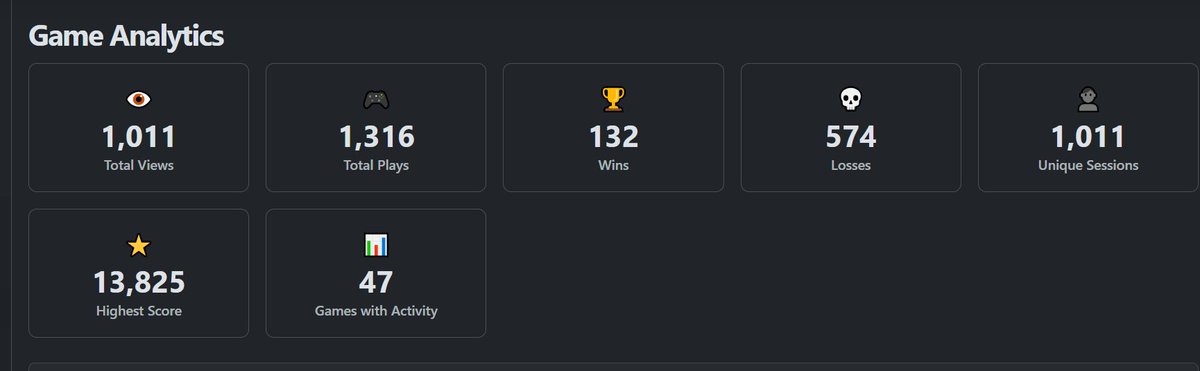
Over 1,300 games played, and nearly 50 games total for @lavawebgames!
If nothing else, AI helps you to push through some of the mundane parts of bringing your software idea to life. Especially when the novelty of that new idea fades.
Extra special thanks to @Microsoft and @msdev for Microsoft Agent Framework to give .NET developers great libraries to build AI with AI.
I ended up cancelling GitHub Copilot.
Because ultimately the code changes were much lower quality than before June 1st.
I wasn't happy about the pricing change but was willing to work through it and evolve how I developed to be more token efficient.
But looking back on the couple hours I had tonight to make a small change to my app would've been better served just writing the code by hand.
I can’t help but think this is a veiled comment blaming GitHub Copilot users for exhausting their credits post 6/1.
If I recall correctly, each new model made available in Copilot was praised for being even more magical than prior models so everyone using Opus 4.8 should not be surprising.
@pierceboggan@code Am I better off using @code instead of @VisualStudio for configuring this? I can't say for sure, but it seems like VSCode is more efficient with my GitHub AI Credits than Visual Studio. Asking for a friend...
The mobile games render a lot better on mobile devices now, too. Also, there is an annoying experience where you have to be on the page while the AI Agent is modifying your game. Looking to fix this soon.
New version of Lava Web Games released - new users will get one free game pack with 3 modifications.
Give it a try today and make the game or experience you've always thought would be fun or interesting.
Last night, I did successfully implement the feature I wanted using GitHub Copilot.
One change I made was to dive into the code myself to isolate and debug some of the issues, and it turns out that the app behaved as design I just forgot I designed it that way.
But explicitly add code snippets for places where I wanted to make changes seemed to help. Also I think my session context has analyzed my repo enough that my token use is more efficient.
I still burn through a lot of tokens, but I also may have enabled planning so that probably burns a lot of tokens.
Well, I undid the cancellation, so I still have my GitHub Copilot Pro account.
I thought about it a lot, and one core reason for the low quality results might be because my long running session for my app ended up broken so I started a fresh one.
After June 1st, my long running session was beyond the maximum context window size. And trying to compact the results wouldn't work.
At the very least, I've decided to sleep on it first before making any permanent decisions.
This is a valuable read. I definitely agree that the harness is key. The GitHub Copilot change is painful because I naively thought it, as the harness, was so good it could make feature changes more cost effectively than anything else on the market.
GitHub Copilot just switched to token-based pricing, and people are posting bills that have increased 10x overnight.
Everyone is blaming the pricing.
I run coding agents all day while building Farfield, and most of that bill is self-inflicted.
The model didn’t get more expensive. Your harness did.🧵
@thomasgauvin Same, same, same - one point I'd lay on top of this is that each feature change felt like the same cost which is why I think milestone based pricing is probably the right modal rather than usage
I’m debating cancelling but first I’m willing to try and figure out if I can condense my requests. I thought the value of GitHub Copilot was its ability to process things locally enough to really be efficient with tokens when calling remote LLMs, but turns out it was just subsidizing those costs.
@TechTech99999 I have not, but I'm always exploring. The more I think about it, the "feel good" of using GitHub Copilot was that it felt like each change was about the same cost, which I think is going to be the pricing model that wins,