84 years ago today, a pilot running out of fuel made a decision that won the Pacific War. Most Americans have never heard his name.
June 4, 1942. Six months after Pearl Harbor, Japan's navy is undefeated. Four of the carriers that burned Pearl, Akagi, Kaga, Soryu, and Hiryu, are steaming toward Midway to finish off the US Pacific Fleet.
At 7:52 AM, Wade McClusky launches from USS Enterprise leading 32 Dauntless dive bombers. Here's the detail nobody mentions: McClusky is a fighter pilot. He'd been given the air group weeks earlier and had barely flown a dive bomber in combat. Now he's leading every SBD the Enterprise has at the most important target in the Pacific.
9:20 AM. He arrives at the intercept point where the Japanese fleet is supposed to be.
Empty ocean. Nothing for miles.
The Japanese had turned. Nobody knew where. And now McClusky owns the worst math problem in naval aviation: his fuel is bleeding away, and every minute he keeps searching, he condemns more of his own pilots to ditch in open water where nobody will find them.
Doctrine is clear. Turn back.
McClusky keeps going. He works a search pattern, squeezing miles out of dying fuel tanks.
9:55 AM. Far below, a single Japanese destroyer is cutting a white scar across the ocean at flank speed. It's the Arashi, racing to rejoin the fleet after depth-charging the American submarine Nautilus. Think about that. A failed sub attack is about to give away the entire Japanese navy.
McClusky reads the wake like an arrow and follows it.
10:02 AM. The horizon fills with the entire Japanese strike force. Four carriers, their decks crammed with planes being refueled and rearmed. Fuel lines snaking everywhere. Bombs stacked in the open.
And here's the miracle: the sky above them is empty. Minutes earlier, American torpedo squadrons had attacked at sea level and been annihilated. Torpedo 8 lost all 15 planes. One survivor, Ensign George Gay, watched what came next while hiding under his seat cushion in the water. Those doomed pilots dragged every Japanese fighter down to the waves. The door upstairs was wide open.
10:22 AM. McClusky pushes over from 14,500 feet. Both squadrons follow him down onto Kaga. It's actually a mistake, doctrine said split the targets, but Lt. Dick Best catches it mid-dive, pulls out with two wingmen, and goes after Akagi alone. His single bomb pierces the flight deck into the packed hangar. It's enough.
By 10:28, Kaga, Akagi, and Soryu, the third hit simultaneously by Yorktown's bombers, are floating infernos. Six minutes. Three carriers that attacked Pearl Harbor, gone. Hiryu follows them to the bottom that evening.
The cost of McClusky's gamble was real. Many Enterprise bombers never made it home, some shot down, others swallowed by the sea when their tanks ran dry. McClusky himself was jumped by two Zeros on the way out, took five bullets through his shoulder, and still flew his shot-up Dauntless back to the Enterprise.
Admiral Nimitz said McClusky's decision "decided the fate of our carrier task force and our forces at Midway." Japan never won another major battle.
One borrowed pilot. One destroyer's wake. One choice to keep flying when every gauge said go home.
In Wisconsin, a graduate was forced to stop on stage when his diploma couldn't be found.
That's when the school said a person traveled thousands of miles to deliver it to him.
It was his sister, returning from military service, for over a year. ❤️
On this day in 1941, the British Empire saved its oil supply with a force smaller than a London police precinct.
Almost nobody remembers it.
Two months earlier, a pro-Nazi colonel named Rashid Ali had seized power in Baghdad in a four-man military coup. He immediately offered Iraq's oil fields, airfields and railways to Hitler in exchange for German support against the British, who had controlled Iraq under treaty since the 1930s.
Hitler said yes. Luftwaffe squadrons were dispatched to Mosul. A handful of Heinkels and Messerschmitts painted in Iraqi colors were already on the ground.
If Iraq fell, Britain lost its main wartime oil supply, the route to India through Basra, and any chance of holding the Middle East against Rommel pushing east and the Germans driving south through the Caucasus.
Britain had almost nothing in Iraq to stop it.
What it had was RAF Habbaniya. A flight training school on a desert plateau 50 miles west of Baghdad. The aircraft were obsolete biplane trainers: Hawker Audaxes, Airspeed Oxfords, a handful of Gloster Gladiators meant for student pilots. The garrison was 1,200 men: airmen, mechanics, flight instructors, six companies of Assyrian Christian Levies, and a few hundred student pilots who had never seen combat.
On May 2, an Iraqi army of 9,000 men with field artillery surrounded the plateau on the surrounding cliffs and ordered them to surrender.
They didn't.
For five days the obsolete trainers flew 647 sorties against the Iraqi positions, instructors leading their own students into combat over the wire. They lost a third of their aircraft. They lost 13 men. They broke the siege and chased the Iraqi army back toward Baghdad.
Meanwhile a scratch relief column called Habforce had set out across 500 miles of open desert from Transjordan with no maps and almost no water. At its head rode a column of Arab Legion soldiers led by an Englishman who had gone native, John Bagot Glubb, whose Bedouin troops called him Abu Hunaik, "father of the little jaw," after a wound he had taken in the trenches in 1917.
Glubb's men reached the outskirts of Baghdad on May 30.
The coup leaders fled to Iran in the night. The Mufti of Jerusalem went with them. Rashid Ali eventually made it to Berlin and spent the rest of the war as Hitler's guest.
Iraq's oil kept flowing west for the next four years.
Hitler had been hours from controlling the Persian Gulf and never knew it.
On this day in 1921, The Tulsa Race Massacre happened in the affluent black community of Greenwood in Tulsa (Black Wall Street)
White supremacists killed more than 300 Black Americans and looted & burned to ground homes & businesses.
History of Tulsa before the riot
A THREAD
If you're happy about the Kennedy Center decision thank Joyce Beatty. @RepBeatty was the plaintiff in the case that made Donald cry and write a 10 page essay about how he was going to abandon the Kennedy Center because they ordered his name taken off of it.
On this day in 1942, the Desert Fox almost lost the war in Africa.
Three days into the Battle of Gazala, Erwin Rommel had driven his entire Afrika Korps around the southern edge of the British minefields in a brilliant night march, then turned north and stabbed deep into the British rear.
It was textbook Rommel. Audacious, fast, and on May 28, very nearly suicidal.
By sunset his panzers were stranded behind British lines.
No fuel. Almost no water. British armor on three sides. His supply convoys somewhere out in 200 miles of open desert, hunted by raiders from the Free French garrison at Bir Hacheim.
The British commander Neil Ritchie had him cornered. All he had to do was attack.
He waited.
That night, Rommel did something that almost no army commander in modern history would do.
He climbed into a truck. Took a handful of staff officers. And drove out into the dark desert himself to find his missing supply column.
He found it by moonlight.
Then he led the trucks back through enemy territory in person, navigating by the stars, threading between British patrols in the dark, all the way back to his stranded tanks.
He arrived at dawn with fuel.
The next morning his men dug into a shallow depression in the desert floor that history would name "The Cauldron." Two weeks later, Tobruk fell. 33,000 British soldiers walked into captivity.
Churchill nearly lost a vote of no confidence in Parliament.
The British learned a lesson that summer that the Germans had known for years.
Sometimes wars are won by generals who do their own driving.
In 1968, an RAF pilot carried out an unauthorized flight over London to mark the Royal Air Force’s 50th anniversary, believing the government had failed to properly recognize the occasion. Flying a Hawker Hunter at low altitude, he swept past major landmarks including Parliament before dramatically passing through Tower Bridge.
The pilot was Alan Pollock, and the stunt quickly became one of the most infamous acts of aerial protest in British military history.
On April 5, 1968, frustrated by what he believed was the British government’s lackluster recognition of the Royal Air Force’s 50th anniversary, Pollock decided to stage his own tribute. Flying a Hawker Hunter from RAF Tangmere, he roared at low altitude over central London, circled the Palace of Westminster, and then carried out the maneuver that made the flight legendary: flying directly through Tower Bridge.
The space between the bridge’s upper walkways is around 200 feet wide, but guiding a fast-moving jet through the structure above the River Thames was extraordinarily dangerous. The flight had never been authorized, London’s airspace was heavily restricted, and the spectacle shocked both officials and the public.
Pollock was immediately grounded and faced disciplinary action, though he ultimately avoided court martial after being medically discharged from the RAF. Ironically, while the RAF had intended to hold formal celebrations for its anniversary, delays and budget problems had frustrated many personnel. Pollock’s rogue flight ended up drawing more public attention to the milestone than many of the official events combined.
Robert Duvall had less than 20 minutes in Apocalypse Now and still gave us an Oscar nod, an all-timer quote, and total dominance of the ‘Ride of the Valkyries’ scene.
Luftwaffe ace and I./Jagdgeschwader 54 Gruppenkommandeur Hans Philipp blows one of his ground crew away with the prop wash of his Bf 109 F on the Eastern Front circa early 1942
On this day in 1943, a thousand starving Japanese soldiers ran screaming out of the fog on a frozen Alaskan island, bayonets lashed to broken sticks, to die.
The island was Attu, the westernmost tip of the Aleutian chain. It was the only piece of North American soil the Japanese had captured in the entire war. The Americans had been trying to take it back for nineteen days in the worst conditions either side had ever fought in: freezing rain, knee-deep mud, fog so thick a man could not see his own rifle, and tundra that swallowed boots and never gave them back.
The Japanese garrison was down to 800 men. They had no food left. No medicine. No way off the island. They had been told no rescue was coming.
Their commander was Colonel Yasuyo Yamasaki, a 51 year old career officer who had been on Attu for less than three weeks. On the night of May 28, he gathered every man who could still hold a weapon. This included his wounded. Those who could not walk were shot or given grenades. Those who could limp were given anything that could stab. Some had bayonets. Some had bayonets lashed to ski poles. Some had bayonets lashed to tent stakes.
Then he led them straight at the American line in the dark.
It was the largest banzai charge of the Pacific war up to that point.
They came through a gap in the fog at 3:30 AM, completely silent until they were inside the American positions. Then they screamed. They overran the front line in minutes. They overran the artillery batteries behind it. They reached the field hospital and butchered the wounded in their cots. They got within a hundred yards of the American command post before they were finally stopped by a scratch force of engineers, cooks, military police and walking wounded who fired at point blank range until their rifles were too hot to hold.
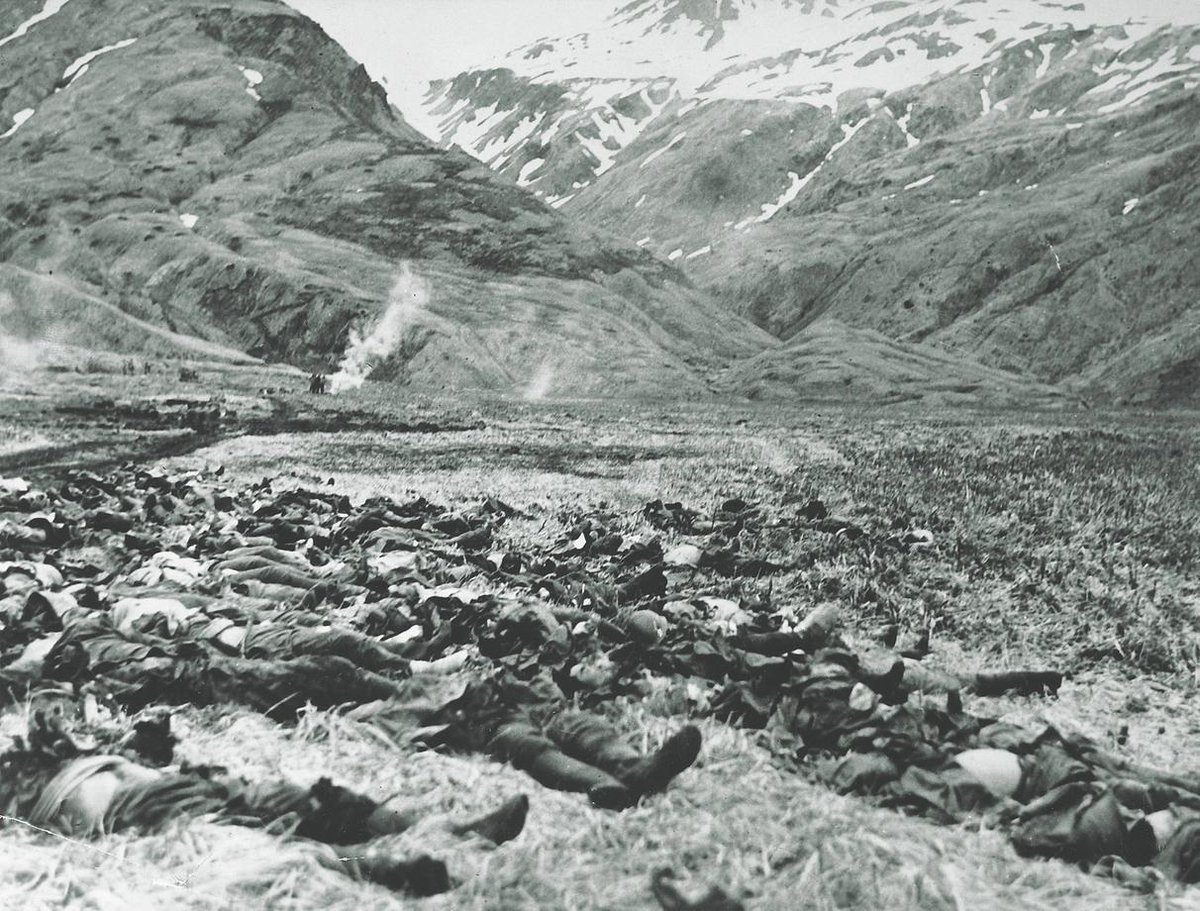
When the sun came up, the snow on the slope was carpeted with bodies.
The Americans counted 500 dead Japanese on the ground in front of them. Then they began finding the rest. Almost all of the remaining defenders had killed themselves with grenades held against their chests. American soldiers walking the field afterward described finding small groups of three or four men curled in a circle, their bodies folded around the same grenade.
Out of a Japanese garrison of nearly 2,900, the Americans took 28 prisoners.
It was the second highest American casualty rate of any battle in the Pacific war, after Iwo Jima.
Almost no one in the United States has heard of it.
My husband and I both work full-time, but somehow after we got married, all the house chores quietly became my responsibility.
Even when he helped, it felt like he was “assisting” me instead of us both taking care of our home.
One week, his mom came to visit. I was cleaning, cooking, doing laundry, basically running around the house while my husband sat on the couch watching football. I asked him if he could help vacuum and he casually said, “Later,” without even looking up.
His mother looked at both of us and said “Did you both not come back from work yesterday at the same time?”
I laughed and said, “We did.”
Then she asked my husband, very calmly, “So why is she the only one working today too?”
Silence.
That woman got up, took the remote from his hand, switched off the TV, and handed him the vacuum cleaner.
Then she said, “Marriage is not a system where one person rests while the other manages everything. If both of you are contributing financially, then both of you contribute at home too.”
She then looked at me and said “I didn’t raise my son to think his wife is his personal maid, Don’t let exhaustion become your personality because you’re trying to prove you’re a good wife.”
I swear that sentence changed something in me.
Now we split things properly . If I cook, he cleans up. If one of us is overwhelmed, the other steps in. The entitlement disappeared completely.
She still calls sometimes just to ask him, “Hope you’re not stressing my daughter?” 😭
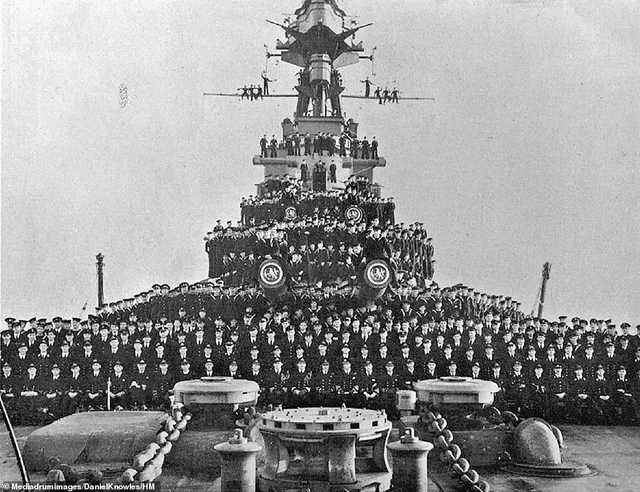
HMS Hood’s crew photographed in March 1941. In just two months most of the men pictured will perish with the ship.
RIP to the 1,415 brave men lost at sea. Lest we forget 🇬🇧
On Memorial Day, we pay tribute to the brave men and women in uniform who gave their lives for this country that we love. It is a debt we can never fully repay, but we must never stop trying. I’ll always be grateful to our fallen heroes and their families, whose sacrifice reminds us of what it means to live for something greater than ourselves.
In late 1967, a US Army supply convoy drove straight into a Viet Cong kill zone. In ten minutes, 30 trucks were burning, seven drivers dead and 17 wounded. The VC had mapped every route the convoys used and knew how to turn supply columns into a turkey shoot.
Without any armor or firepower worth mentioning, the drivers were practically sitting ducks every time they left the gate.
Something had to change. But official Army channels could take months, and the men in those convoys didn't have that kind of time. So they simply built their own gun trucks in the motor pool. At first, they bolted sandbags and wooden planks onto the back of 2.5-ton trucks. They soaked up monsoon rain, snapped axles, and turned the trucks into overloaded coffins.
On paper, the only weapon allowed was the M60 machine gun. The guys driving through the kill zones had a different opinion. They strolled over to the Air Force, talked them out of .50 cals, and yanked miniguns off Hueys. One crew mounted their minigun without its electric motor and hand-cranked it through firefights like a Civil War Gatling gun.
They proved themselves a few months later at Ambush Alley. Charging straight into the kill zone, the gun trucks lit up the treeline. The Americans lost four gun trucks and six cargo trucks, but the VC got smoked, left 41 dead and pulled back.
From then on, convoys ran one gun truck per ten cargo trucks.