Ladies and gentlemen... @California_HCD has finally dropped it's yearslong investigation into San Francisco's bullshit and convoluted housing approvals process:
https://t.co/ICegD9nrQ6
I'll be eagerly reading this all evening inbetween my other committments...🙃🙃🙃
Everyone knows real estate comes with huge tax advantages.
But the tax edge goes far beyond bonus depreciation and tax losses. A lot of startups can generate losses quickly too!
So what does make real estate unique from a tax perspective? 👇
7 of the biggest real estate specific nods in the tax code - things you can’t get with other startup investments:
1) 1031 like-kind exchanges
2) Qualified non-recourse debt
3) Real estate professional status
4) Unrecaptured gain preferred rate
5) 163j RPTOB election
6) OZ inclusion
7) §1061 carried interest exclusion
A closer look at each one - vintage thread style 🧵
🧵This @SFNext podcast w/ SF supervisor Hillary Ronen is revelatory.
Through emotion, examples & a theory of change, she conveys how SF-style progressivism has utterly failed as a mode of city governance. (And also--I think--why it's failed.)
1/
https://t.co/NtWdX8jsnT
Stop drug tourism in San Francisco
End the open air drug markets
Audit the nonprofits and end the housing first grift
Build shelters and fund recovery and treatment and sober housing
Vote out Preston Peskin Walton Chan Ronen Melgar and all their cronies and sycophants
Despite what most people would like you to believe, evaluating a property is actually incredibly easy
Here’s how you evaluate the financials of a building in the most simple way possible:
(Hint: You shouldn’t even be thinking about IRR in the beginning)
The @SFDemocrats just granted our charter!
Thank you to all the members for their support, and everyone who has supported us over the past few weeks.
We're excited to get to work with the party to improve SF & fight for a more just, equitable country 💪
The holy grail of real estate tax edge is the negative capital account. It’s peak use of leverage to reduce your current taxable income.
But to unlock this, there is a labyrinth of tax code to wade through.
And the biggest guiding principle? Partners capital accounts ≠ partners basis.
Personally guaranteeing debt, while increasing basis, doesn’t mean you get a bigger share of the losses (pause for effect).
Loss allocation is driven by the Operating Agreement (OA) language.
Let’s take a deep dive into how debt and tax losses work together.
🚨WARNING: full tax nerd vibes below; complete with a decision tree🚨
———
To start, a capital account is cash contributed, less distributions, +/- tax income / loss. There’s more but that’s the ELI5 version.
Partners basis is the capital account + debt allocated to the partner. Again, ELI5.
The kicker is that it’s the capital account that normally drives income / loss allocation - not basis.
Enough background. How do you pull this off legally? Again, it starts with the OA.
The majority of OAs don’t include deficit restoration obligations (DROs). That’s because attorneys write OAs and they’re (rightly) concerned with not getting sued.
(If you recall, a DRO is a promise to fund the partnership upon liquidation to the extent one’s capital account is negative.)
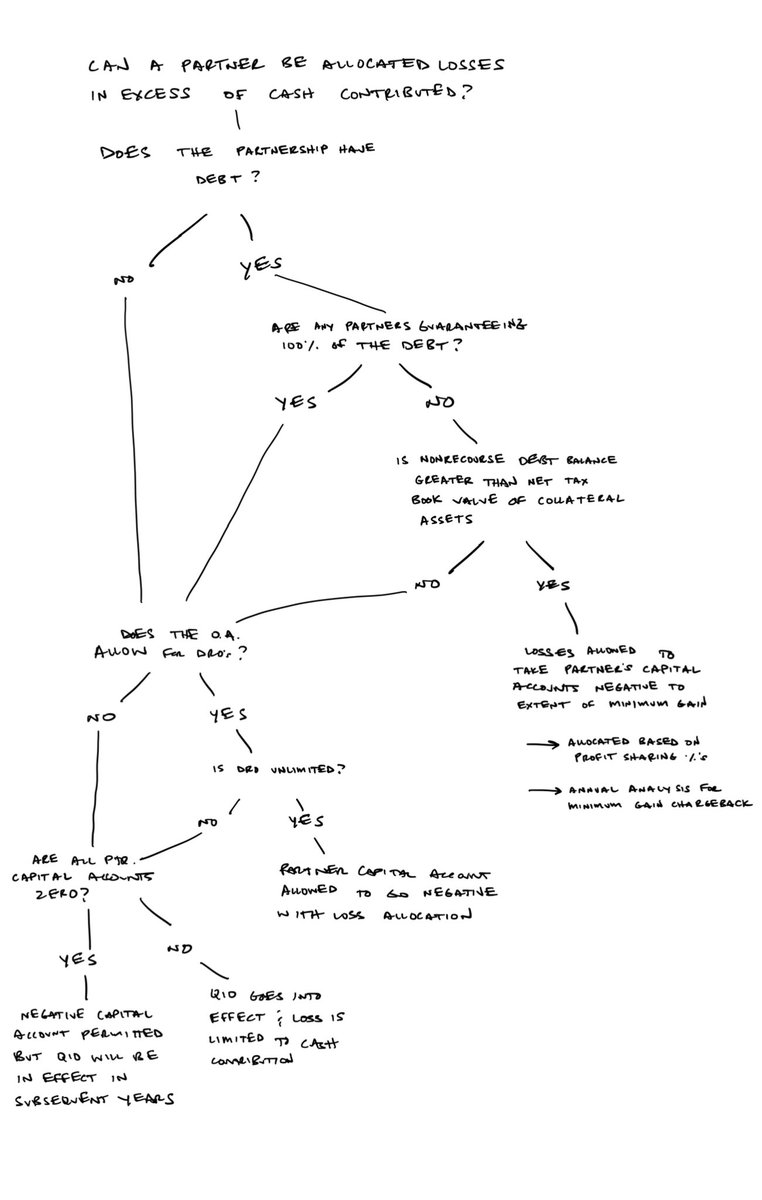
But DROs are the primary way that partners can get allocated debt-financed losses and go negative in their capital account.
Without a DRO, a partner (even a guarantor partner) can only take losses to the extent of their cash contribution - EXCEPT for when there is minimum gain.
Stay with me - minimum gain is when the nonrecourse debt of the partnership that is collateralized by real property is greater than the net tax book value of that property (basis less depreciation).
To the extent that the partnerships real property net tax basis is less than the associated non-guaranteed debt, partners are allowed to go negative in their capital account (ie - get allocated loss financed by debt).
But when the debt is recourse, you lose minimum gain treatment and are right back to the DRO being the gatekeeper of losses.
If for some reason you’ve suffered through my other threads, you’d also know the alternative to DRO language is a QIO - qualified income offset.
When a QIO is in effect, if some partners have positive capital and some don’t, there is a phantom income shift between partners to keep partners from going negative while others have positive capital.
In this case, even though a partner may be guaranteeing debt - other partners may be getting losses.
In summary, the ideal scenario to go negative in a capital account without a DRO is max nonrecourse debt. There are still phantom income issues with that but that’s another thread for another time.
———
This stuff is not easy - but in case you’ve made it this far, here’s a hand-drawn decision tree I’ve put together to analyze when a partner can get allocated loss that takes him negative in his capital account.
Enjoy!
People left San Francisco but the existing population wanted the few homes that finally became available.
Household formation paper by @ModeledBehavior
In retrospect, so obvious. https://t.co/Oy1ct8Ddb7
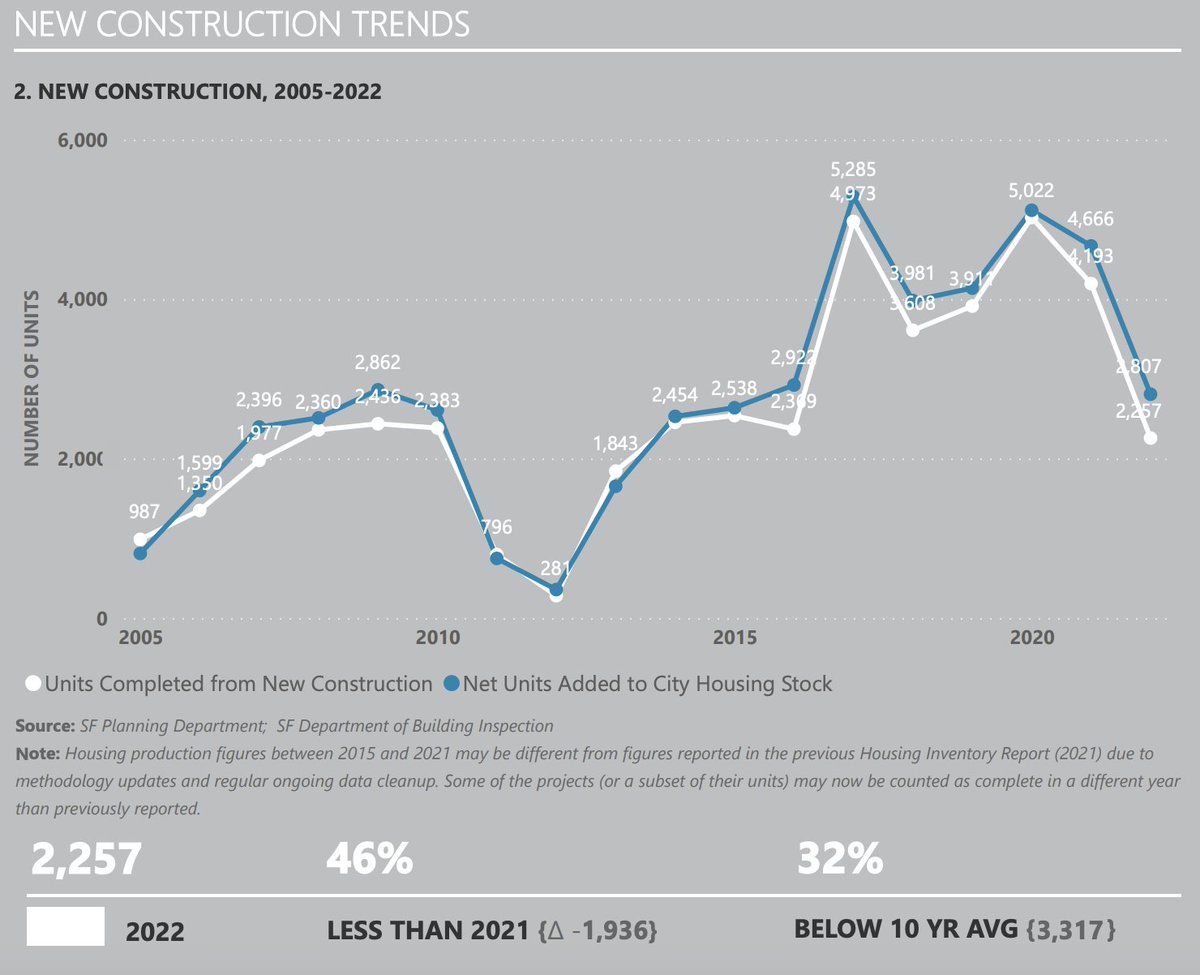
Lots of data to dig into here! Unfortunately, not a lot of housing (again). Remember, we need to be building 10,000 a year to hit our housing goals from the state! We can but only if we make changes now to how we build homes. That's what we said we'd do in our housing element
We toured an interesting building today, developed by "Housing Diversity"/Brad Padden.
$6/sq ft rents, no parking
Average unit size: approximately 361 sq ft
Rents in the $2,000-$2,500 range
Address: 6762 Hawthorne Ave, Hollywood CA
41,489 sq ft (gross)
360 sq ft retail
7,437 sq ft lot
8 stories
69-unit all-studio housing development (61 market-rate attainable, 8 designated for Extremely Low Income)
Neighborhood: Hollywood, Los Angeles
Close to Hollywood/Highland Metro Station
Qualified Opportunity Fund project
This type of product is feasible BECAUSE it has no parking.
We will see more of these projects in LA and across the state now that parking minimums are gone.
This was an impressive project on a TINY lot.
If anyone knows Brad, please connect us.
1960, Orson Welles explained how he wrangled complete creative control for his first film, Citizen Kane, as well as the value of “ignorance” to break through old ideas.
after living in sf for the past 8 months I've compiled a list of some of my favourite day plans
📍Inner sunset: start off the day with breakfast at devil’s teeth baking company, explore ocean beach, inner sunset’s farmer’s market, and climb the 16th tiled stairs for sunset
“This is a recourse type of deal”
We all love non-recourse debt.
But there are certain loan types and properties that have profiles that make it more likely to have recourse (personal guarantees).
A few types: