A large fraction of valuable business work is repeatable and decomposable into steps that don't each require frontier intelligence, and the act of decomposing it is where the durable value concentrates.
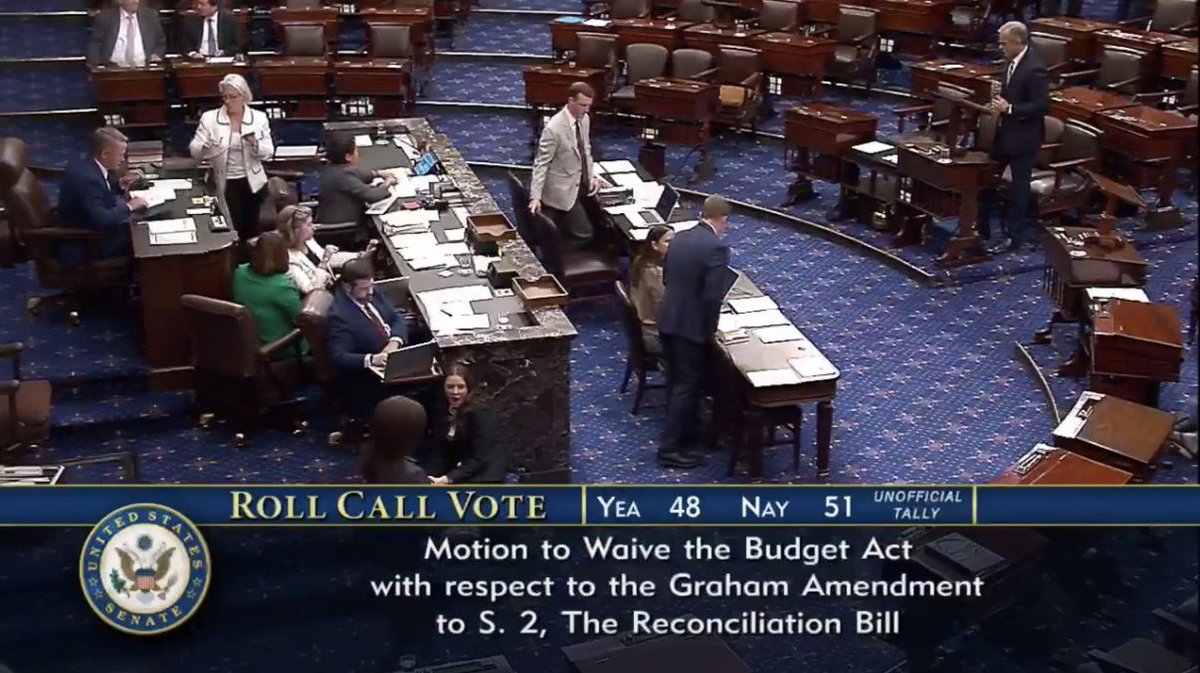
The U.S. Senate has just rejected a motion to add the SAVE America Act as part of budget reconciliation on a 48-50 vote.
Republicans who voted against it:
-Thom Tillis
-Lisa Murkowski
-Mitch McConnell
-Susan Collins
@MarioNawfal Voter ID and proof of citizenship are not radical positions. They are basic legitimacy checks.
When 80% of the country supports something this obvious and Washington still kills it, people are not being paranoid when they say the system is protecting itself.
🚀 Gemma 4 12B is here!
We partnered with @GoogleDeepMind to bring and optimize their new dense and unifed multimodal model for Apple Silicon.
◈ 12B dense · 256K context
◈ Thinking mode (built-in reasoning)
◈ Vision: dynamic res, OCR, UI + charts
◈ Native audio: ASR + speech translation
◈ Function calling for agents
◈ Text + image + audio, interleaved
Runs local. Get started now ⚡
> uv pip install -U mlx-vlm
https://t.co/7BvnEuzKvj
When you run a fleet of agents, system throughput is gated by the human: initiating, reviewing, confirming, and correcting.
The bottleneck shows up to be you.
@DavidSacks What is the single biggest threat to Anthropic or any of the frontier proprietary labs?
Open source LLMs.
Open source LLMs run on local hardware or even on local to the company data centers.
The biggest threat is akin to the PC revolution, where things move from mainframes to personal computers, because at that point, the cost per token, (which is the business model of these proprietary labs) goes to the cost of electricity, and disrupts the business model of selling tokens.
And IF models are converging in capacity or staying within a few points of each other, then that signals commoditization and these labs DO NOT want that.
(Note how the LLMs are increasingly training for in harness interactions, so that if you don't use their harness, the output is "off distribution")
No wonder then, that, Anthropic would suggest that AI is dangerous and must be regulated and guardrails must be implemented, and therefore, what's the conclusion?
Kill distributed open source LLMs so that their existential risk (price per token going to zero) is fully nullified.
Blue Origin just vaporized a rocket, a launch pad, and Amazon's entire satellite deployment timeline in nine seconds.
NG-4 was supposed to fly June 4 carrying 48 Amazon Leo satellites. That mission was the first of 24 contracted Blue Origin launches Amazon needs to build its Starlink competitor. Amazon has roughly 240 satellites in orbit against an FCC requirement of 1,618 by July 2026. They already filed for a two-year extension because they were falling short. Losing your primary heavy-lift rocket on the pad doesn't help that math.
The pad damage is the part people aren't thinking about. New Glenn carries roughly 2.4 million pounds of propellant. The explosion toppled one of LC-36's lightning protection towers. That launch complex took years to build and billions to outfit. You can manufacture a new rocket in months. You cannot rebuild a launch pad in months.
The cascade gets worse. Blue Origin's Blue Moon MK1 lunar lander is supposed to launch on New Glenn this fall for NASA's CLPS program. That mission is the pathfinder for Artemis III, which needs Blue Moon MK2 to fly on New Glenn in mid-2027 to land astronauts at the lunar south pole. Every month LC-36 sits damaged pushes Artemis further into the late 2020s.
Jeff Bezos has two companies betting on the same rocket. Amazon Leo needs 24 New Glenn launches to close the gap with Starlink. NASA needs New Glenn for Artemis. Both timelines just broke simultaneously, and LC-36 is on fire.
SpaceX has almost finished writing V1.0 of an in-house AI training stack in C that exact-maps to 220k GB300s with 800G NICs, making heavy use of pipeline parallelism and getting as close to bare metal as possible.
The potential speed improvement vs JAX for large training runs is over an order of magnitude.
I found an interesting thing: Due to a bug in my cog system, before I submit a PR I subject the PR locally to a context free review (meaning the coding agent doesn’t know about any of the main context used to author the PR) locally with the same model that built it (Opus 4.7) and it does this 3 times before creating the PR and paying for Copilot to do a review.
Results: I almost never get a comment by Copilot, and in the past I’ve really depended on Copilot to catch things Claude Code or Codex missed.
Just goes to show that you can increase code quality if you throw tokens at the problem.
AI can really help with self-coordination.
Your past self had context.
What you were thinking, what you'd just read, who you'd just spoken to, what mood you were in, what the project felt like in that moment. Your future self will have access to almost none of that. The two of you are nominally the same person but operationally are not: you don't share working memory, you don't share affect, you don't share the salience-weights that made certain things foregrounded at the time. The work of writing things down, keeping notes, building templates, maintaining a journal, codifying a routine, that's the medium through which one temporal slice of you communicates with another.
Not for replication into a workforce.
Just so the version of you who shows up Tuesday morning doesn't have to re-derive what Friday-you already knew, or stumble back into the same decision Friday-you already worked through.
This is why the so called "second brain" efforts with AI matter. It's for a gap humans experience everyday.
@lennysan@danshipper It's the difference between autonomy and agency. AI agents execute goals but they don't decide where to go, that's agency. It's like self driving cars, they can drive to a destination with autonomy, but the human sets the destination.
The agentic-coding pitch assumes hands-on-keys is toil to eliminate (describe intent, let the agent draft, review the diff)
But a real slice of developers are craft/identity-bound and like being in the code: the syntax-level taste, the debugger, the feel of a function coming together.
The "drowning in tickets" cohort wants the agent to take the wheel sure
BUT "stay out of the implementation as much as possible" is being asserted as the universal endpoint, and that's where a lot of the current angst is coming from.
The pitch isn't landing as "we freed you from the bad parts," it's landing as "we decided the part you love was the bad part."
I just got back from SF and I FEEL INSPIRED.
I spent 5 days with frontier AI model teams, AI startup founders, and 3 billionaires.
My takeaways:
1. I had lunch with 3 billionaires. All of them are buying SaaS companies and rebuilding them agent-first. They were deeply inspired by Bending Spoons and Ryan Cohen's eBay deal. Buy the company, cut the headcount, rebuild the tech, add agents, add features, make more valuable experience, raise prices.
2. The frontier model companies are hungry for usage data from the field. They can see API calls and token counts. They can't see the actual workflows. If you're deep in a niche using these models in ways the model companies haven't seen, that understanding is incredibly valuable. Usage intelligence is the new alpha.
3. Consumer AI is massively underbuilt. Every billboard in SF is either B2B inference infrastructure or vertical agent companies. The entire city is optimized for enterprise. Meanwhile you have companies like Cal AI doing $50M ARR in 18 months as a consumer app. I met with a cool few teams doing consumer AI (@paulscherer / @ekuyda)
4. MCP came up in literally every conversation. The companies exposing their product as MCP endpoints are getting pulled into deals they never pitched for. The ones that aren't are becoming invisible to agents. This is the new SEO. If agents can't find you, you don't exist. Building products for agents is the new zeitgeist in general.
5. Not uncommon for hot seed rounds to be $25-50 million valuations. I saw a Series A at $450 million
6. If I had a dollar every time someone mentioned "forward-deployed engineer" this trip I could have funded a seed round. It's the hottest role in SF right now. The person who sits between the agent and the customer, making sure everything actually works.
7. The mood around open source shifted. A year ago it felt like open source was chasing the frontier models. Now founders are telling me Gemma and DeepSeek are good enough for 80% of what they need at a fraction of the cost. The "which model do you use" conversation is being replaced by "which model for which task." Model loyalty kinda feels dead.
8. Voice agents came up more than I expected. Multiple founders told me voice is the interface for the next billion users. The billion people who will never type a prompt will absolutely talk to one.
9. The Obsidian community in SF is weirdly intense. Multiple founders showed me their vaults unprompted. Like showing someone your home gym. It's a flex now. The quality of your knowledge base (second brain?) is becoming a status symbol among builders.
10. Maybe it was just the people I met but the age of the founders is shifting. I met more founders over 40 this trip than any trip before and more founders under age 21 than ever before. Founders getting older and younger at the same time.
11. I spoke to a lot of fast-growing startups, VCs and frontier models who are hiring content creators right now.
12. The restaurant scene in SF is actually better than it's been in years. Founders are going out more. Alcohol is out, not surprisingly.
13. SF doesn't feel like the only place anymore. We all have access to the same frontier models. We all read the same X feed. A founder in NYC or Lagos is calling the same APIs as a founder in SoMa. So in the past it felt like SF was always lightyears ahead, doesn't feel that way anymore. It's okay not to live in SF and have BIG DREAMS.
14. The coworking spaces in SF are half empty but the coffee shops are packed. People want to be around people. I had a few startup ideas here....
15. Walking around the Mission I noticed something: the street-level businesses, the taquerias, the barbershops, the laundromats, none of them use any AI at all.
16. I heard the phrase "agent debt" for the first time. Like technical debt but for agents. When you hack together an agent workflow fast and never clean it up, the system prompts conflict, the memory gets polluted, the tools overlap. 6 months later the agent is doing weird things and nobody knows why lol.
17. Met a few people who carry two phones now. One for personal. One that's basically an agent terminal running Telegram or iMessage connections to their agent fleet.
It's always amazing to get that dose of inspiration in SF. I FEEL INSPIRED.
But I'm so happy to be back home, locked in and building.
We're 12-18 months into a shift that will take 15 years to play out. The urgency in every conversation was real.
What an incredible time to be building.
Grok Build is now available in Beta for all SuperGrok and X Premium+ users.
Use Plan Mode, create images and videos with Imagine, and build automations or orchestrators with the CLI.
Visit https://t.co/bpTHpjivWD to get started.