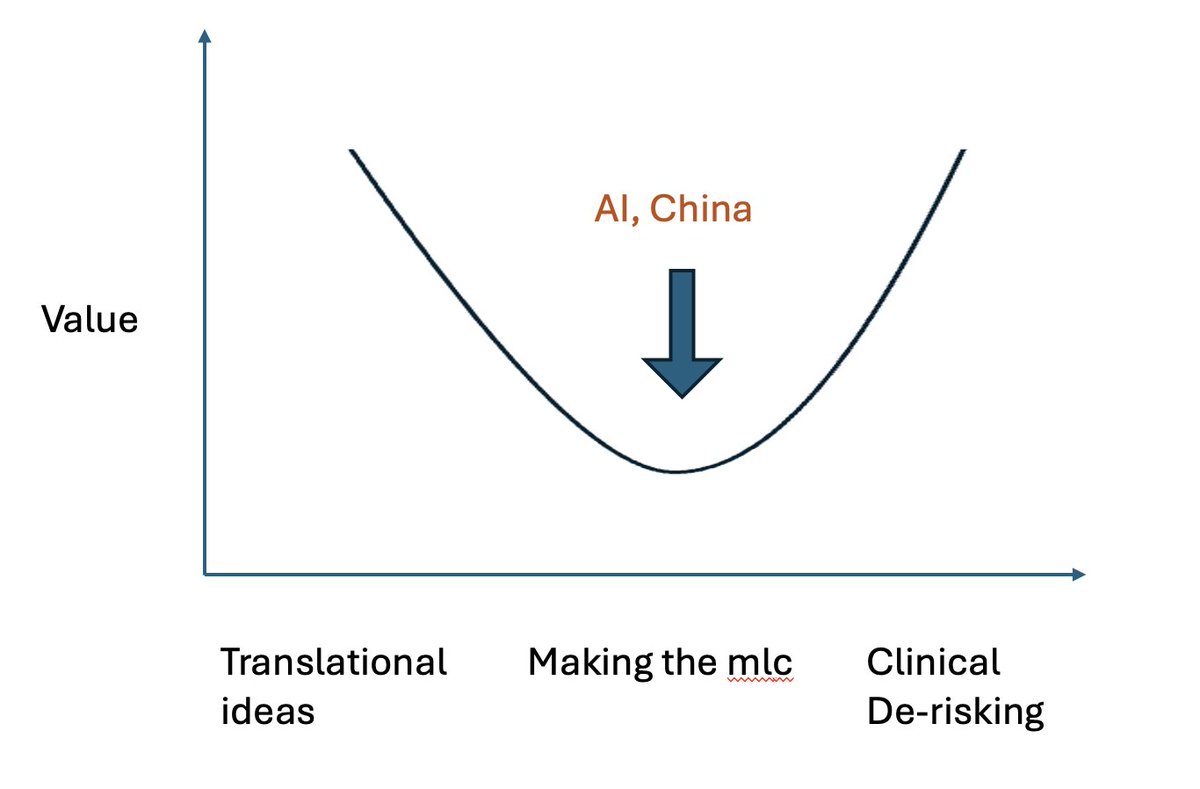
Recent advancements in one-shot AI protein / antibody development by Chai, Nabla, AI Proteins, Generate, and a few others are accelerating the *main* theme in biotech:
Value of building the molecule is going down. The value of novel targets, novel translational ideas, AND also the value of clinical execution is going UP
Here's where the value graph is moving towards:
The twin forces of AI and China are quickly driving down price of mlc dev across many modalities:
For AI - mainly Ab right now, emerging for genetic medicines, small mlc, ADCs, cell therapy;
For China - Abs, cell and gene therapy, small mlc, and soon genetic medicines
Having a "best in class" mlc is no longer enough - many tech platforms will soon offer you a mlc priced on metered compute (getting cheaper) and China CROs / biotechs will continue to eat the world with (over)capacity (continued involution).
To make a valuable drug, you must differentiate on either:
a) Novel translational ideas.
Novel targets, novel mechanisms, but not just that - connecting targets with diseases; novel application of certain targets in new disease settings, new intuition on which patient pops have widest therapeutic index for a drug, etc
OR
b) Clinical execution.
Determining the appropriate endpoints in a trial. Recruiting the right patients. Appropriate relationships with the right PIs / clinical sites. Ability to finance registrational studies in US markets ($10s to 100s of Ms)
Either be a translational target discovery engine / tech platform that unlocks new modalities (which unlocks new translational hypotheses) OR get a team of grizzled clin dev / CMO vets and go raise $X00M+ to validate a clinical hypothesis
Living in the middle (ie being "full stack") is dangerous work (at least for a startup)
**A grand unified theory on what will happen in biotech in the next 10-20 years**
the two major forces reshaping industrial biotech in the next decade are:
1. China
2. AI
- and they're critically linked
how?
China's low R&D cost basis democratizes execution by providing infrastructure to more drug developers (similar to how AWS helped cloud apps explode in 2010s)
AI makes scientific information much more freely available; agents & lab automation increase R&D productivity as well as throughput, further deflating development costs
What happens when many more translational ideas can be tried much more cheaply?
Value starts accruing in the best ideas to try ie the value shifts earlier in the value chain
if the cost of everything from preclinical R&D to clinical trials are dropping significantly due to combo of AI and China, the disparity between clinical stage vs early pipeline assets shrinks dramatically from the current order of magnitude difference
The premium on true creativity, novel scientific insight, fundamentally new biology will 100x
In a few years the top-of-industry drug hunters / translational biologists will command a hefty premium (maybe not $100m a year like current top AI scientists but ... maybe??)
Even more provocatively, foundational models in translational biology that surface / accelerate novel biological hypotheses will suddenly capture outsized value
When will a translational foundational model be worth more than a top 10 pharma co?
sounds crazy... but like everything else --> slowly, then all at once
Would be interesting to apply the new b-school grad search fund model to newly minted MD/PhDs starting AI-native biotechs.
One of the hottest career paths right now for @HarvardHBS & @StanfordGSB students is to look for small businesses to buy and run on their own.
After college, they get some small amount of funding to cover their living expenses that then expands once they find a business to buy (HVAC, niche service provider, etc.) so they can actually buy it.
This wasn't really possible in biotech until this year. The act of finding assets, running trials, running a regulatory function has collapsed.
Could go something like ~$500k-$1M until you get an asset and then ~$10M to scale up, ~$5M for the asset & ~$5M to push it forward like next step of a trial (likely abroad), token costs. Ofc needs to fit a specific profile like rare diseases.
Have also talked to former hired biotech CEOs who are excited to be founders with more ownership and eager to re-invent the pharma model, have insight into how'd they capitalize on pharma relationships but acquire/advance assets much differently than they've done in the past.
@Curie_Bio, @FlagshipPioneer & others do some flavor of this. But haven't seen anyone target the biotech-equivalent recent b-school grad founder persona that matched PhD & MDs.
h/t to @davidycli for insights & ideas on this
@abigaillafrica@RuxandraTeslo@kroetscha Great illustration
In my experience, the us timeline can be even longer, esp on site startup and contract negotiations
And the aus timeline can be even faster
@varma_ashwin97@masterlongevity@AlecStapp Soc in many indications are now near or on par
Underrated driver is the high speed rail system
Allows 90% of patients who want to be in a trial to be able to reach a top tier research center where trials are conducted in 2 hrs or less
Faster, more numerous, and more efficient phase 1 trials directly solve both of your purported fundamental issues
1. We will understand human biology better if we have tested more molecules in humans
2. More efficient and greater number of phase 1 trials enable better focusing of phase 2 trials, improving ROI of drug dev - which will enable drug prices to come down
Currently return on capital is net negative for the drug development industry
Without positive economics for developing drugs, we will have no new innovative drugs
for the next 18-24 mo., the biggest bottleneck in AI drug discovery is experimental validation and verification
however it is increasingly clear that in 36 mo., the biggest bottleneck in AI drug discovery will be clinical trial scarcity
the challenge with US clinical trial infrastructure goes far beyond simply regulatory reform
in fact, outside of Australia, US FDA is the fastest in the world in getting INDs reviewed (30 day response time vs 60 in UK and Western Europe, and 60 working days in China)
Yet, median time to site activation after trial regulatory approval for oncology trials is:
US (academic oncology site) - 171 days (~6 mo)
Australia Phase 1 - 63 days (~1.5 mo)
China - as quick as 4 weeks
It gets worse. Based on July 2026 analysis, US sites not only take median 124 days to get sites activated, it takes *another* 93 days to get FPI (first patient in).
Australia sites can usually get from site activation to FPI in 2 weeks.
To top it off, it takes *309 days* on average for US trials to get 75% of sites in a trial activated
what's going on?
the challenge is multifactorial - in the US, drawn out budget negotiations at every clinical site, significant overlapping local ethics and protocol reviews (esp at high profile academic research centers), and extensive site contract negotiations lead to months / quarters / years of delays.
There is no magic bullet solution - no fell swoop of regulatory or policy change will address this - wholesale revamp is needed.
simultaneously, US and western biotechs (and frontier labs) can't just wait around for systemic change to unfold. They need to play the game on the ground in order to establish a human data edge
a new clinical execution paradigm + AI-native translational layer is sorely needed
@DrSynbio@MartinBJensen sure just saying IND prep / IND filing are not the only problem for FIH trials. the after approval problems are arguably even more impactful to viability of increasing biotech trial scale in US - if cannot get sites started for quarters / years, no point running the trial
true but the difference is often only a quarter or two without (dramatically) different cost
post approval delays on trial startup and execution range up to years - making FIH studies in US completely untenable option for biotechs
many such conversations with US biotech CEOs and CMOs