Every household in Britain should be forced to take in a refugee. We are a tolerant and welcoming nation. It's only fair that we open our doors and let them live with us 🌍
La situation est simple :
La France ne produit plus assez de commun, de richesses et d'enfants depuis des décennies.
Elle a compensé avec de la dette et en bradant les bijoux de famille.
Donc en sacrifiant le passé et le futur.
Maintenant le système est à bout de souffle, il n'y a plus beaucoup de choses à brader, et plus beaucoup de gens prêts à prêter : la crise est inévitable.
Toute l'élite actuelle sera balayée. (Qui se souvient de Félix Gaillard et Pierre Pflimlin ?)
Un très grand nombre de tabous tomberont.
La crise dégradera profondément la situation déjà très grave de la France (imaginons simplement ce que l'Allemagne obtiendra de la France en échange de l'aide de la BCE sur sa dette).
Mais cela en réalité n'est pas la fin du jeu. Ce n'est que le début, la donnée de base.
La seule question qui vaille est désormais de savoir ce qui succédera à la crise.
Nous avons ce fantasme, à cause de notre Histoire, qu'à la crise succédera nécessairement le redressement. Il s'agit là plus de l'exception que de la règle.
Il y a plus souvent un Pétain qui succède à Reynaud qu'un De Gaulle qui succède aux collabos.
On ne sort des crises par le haut que si deux conditions sont remplies.
1. Que le diagnostic et ses solutions concrètes soient déjà établis avant que la grande purge n'ait lieu. (Les idées du plan Rueff sont mûres bien avant que De Gaulle revienne au pouvoir.)
2. Qu'une contre-élite, déjà proche des cercles du pouvoir mais à l'esprit neuf, capable de comprendre les enjeux spécifiques du temps, soit déjà structurée, se connaisse et soit prête à agir.
Ce sont les deux seules tâches qui incombent immédiatement à notre génération.
Tout le reste n'est qu'écran de fumée.
Emmanuel Macron, who is preparing to sign a text with Merz to ask the Commission to design a tool to block trade with China (a EU-stylenSection 301), tries to justify the protectionist measures with one sentence :
"China subsidizes some of its industries to about 8 times the average in OECD countries, and that is not acceptable".
I have already explained here how France and Germany are massively subsidizing TSMC and ProLogium (respectively 50% and 30% of the total amount of the project), two Taiwanese companies, to set up factories on their territory.
But these are far from being recent exceptions to the dogma of free trade.
For decades, the EU used special legal exceptions to funnel billions into strategic sectors.
Instead of backing foreign firms, previous massive state aid packages primarily funded domestic tech giants, automotive suppliers, and aerospace consortiums through structural frameworks like the Important Projects of Common European Interest (IPCEI), launched in 2018 (and expanded in 2023) to distribute over €10 billion in public funding to domestic chipmakers.
- STMicroelectronics (France/Italy) was heavily subsidized by the French and Italian governments, and also secured billions in joint state aid for a major manufacturing plant in Crolles, France.
- Infineon (Germany) received hundreds of millions in state backing for its €5 billion power electronics factory in Dresden, which broke ground before the European Chips Act was fully formalized.
- Bosch (Germany) was subsidized heavily under European microelectronics frameworks to build and scale its advanced wafer fab in Dresden.
- Soitec (France) received substantial state funding to scale its silicon-on-insulator (SOI) technologies used globally in smartphones and automotive chips.
Before ProLogium’s Dunkirk gigafactory project, the EU authorized two multi-billion-euro Battery IPCEIs to establish a domestic supply chain and counter China dominance:
- Automotive Cells Company / ACC (France/Germany/Italy): A joint venture between Stellantis, TotalEnergies (Saft), and later Mercedes-Benz. ACC received over €1.3 billion in public subsidies to build gigafactories in France and Germany.
- Northvolt (Sweden/Germany) secured a €902 million German state-aid package approved under temporary crisis frameworks to build its Heide gigafactory, explicitly preventing the company from moving that project to the United States. The company went bankrupt shortly after.
The ultimate precedent for European strategic subsidization is Airbus.
For decades, the governments of France, Germany, Spain, and the UK provided what they called "launch aid" (low-interest, repayable loans) covering up to 33% of development costs for new aircraft like the A380 and A350. This triggered a 17-year dispute with the U.S. at the WTO, functioning effectively as the blueprint for how Europe defends an industry it deems vital to its survival.
If we look now at the automotive industries of France, Germany, and Italy, Macron's double-standard when dealing with China becomes more obvious.
This industry has been deeply intertwined with state funding, nationalization, and heavy subsidies since the 1950s. For decades, these nations viewed their car industries not just as private businesses, but as national icons and vital employment engines.
France historically practiced dirigisme (state-directed capitalism) where the government directly owned and financed its carmakers:
In 1945, the French state seized Renault and turned it into a state-owned entity called the Régie Nationale. For decades (including the 1950s–1980s), its expansion, factories, and deficits were heavily subsidized or backed by the French taxpayer until it was privatized in the 1990s. France still maintains a significant shareholding in Renault today.
In 2014, when Peugeot faced bankruptcy, the French government stepped in with a €800 million capital injection to buy a 14% stake, matching Chinese firm Dongfeng to keep the company afloat.
In Germany, the "Volkswagen Law" (VW-Gesetz) was enacted in 1960 when Volkswagen was privatized, this law gave the German state of Lower Saxony a 20% voting share and a legal veto over any hostile foreign takeovers. This acted as a structural, permanent state shield for VW.
During economic downturns, Germany deployed multi-billion-euro consumer cash injections. In 2009, it introduced a €5 billion "cash-for-clunkers" scheme (Abwrackprämie) to artificially boost demand for German automakers during the global financial crisis.
It is important to keep in mind the history of European industrial juggernauts since the 1950s to realize how they would not be where they are today without state support.
Blaming China for merely borrowing a page from our book is eminently dishonest.
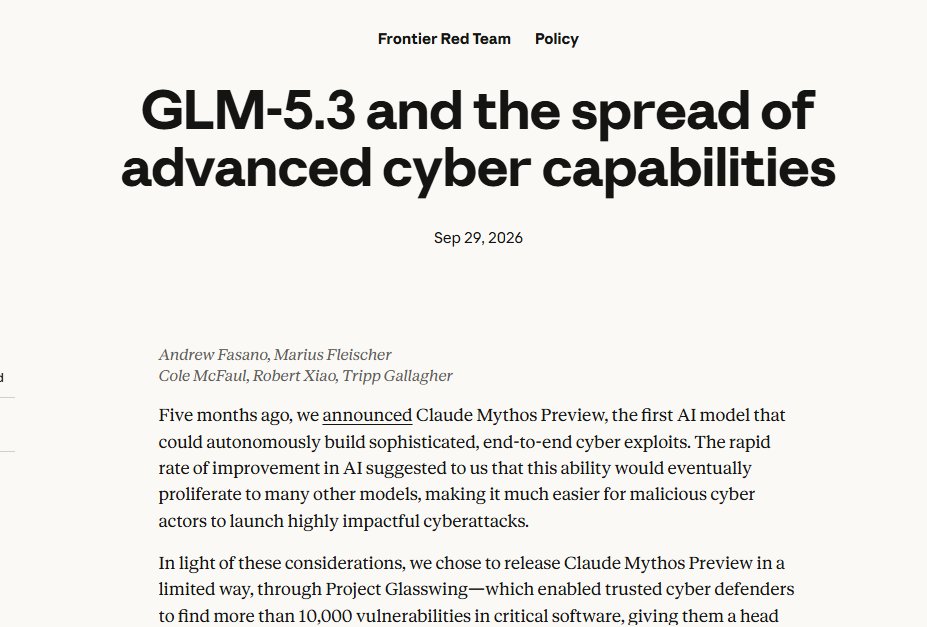
Wait, I can't believe Anthropic posted this.
Their new research post is a full red team report on someone else's model, GLM-5.3 from Zhipu.
The finding is that it builds working exploits almost as well as Claude Mythos Preview. You know, the model Anthropic kept locked away for safety.
Except this one you can just download.
Europe’s current condition is a function of WWII, the Marshall Plan, the Cold War and the fall of the Soviet Union. Europe, not just Germany, lost the war. The US - a maritime power - “won.” But so formidable were its maritime capabilities and control over global trade through the reserve currency post Suez crisis, that it could harbor serious transatlantic continental power aspirations. The intention was to keep Russia, a continental power, in check, by controlling Europe’s destiny.
Generations of politicians and the think tanks they aligned with were tacitly backed by the US. Meanwhile, as Russian influence waned post communism, the contours of US influence pushed further east. EU membership amongst eastern states mattered little unless attached to NATO membership. Ukraine would have been the last to fall, expanding the periphery deep into what Moscow sees as its back yard.
American influence in European politics kept the continent pliant and ever ready to sacrifice its economic, energy and security interests for Washington’s, when needed. The bureaucratic and political classes were tuned to hollow out the economy with overregulation, self-sabotaging green energy policies, overdependence on the US security umbrella and politically convenient uncontrolled immigration. Neoliberalism was foisted upon Europe, and was eventually readily accepted by a public mentally conditioned by American metaculture. It could have worked had the Euro become competitor to the Dollar, but that of course, was never allowed to happen. So Europe copied the most suboptimal policies of the US, including over-reliance on Chinese imports. Seeking short term profits, industries offshored manufacturing until those companies were rendered uncompetitive in the front of Chinese state-subsidized firms. But innate socialist impulses prevented any meaningful economic reform to pivot away from this model, which a capitalist US could afford when push came to shove.
A strong, cohesive and strategically autonomous Europe never suited US. The region is short of natural resources, and dependence on cheap Russian gas was the key to building a competitive industrial base. That was vetoed by Washington. The ability to print money at will was also limited. The US vetoed the use of a petroeuro over a decade ago, a move which would have supported a parallel reserve currency to the dollar. The strength of a reserve currency is that it can be printed at will. It allows markets allocate abundant capital to sunrise sectors and for an economic bloc to develop a technological edge.
Successive policy failures in Europe compounded, leading to economic stagnation, societal fissures and therefore, constrained strategic maneuverability. As a new great power contest emerged between the US and China/Russia, Europe has turned into one of the many proxy fronts of the US, much like the Gulf states.
When cheques of the Marshall Plan are called in decades later, Europe can pay back only by capitulating further at the cost of its future. The time to stand up for sovereign rights has passed. With a median age of natives pushing the high end of the 40s, the demographics do not support a strategic pivot to sovereignty. Europe’s managed decline can at best be kept peaceful through tactical regime changes, which Washington is ever ready to assist with. In the absence of this, more Chinese proxy governments - like the one in Spain - will find a footing. Influencing policy in a large market for Chinese goods is strategically critical for Washington. Rallying locals to push back against Russia is equally important for keeping the US sphere of influence somewhat intact.
But Beijing and Moscow know that this US outpost is structurally weakening. It may hold out for a few decades at best. And just like in West Asia, US influence may slowly recede. Or, the US doubles down and goes for overt reverse colonization. It’s battleground Europe with lessons for the rest of the world.