10 GitHub repositories so good they shouldn't be free.
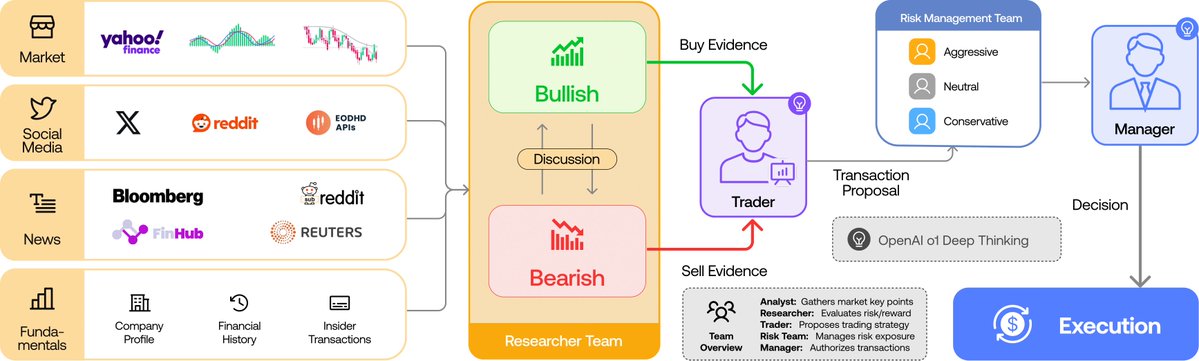
1. TradingAgents
A full team of AI analysts that debates strategies and executes trades in real markets. 4 analysts in parallel: fundamental, sentiment, news, and technical. Then a risk manager and an executor agent. Like having a Wall Street team working 24 hours on your computer.
repo - https://t.co/UaRcwTBIih
2. LibreChat
ChatGPT, Claude, Gemini, DeepSeek, and 20 more models in a single interface. Self-hosted. Native MCP support. Your history, your infrastructure, your data. OpenAI charges $20 a month for its interface. Here you use your own keys and don't pay a dime extra.
repo - https://t.co/WhVNyHfE5Q
3. HyperFrames
HeyGen open-sourced its internal video engine. You write HTML. The agent renders MP4. No React, no JSX, no proprietary formats. GSAP, Lottie, and Three.js work out of the box. The same HTML always produces the same file. Used in production by HeyGen, tldraw, and TanStack.
repo - https://t.co/f7n0Aj2v39
4. Fincept Terminal
A Bloomberg terminal that runs on your laptop. CFA level 1, 2, and 3 analysis. Over 20 investor AI agents that reason like Buffett, Dalio, and Soros. Over 100 data connectors. Bloomberg charges $24,000 a year. This costs nothing.
repo - https://t.co/Y21MkkfIKR
5. MoneyPrinterTurbo
You input a keyword. Out come the script, images, subtitles, music, and final high-quality video. Horizontal or vertical. No manual editing. What content creators do that they don't want you to know they use AI for.
repo - https://t.co/IXuG9rMwzX
6. Agentic Inbox
Cloudflare just open-sourced an email client where an AI agent reads your inbox and drafts responses. 100% on Cloudflare Workers. Your email never leaves your account. No external servers. No subscription.
repo - https://t.co/N0UziIIroA
7. VoxCPM2
Clone any voice with 3 seconds of audio. 30 languages. Studio-quality 48kHz. Design voices from text: "deep male radio announcer voice." No paid API. No voice samples leaving your machine. ElevenLabs charges $22 a month.
repo - https://t.co/j1wPFr2CJo
8. Flowsint
You enter a domain. The tool deploys a graph with all IPs, subdomains, emails, crypto wallets, and connected social profiles. All stored locally. Without anyone knowing what you're investigating. For OSINT, due diligence, and competitor analysis.
repo - https://t.co/qcjGwwZ21Q
9. addyosmani/agent-skills
The Google engineer who's been teaching web performance to the entire industry for 15 years published his skills for Claude Code. 23 real workflows tested in production. API design, code review, debugging, CI/CD, and frontend. Installation with one command.
repo - https://t.co/jRjpYjd8Ph
10. Nango
The integrations layer that companies pay $50k a year to rent. 700 ready APIs: Salesforce, HubSpot, Slack, Gmail, Stripe, Jira, and more. Managed OAuth. Your AI agent generates integration code from a prompt. Used in production by Replit, Ramp, and Mercor.
repo - https://t.co/fuybcYXmhh
These aren't toys. Each one replaces a paid product that you're still being charged for.
Pick one. Install it. Connect it to your workflow.
100% free. 100% open source.
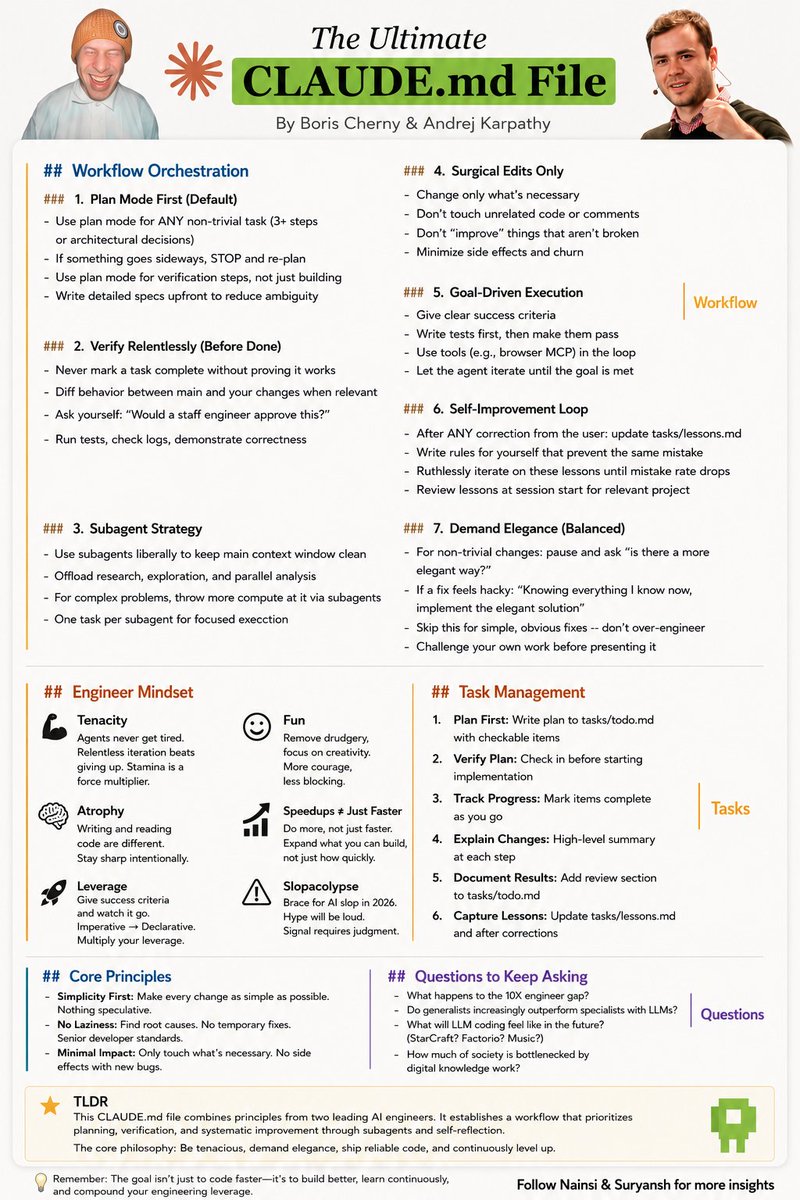
The engineer who BUILT Claude Code, Boris Cherny, and the engineer many call the Godfather of AI, Andrej Karpathy, just independently arrived at the same conclusion:
The future of software engineering isn't better prompts.
It's better systems.
I combined both of their CLAUDE.md files into a single framework, and the overlap is fascinating.
Despite coming from different backgrounds, both are obsessed with the same ideas:
→ Plan before coding
→ Verify everything
→ Keep solutions simple
→ Use AI agents in parallel
→ Learn from every mistake
→ Optimize for correctness, not speed
And that's the biggest signal.
The smartest people in AI are no longer talking about prompting.
They're talking about workflows.
Karpathy's philosophy is centered around disciplined execution:
• Plan Mode First
• Verify Relentlessly
• Surgical Edits Only
• Goal-Driven Execution
• Parallel AI Agents
• Simplicity Above Everything
Boris pushes it even further with self-improving systems:
• Every mistake becomes a lesson
• Every correction updates the system
• Every project compounds knowledge
• Agents continuously improve through feedback loops
His rule is simple:
«If the same mistake happens twice, the system failed.»
Karpathy's insight is equally powerful:
«Don't tell the model what to do. Tell it what success looks like.»
That single shift changes everything.
From:
"Write this function."
To:
"Here's the objective, constraints, tests, edge cases, and verification criteria. Iterate until correct."
That's not prompting.
That's management.
And that's exactly why CLAUDE.md files are exploding across the AI engineering world.
They're not prompts.
They're encoded engineering culture.
A persistent operating system for AI agents.
The most advanced teams today are already running multiple agents simultaneously:
• One researching
• One coding
• One debugging
• One writing tests
• One reviewing outputs
• One validating edge cases
Not AI-assisted coding.
AI orchestration.
The biggest opportunity over the next decade may not belong to the engineers who write the best code.
It may belong to the engineers who build the best systems around AI agents.
We're witnessing the shift from:
Prompt Engineering → Workflow Engineering
Single Agents → Agent Teams
Manual Execution → Autonomous Systems
And both Boris Cherny and Andrej Karpathy are pointing in exactly the same direction.
The future belongs to engineers who can orchestrate intelligence, not just use it.
For DevOps Engineer, Which one are you?
A. Linux -> Bash -> Git -> CI/CD -> AI Automation
B. Docker -> Kubernetes -> CI/CD -> AI Ops
C. AWS -> Infrastructure as Code -> Monitoring -> AI Integration
D. Azure -> DevOps Pipelines -> Automation -> AI Services
E. GCP -> Kubernetes -> Observability -> AI Monitoring
F. Terraform -> Multi-Cloud -> GitOps -> AI Automation
G. Kubernetes -> Platform Engineering -> SRE -> AI-Driven DevOps
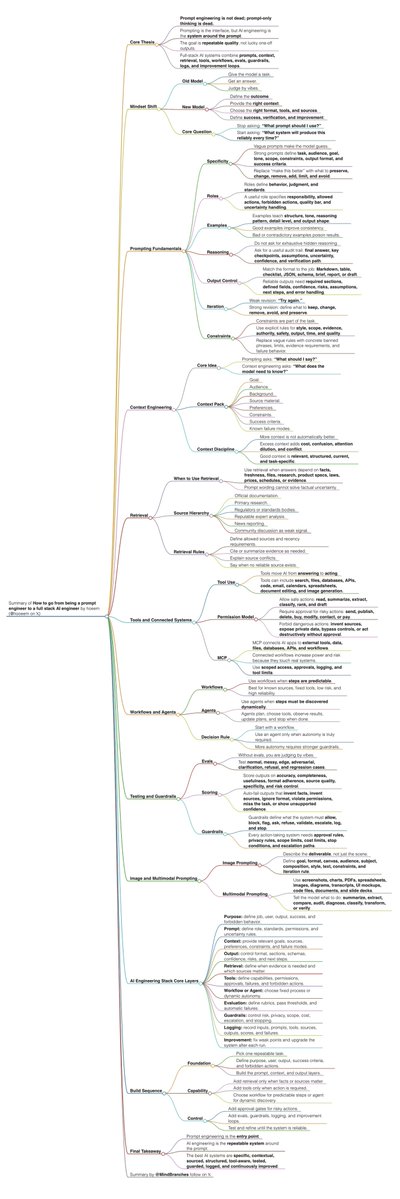
you can call it prompt engineering, forward deployed engineering or vibe coding with AI but it all boils down to knowing what AI models are capable of and knowing the right questions to ask.
Article Summary: How to go from being a prompt engineer to a full stack AI engineer
𝗠𝗼𝘀𝘁 𝗱𝗲𝘃𝗲𝗹𝗼𝗽𝗲𝗿𝘀 𝗱𝗼𝗻'𝘁 𝗿𝗲𝗮𝗱 𝗮𝗻𝗱 𝘁𝗵𝗶𝘀 𝗶𝘀 𝗽𝗿𝗼𝗯𝗮𝗯𝗹𝘆 𝗺𝘆 𝗯𝗶𝗴𝗴𝗲𝘀𝘁 𝗽𝗿𝗼𝗳𝗲𝘀𝘀𝗶𝗼𝗻𝗮𝗹 𝗮𝗱𝘃𝗮𝗻𝘁𝗮𝗴𝗲
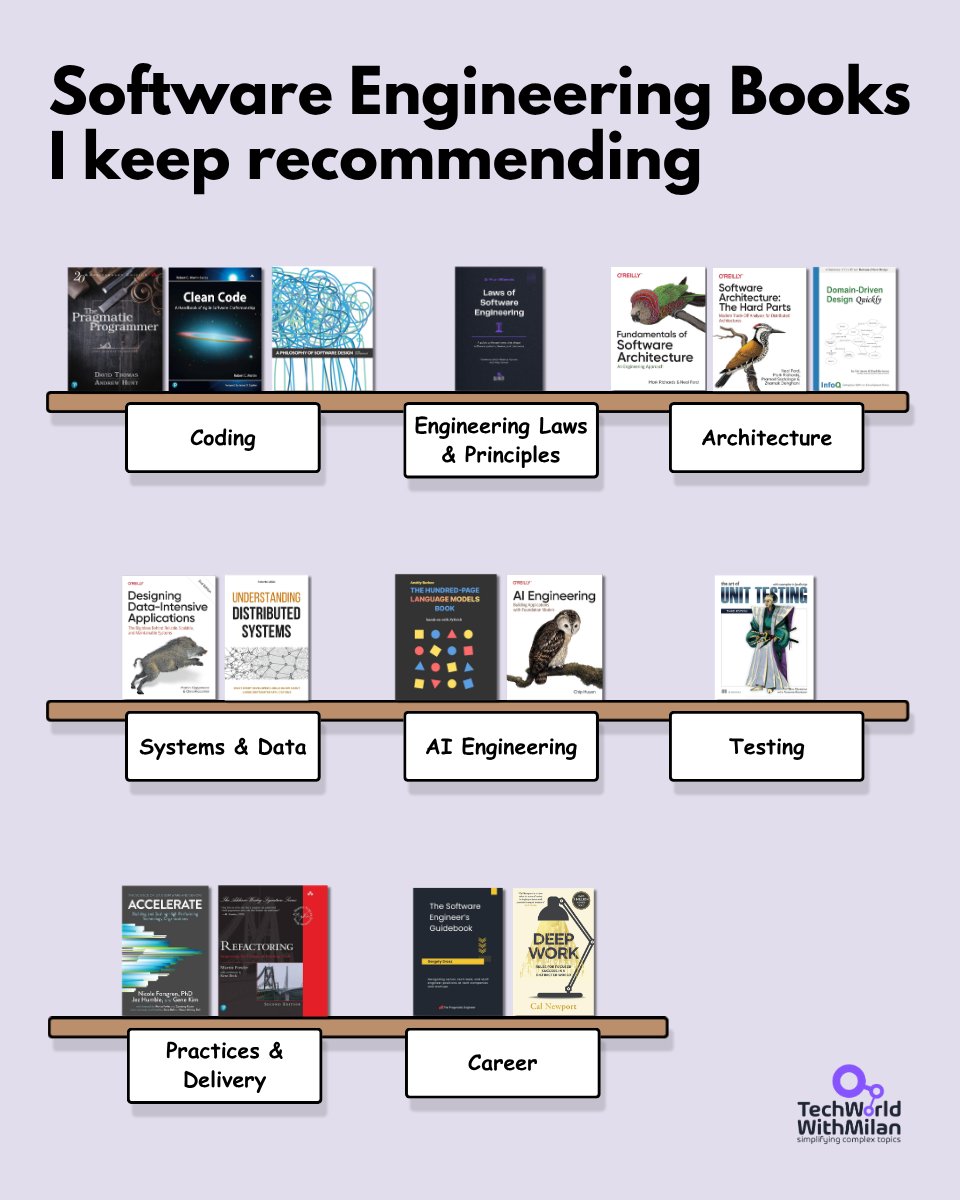
So when people ask me for book recommendations, I don't give the same ones as others: Clean Code, The Pragmatic Programmer, and DDIA. Those are fine, of course, but you've heard about them many times.
In the new issue of Tech World With Milan newsletter, there is the list I actually gave people in 2026. 17 books, sorted by the problem you're having.
A few that earned their place:
- 𝗔 𝗣𝗵𝗶𝗹𝗼𝘀𝗼𝗽𝗵𝘆 𝗼𝗳 𝗦𝗼𝗳𝘁𝘄𝗮𝗿𝗲 𝗗𝗲𝘀𝗶𝗴𝗻 by @JohnOusterhout. I read it late and wished I hadn't waited. Best explanation I know of why complexity is in and how to push back.
- 𝗗𝗲𝘀𝗶𝗴𝗻𝗶𝗻𝗴 𝗗𝗮𝘁𝗮-𝗜𝗻𝘁𝗲𝗻𝘀𝗶𝘃𝗲 𝗔𝗽𝗽𝗹𝗶𝗰𝗮𝘁𝗶𝗼𝗻𝘀, 2nd edition, by @martinkl and @criccomini. The rewrite adds AI data systems. Still, the book I reach for most on distributed data.
- 𝗔𝗜 𝗘𝗻𝗴𝗶𝗻𝗲𝗲𝗿𝗶𝗻𝗴, by @chipro. If you're putting LLMs into production, this is the one.
- 𝗧𝗵𝗲 𝗦𝗼𝗳𝘁𝘄𝗮𝗿𝗲 𝗘𝗻𝗴𝗶𝗻𝗲𝗲𝗿'𝘀 𝗚𝘂𝗶𝗱𝗲𝗯𝗼𝗼𝗸, by @GergelyOrosz. The career stuff nobody teaches you. We usually learn it by experience the hard way.
- 𝗥𝗲𝗳𝗮𝗰𝘁𝗼𝗿𝗶𝗻𝗴, by @martinfowler. Changing code without breaking it, which is most of the actual job.
My own book is on the list too. 𝗟𝗮𝘄𝘀 𝗼𝗳 𝗦𝗼𝗳𝘁𝘄𝗮𝗿𝗲 𝗘𝗻𝗴𝗶𝗻𝗲𝗲𝗿𝗶𝗻𝗴: 63+ laws and principles every engineer learns from experience and fails. I collected them so you don't have to.
Link is in the comments.
for anyone asking where to learn this stuff:
• RAG → https://t.co/4bzbUIwV5g
• Agentic RAG → https://t.co/IotOiGmV1Y
• AI Agents → https://t.co/nEeMnVJQbk
• Multi-Agent Systems → https://t.co/pavDPVJEFj
• LangGraph → https://t.co/3miEqqFzF0
• LangGraph (code) → https://t.co/v7kxHZXqba
• MCP → https://t.co/lKawRb4etX
• Memory Systems → https://t.co/LSaT2UaPAS
• Evals → https://t.co/vxChxa1kqQ
• Context Engineering → search "Context Engineering Survey" on arXiv
and please skip the "build an ai agent in 10 minutes" videos
build something, watch it fail, then figure out why.
AI agents are impressive... until the API they depend on goes down.
I've built agentic systems that could reason, plan, and execute tasks autonomously. Yet some of their biggest failures had nothing to do with AI. The problem was a third-party API failing, timing out, or changing its response format.
It makes me wonder:
Will APIs still be the backbone of AI in 10 years?
Or will local AI agents with direct access to company data and systems become the new standard?
Maybe AI's biggest challenge isn't intelligence.
Maybe it's integration.
#AI #ArtificialIntelligence #AgenticAI #AIAgents #Automation #MachineLearning #SoftwareDevelopment #APIs #Tech #Innovation #FutureOfWork #EnterpriseAI
As an AI Engineer. Please learn:
Harness engineering, not just prompt engineering
Context engineering, not just long prompts
Prompt caching vs. semantic caching tradeoffs
KV cache management, eviction, reuse, and memory pressure at scale
Prefill vs. decode latency and why they optimize differently
Continuous batching, paged attention, and throughput optimization
Speculative decoding vs. quantization vs. distillation tradeoffs
INT8, INT4, FP8, AWQ, GPTQ, and when quantization hurts quality
Structured output failures, schema validation, repair loops, and fallback chains
Function calling reliability, tool contracts, argument validation, and idempotency
Agent guardrails, loop budgets, tool budgets, and termination conditions
Model routing, graceful fallback logic, and degraded-mode UX
RAG architecture: chunking, embeddings, hybrid search, reranking, and freshness
Retrieval evals: recall, precision, grounding, attribution, and citation quality
Evals: golden sets, regression tests, adversarial tests, LLM-as-judge, and human evals
LLM observability as a first-class discipline: traces, spans, tokens, latency, errors, and drift
Cost attribution per feature, workflow, tenant, and user journey not just per model
Safety engineering: prompt injection defense, data leakage prevention, and permission boundaries
Multi-tenant isolation, cache safety, and cross-user context contamination prevention
Fine-tuning vs. in-context learning vs. RAG vs. distillation and when each is the wrong tool
Latency, quality, cost, and reliability tradeoffs across the full inference stack
Production failure modes: hallucinated tool calls, malformed JSON, stale retrieval, runaway agents, and silent eval regressions
Shipping LLM systems as reliable infrastructure, not demos wrapped around prompts
https://t.co/OhK9MK04ld
Microsoft just pulled back the curtain on how its teams build AI agents with Anthropic.
A senior AI engineer shared the exact workflows, tools, and architecture they're using in a free 34-minute workshop.
One thing stood out:
We're moving beyond prompts and into agent infrastructure.
⚡ Claude Opus 4.7
⚡ 1,400+ MCP tools
⚡ Production-ready agent workflows
The process is surprisingly simple:
Connect Claude → Attach tools → Deploy agents
No hype.
Just practical systems that teams are using today.
This workshop delivers more real-world value than most expensive AI courses on the market.
Watch it. Bookmark it. Build with it. 🔖🚀
Most AI agents today are glorified chatbots.
The ones replacing hours of human work look very different.
They don't just answer.
They:
🧠 Reason
🔌 Use tools
👥 Delegate tasks
⚡ Trigger workflows
📚 Access knowledge
🔄 Self-correct
That's the difference between an AI assistant and an AI workforce.
The architecture behind it is surprisingly simple:
• Skills → what the agent knows
• MCP → what the agent can access
• Subagents → who the agent can delegate to
• Hooks → what the agent does automatically
This is the biggest shift happening in AI right now:
2024: Prompt Engineering
2025: Agent Engineering
2026: AI System Engineering
The future won't belong to people who can write clever prompts.
It'll belong to those who can build systems where AI can think, act, collaborate, and execute independently.
We're moving from "chat with AI" to "work gets done by AI."
And we're still in the early innings. 🚀
🔖 Bookmark this. You'll understand why in 12 months.