With @matteo_sartori_ and @MarcoGPalladin1 we study fixed-term contracts in Italy. They are valuable for firms that operate under high uncertainty. At the same time, these firms are, on average, less productive. A well-known trade-off—we make it visible in the data 1/2
It was my distinct honor to present Mario Draghi with the @SIEPR Prize for Contributions to Economic Policy at a dinner last night on the Stanford University campus. Sharing a few photos here and my remarks in the post below👇
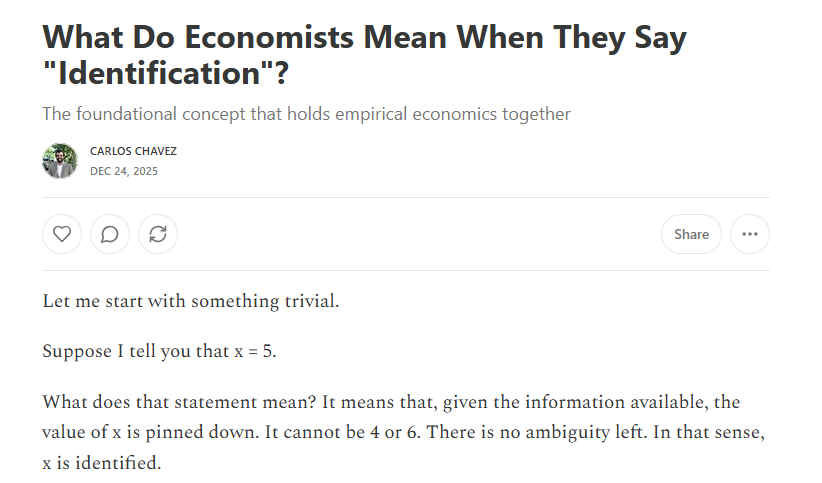
Suppose I tell you x = 5.
That's identification. The value is pinned down. No ambiguity.
Econometrics asks the same question—just in a messier world.
New post on what economists actually mean when they say "identified":
https://t.co/rDwXI6NLgc
Pourquoi les chiffres de PIB par habitant ou de PIB par heures travaillées semblent si différent selon la source ou la personne qui les cite ?
Une petite explication
📦 Can industrial policy work? Yes—the East Asian experience shows it can (at least partially).
But its success rests on a key condition: labor control.
🇯🇵🇰🇷🇹🇼 Japan, South Korea, and Taiwan industrialized rapidly under authoritarian or semi-authoritarian regimes. Wages and labor rights were systematically repressed to favor capital accumulation and export competitiveness.
This was especially stark in South Korea during the 1980s–1990s, when unions clashed with the state and business. (If you’ve watched Squid Game, it’s in the backstory of Seong Gi-hun.)
⚠️ Authoritarianism wasn’t incidental—it was functional.
Not all authoritarian regimes succeed with industrial policy, but successful cases relied on the ability to suppress real wages and labor rights.
🇦🇷 This is why Latin America’s Big Push programs failed: their political base—urban working-class voters (e.g., Peronistas)—couldn’t sustain the wage repression required. The strategy collapsed under its own contradiction.
💥 You can’t push industrialization with cheap labor and depend politically on those who demand higher wages. The internal logic breaks. Latin America’s populism was a road to nowhere.
As far as I can tell, there are no examples of country-wide industrial policy success where real wages (and consumption) were not kept relatively low.
🇨🇳 China is not so different today.
🧾 Consumption as a share of GDP remains exceptionally low—even compared to countries at similar stages of development.
That wouldn’t be the case if China were a democracy. High savings and low consumption are features, not bugs, of its growth model.
🤔 That’s why I’m puzzled when advocates defend industrial policy from a progressive position that favors high wages and democratic institutions. You can’t have your cake and eat it too.
📚 This point isn’t new: @pseudoerasmus has made it for years. And long before him, it was central to Marx, Gerschenkron, and Dobb—and deeply embedded in the logic of socialist Big Push programs, from Stalin to Mao.
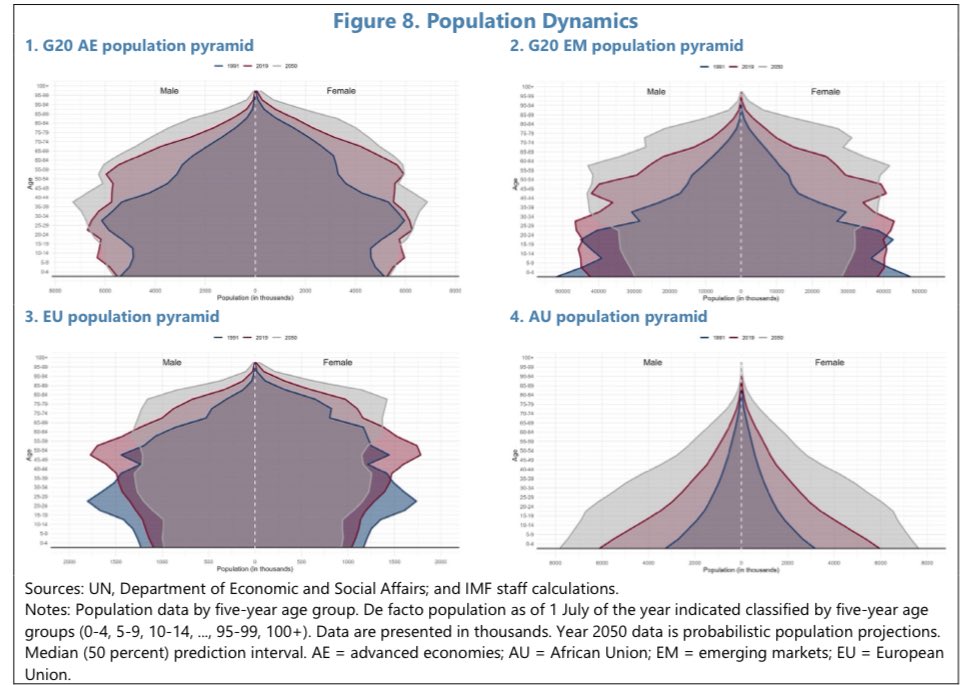
If you’re interested in how demographic factors shape growth and productivity (and you should be, as low fertility, aging and migration are first order issues), you may want to take a look at the new @IMFNews note prepared for the @g20org. You can download it here: https://t.co/PFBEebr9xt
@_alice_evans@JesusFerna7026@RiccardoTrezzi
Average mortgage interest rates are set to rise despite recent ECB rate cuts, slowing the recovery in consumption.
Why?
🔹lag effects from the previous hiking cycle
🔹a high share of fixed-rate mortgages
Read more in our #EconomicBulletin
Despite recent ECB rate cuts, the average interest rate on mortgages is expected to further increase.
That is due to lag effects from the latest hiking cycle.
The ECB blog shows that the resulting drag on consumption could last at least until 2030.
Cool result by Levintal/Fernandez-Villaverde: the rich are rich because they are less risk averse, not because they’re more patient
Gamma heterogeneity is needed for wealthy to save in riskier, higher return assets (opposite to Beta-het in Krusell Smith)
https://t.co/WrlfIb7TFS
‼️New/substantially revised paper: Why are the wealthiest so wealthy?‼️ A short thread on new empirical evidence from 23-year administrative panel data and what they mean for theories of top wealth inequality. Joint work with @Elhalvorsen, @JoachimHxx, and Salgado. https://t.co/C6LWYPKaHR
In a speech at @StanfordGSB, Chief Economist Philip R. Lane reviews the monetary policy tightening cycle and discusses the next phase of reducing the level of restriction.
Read his speech https://t.co/Y5FCJIZWSA