UBC Computer Science Professors Emeriti Alan Mackworth and David Poole were awarded the AAAI/EAAI Patrick Henry Winston Outstanding Educator Award for developing free online resources to learn foundations of AI. Congratulations! Read more: https://t.co/cRh5gtsoQu
@RichardSSutton "Discriminative models are usually better than generative models" is true when the test is distributed the same as the training. Generally we want to predict the future from the past. Assuming these are distributed the same is a big stretch, I'm surprised anyone would make!
I wrote this piece on AI and creative writing after reading articles by creative writers lamenting the impact of AI... Enjoy! "Why AI can’t take over creative writing" https://t.co/pJQ3La6Lop via @ConversationCA
I really wonder why so many AI companies seem to blindly compete for building the same thing: the best foundational models, as measured by some abstract set of benchmarks. It feels like there is now an entire ecosystems of companies that want to outperform GPT.x. Why?
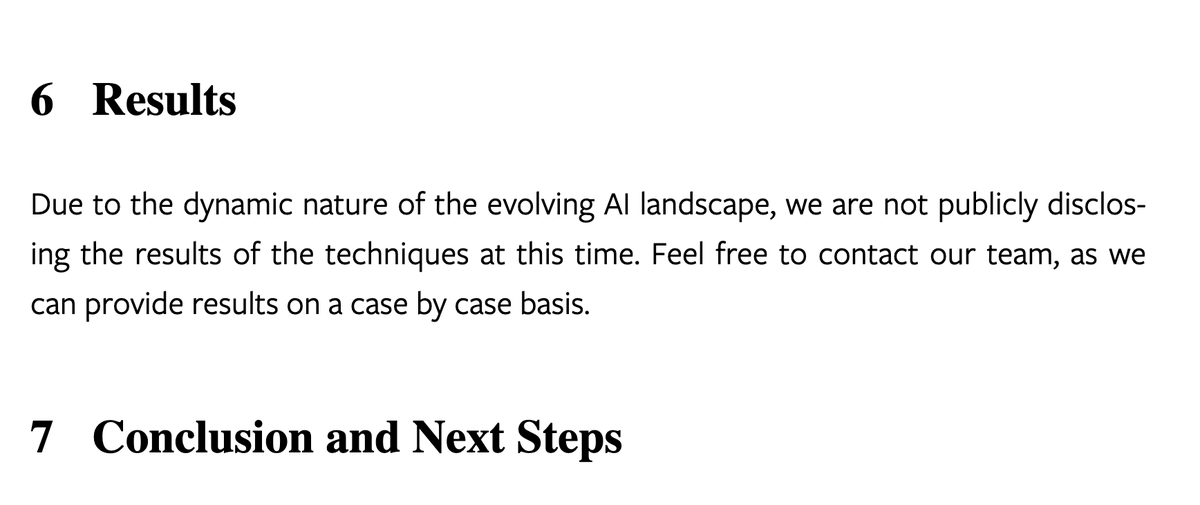
PSA: Every time you cite the arXiv version of something instead of the peer reviewed version, you're lending legitimacy to nonsense like this:
Source: https://t.co/1e2Tvef30v
“The profound anthropomorphisms that characterize today’s AI discourse—conflating predictive analytics w/INTELLIGENCE & massive datasets with KNOWLEDGE & EXPERIENCE—are primarily the result of marketing hype, technological obscurantism & public ignorance.” https://t.co/jY2HpPtL54
LLMs are useful, but they are an off ramp on the road to human-level AI.
If you are a PhD student, don't work on LLMs.
Try to discover methods that would lift the limitations of LLMs.
AI is not some sort of natural phenomenon that will just emerge and become dangerous.
*WE* design it and *WE* build it.
I can imagine thousands of scenarios where a turbojet goes terribly wrong.
Yet we managed to make turbojets insanely reliable before deploying them widely.
The question is similar for AI:
"do we think there exists at least one design of an AI system that is simultaneously safe/controllable, and can fulfill objectives in more intelligent ways than humans ?"
If the answer is yes, we'll be fine.
If the answer is no, we won't build it.
Right now, we don't even have a hint of a design of a human-level intelligent system.
So it's too early to worry about it.
And it's way too early to regulate it to prevent "existential risk."
@GaryMarcus@randomwalker Geoff is probably right about machine learning; we just need lots of homogenous data and lots of compute. However, for lots of problems there is inherently little data. And machine learning is only part of AI, which is far from being solved.
While intellectual independence and scholarly pursuits are the key reasons why many of us choose to be in academia, arguably, the most satisfaction comes from teaching the next generation of great minds!
Another class of ML papers that collect good review scores largely overclaims the implications and generality of what is actually proven and sweeps the underlying assumptions under the carpet. See below what I ask the referees for those:
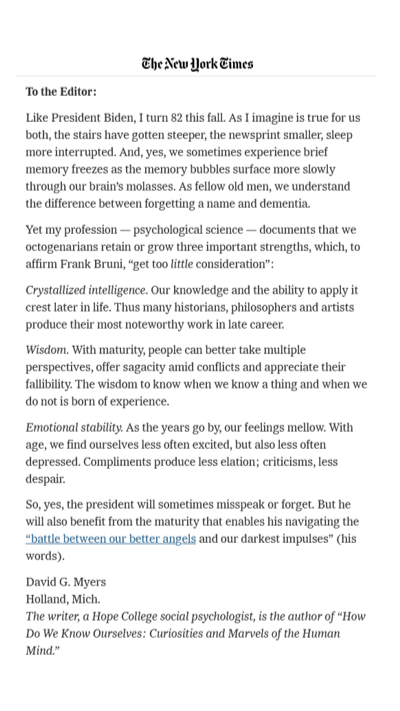
A psych science perspective (writing as President Biden’s age-mate) on the challenges and strengths of octogenarian life.... in tomorrow's print NY Times:
That memorization (which ML has solely focused on) is not intelligence. And because any task that does not involve significant novelty and uncertainty can be solved via memorization, *skill* is never a sign of intelligence, no matter the task.
Wow -- what if we could use those funds to build: alternative energy capacity, improved electricity grid, public transit, modernization of public buildings (schools, hospitals; think ventilation, energy efficiency) instead of data centers for churning out synthetic media?
It seems like there are just endless bad ideas about how to use "AI". Here are some new ones courtesy of the UK government.
... and a short thread because there is so much awfulness in this one article.
/1
https://t.co/k4AWPlZJtA