Stupid or liar?
Microsoft’s public explanation for the Microsoft 365 outage is that “the incident was introduced by an issue during an earlier network capacity upgrade that surfaced following a recent network change.” In other words, a latent network-capacity problem was exposed by a later change, causing capacity loss across Microsoft 365 services.
https://t.co/4RgmIyg6OK
That explanation leaves us with two uncomfortable possibilities.
Either Microsoft is not telling us the real root cause, or Microsoft built and operated an architecture with a single point of failure that should never have existed in the first place.
Resilience is about distribution. Not just spreading workloads across regions and data centers, but coordinating that distribution through mechanisms that preserve optionality when things go wrong. Bad updates happen. Bad configuration changes happen. Cyberattacks happen. Human error happens. Hardware fails. Networks partition. The whole point of resilient architecture is that none of those events should be able to take down a global productivity platform in one broad motion.
If a network capacity upgrade can sit latent in the environment and then be triggered by a later change in a way that impacts users internationally, that is not just an “oops.” That is an architectural failure. It suggests too much shared control, too much coupling, too little blast-radius containment, or insufficient rollback isolation. Pick your poison.
The cloud does not forgive architectural fantasy. You do not get resilience because you have many regions on a diagram. You get resilience because failures are contained, coordination layers are redundant, control planes degrade safely, and recovery paths remain available when the primary automation gets confused.
Microsoft is effectively saying the architecture they leveraged allowed a broad single point of failure. That should not be acceptable at this scale.
So I come back to the same place: either the root-cause explanation is incomplete, or the architecture is sillier than anyone running global-scale infrastructure should be comfortable admitting.
@CKTH85@LastBoyScout87@sparbuchfeinde OK dann hatte ich das falsch interpretiert, hörte sich für mich an, als wäre das eine pauschale Aussage gewesen 🤝
@MaximoMustero@LastBoyScout87@CKTH85@sparbuchfeinde E-Auto: Wer lesen kann ist klar im Vorteil... Was bringt's mir wenn ich fast nicht fahre und das bisschen zudem noch sehr günstig?
Wärmepumpe: Wenn du sowas für 2,5k bis 5k einbauen kannst, würde ich meine Zeit nicht hier verschwenden sondern mir vom großen Kuchen was abschneiden
@LastBoyScout87@CKTH85@sparbuchfeinde Die Rechnung mag sich in Zukunft ändern, aber die letzten Jahre wäre es für mich definitiv nicht lohnenswert gewesen, mein Kapital daran zu binden anstatt anzulegen, da die Opportunitätskosten einfach zu hoch sind - daran denken leider nur wenigsten.
@LastBoyScout87@CKTH85@sparbuchfeinde Ich kann nicht mal 3k€ im Jahr derzeit einsparen, müsste aber mit eCar, Wärmepumpe und PV ordentlich Kapital aufbringen, dass ich auch einfach am Kapitalmarkt anlegen kann. Einfach mal 60k€ veranschlagt, bringt das bei 5% Rendite auch 3k€
Claude 4 just refactored my entire codebase in one call.
25 tool invocations. 3,000+ new lines. 12 brand new files.
It modularized everything. Broke up monoliths. Cleaned up spaghetti.
None of it worked.
But boy was it beautiful.
@simplex_fx@rjlupton@rfleury Well if one would have to start it only once a day then slow startup time would be annyoing given today's hardware but no big hit in productivity. Reality is, it is slow in general, not only during startup and you have to start it multiple times since it crashes a lot as well
@agriffini@rfleury Honestly, that is exactly the problem in our industry: considering HW acceleration as overkill but introducing a web stack is considered reasonable.
@zack_overflow The question as such is as useful as asking whether going left or right at an intersection is getting you faster to your destination.
We don't know the element size, we don't know N, we don't know the caching system (if any) etc. etc.
@yamaheru@TheGingerBill@rfleury Just don't be wasteful. Modern hardware is so damn fast that you don't need to really optimize most of the time. So writing somewhat reasonable code is enough. However, today most people write software like if there are no resource limits at all.
@42blue@aktienmessie Hatte das am WE auch erst jemand gesagt, dass mir Corona mehr Sorgen machte. Das aktuell unterliegt völlig der Kontrolle von Menschen (wenn auch von 🤡); bei Corona hätte kein Mensch von heute auf morgen das Problem lösen können.
@Der_Boersianer@Tiefseher Kapier es auch nicht. Wer zumindest die letzten 5 Jahre mit an Bord ist (@Tiefseher ist wohl "bisschen" länger dabei), sollte sich doch mittlerweile ein bisschen dickeres Fell und Sitzfleisch angeeignet haben und nicht gleich in Pessimismus verfallen...
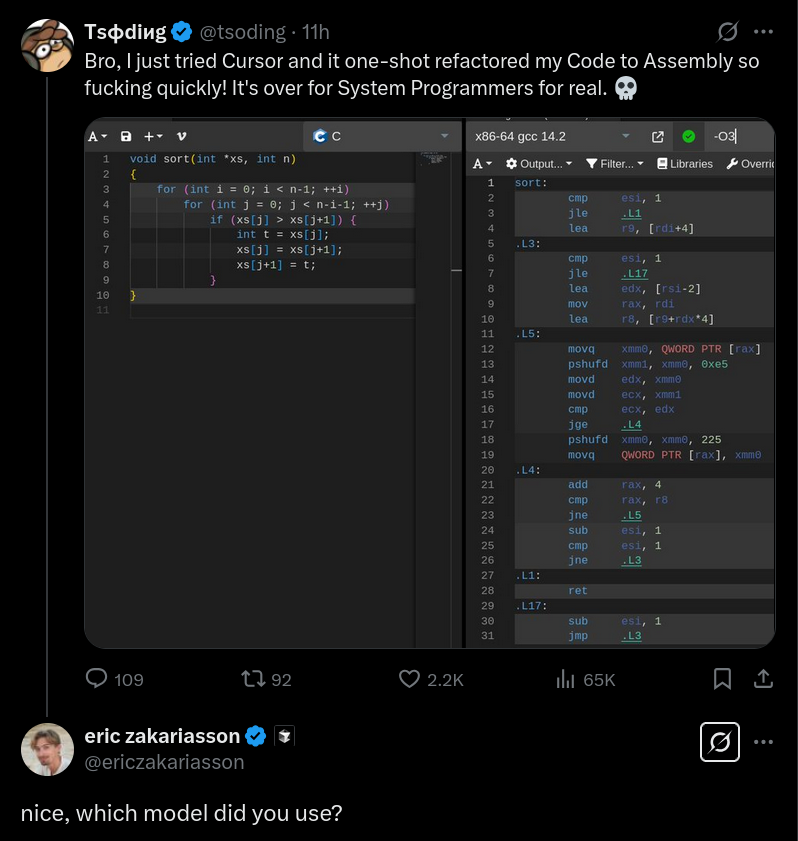
This is a reply from an official Cursor dev (look at the organization badge). Bro's being genuine. He's DM-ing me to give Pro. This is everything you need to know about the people "building" our future. Transforming higher level languages to Assembly is a Technology from 1950s.
@bergfahrten@stenboo@FrauPrivat@MooreDividends Insbesondere darf man die mögliche Eigenleistung nicht vergessen, die mehr Spielraum ermöglicht, wenn man entsprechende Fähigkeiten und/oder den Freundeskreis hat.
Aber wie so oft gibt's hier kein Schwarz/Weiß sondern ist sehr abhängig vom konkreten Kontext.
@Kissaki416@Lars_Kruse_1973@JulianRoepcke Naja da habe ich ein anderes Verständnis von Kultur, insbesondere dessen, was wir seit Jahrhunderten hier aufgebaut haben. Vielleicht ist das der Tatsache geschuldet, dass ich ein "Landei" bin ;-)
@Lars_Kruse_1973@JulianRoepcke Hab ich was verpasst oder von welcher Kultur ist hier die Rede? Wirtschaftlich und technologisch sicherlich das Schwergewicht als einzelne Entität, aber in den beiden Themen so abhängig von uns (und anderen) wie wir von denen - wir haben aber verlernt auf Augenhöhe aufzutreten.