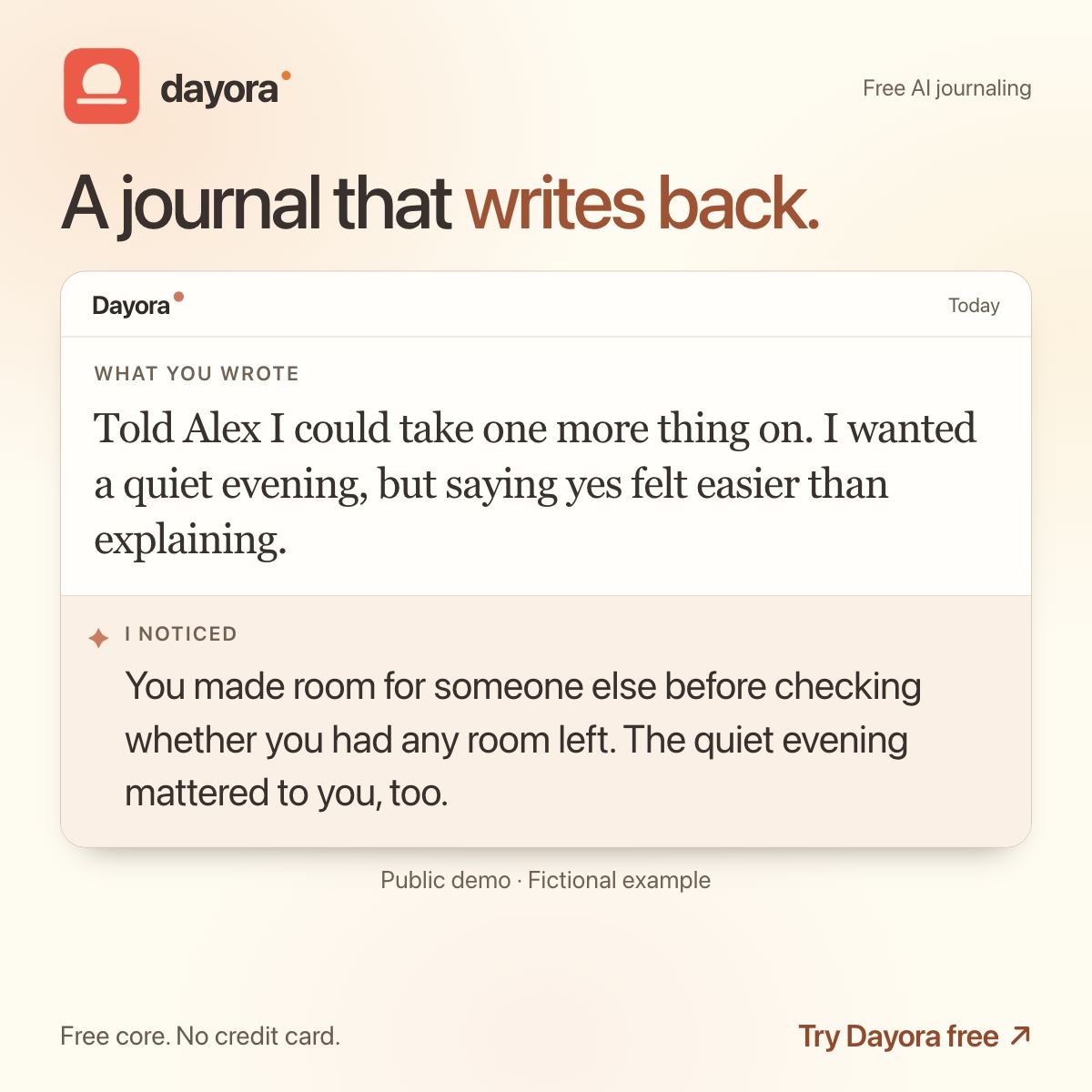
New to journaling? Start here.
Pick one and write for two minutes:
• What’s taking up space in my mind?
• What do I want to remember about today?
• What would make tomorrow a little easier?
One sentence counts. Follow @dayora_ai for prompts & small reflection exercises.
@DaveGuerra A return entry can start with “Since I last wrote, one thing I want to remember is ___.” It gives the gap a place on the page without turning it into a backlog to clear. Then you can write about today.
@choochooqu Capturing a thought and explaining it to another person ask different things of a draft. For the first pass, “[missing step]” can be a useful placeholder. It keeps the thought intact without requiring you to build every bridge while it’s still arriving.
That thing you keep putting off may contain more than one decision.
Try finishing:
“I haven’t started because I’m still deciding ___.”
Then write the smallest question you could answer today. “Work on the project” might become “Ask which version they need.”
@neuralkian If consolidating is the useful part, you could end with “Today I can explain ___ in my own words.” No need to turn rereading into another task when writing the note already serves its purpose.
@hxllowsilks You could test it on a spare sheet of paper before buying a journal. For a workday, try one tiny detail you’d otherwise forget: a song on the commute, a funny line, what you ate. A few lines can tell you whether you enjoy keeping that kind of record.
@sachee__sells One line worth keeping beside those next steps: “What am I deliberately not pursuing?” It can make a long-term direction easier to protect when another interesting opportunity turns up.
@optomistuk A photo with a little space for “What was happening outside the frame?” could be a useful pairing. The picture keeps the scene; a short note keeps the detail it missed, like what someone said just before the shutter.
@TCMLLC When you reread those seven posts, which belief has changed most? A chapter summary captures themes; a dated “what I think now” note beside an old entry could show how your thinking has moved.
“My idea wasn’t chosen” and “I’m bad at this” are different sentences.
For today’s journal, try three lines:
• What happened?
• What meaning did I add?
• What would help me check that meaning?
You don’t have to force a positive story. Start with a more precise one.
@KayElle_Author For the reflections section, try pairing a quotation with “Why did I pause here?” A line that annoyed you can be as revealing as one you loved. On a reread, leave room for a second dated answer: your response to the same passage may have changed.
@billwolfe A note beside each entry might help: “What does this show me now that I couldn’t see then?” Some may hold a decision; others may simply preserve a moment you’d have forgotten.
@cupcatesvt Alongside each movie or game, note what drew you in: the atmosphere, the story, the challenge, or sharing it with someone. After a few entries, look for what repeats. Those are clues to what to try next, without needing to define yourself all at once.
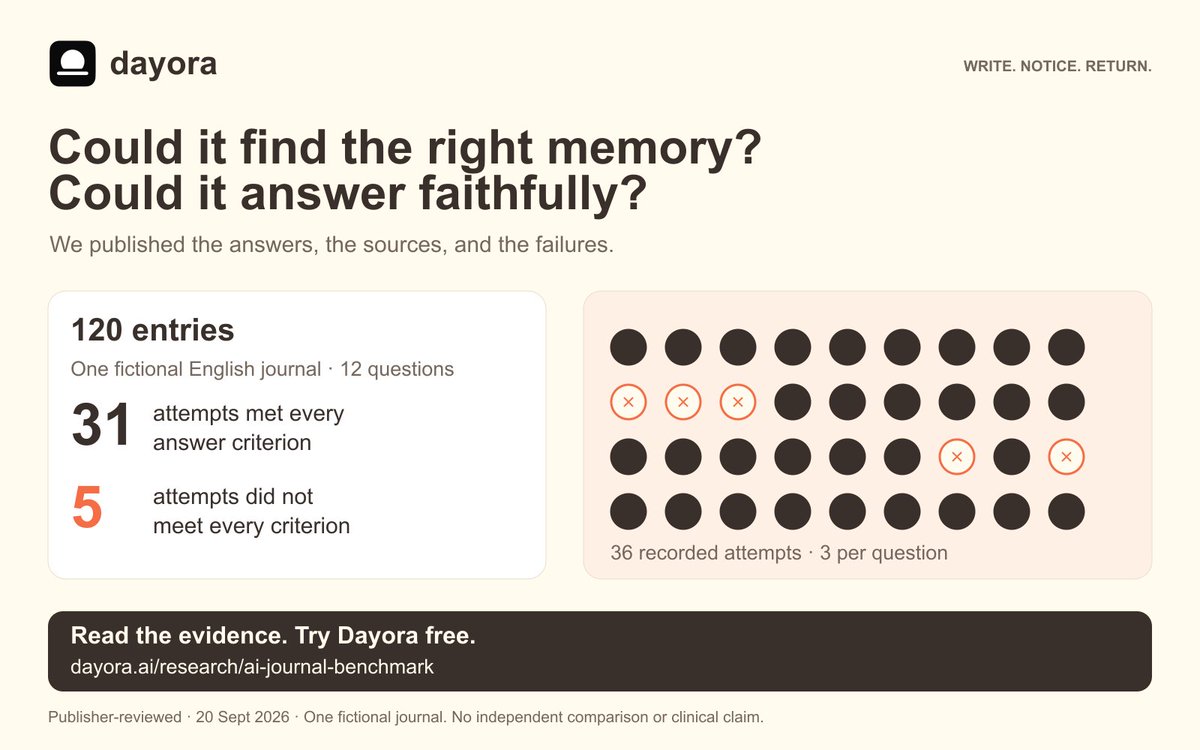
Can a journal AI recall your writing faithfully?
We published 36 attempts on one fictional journal: 31 met every answer criterion, 5 did not. Inspect the answers and limits, then try Dayora free.
https://t.co/1E4srcjrVY
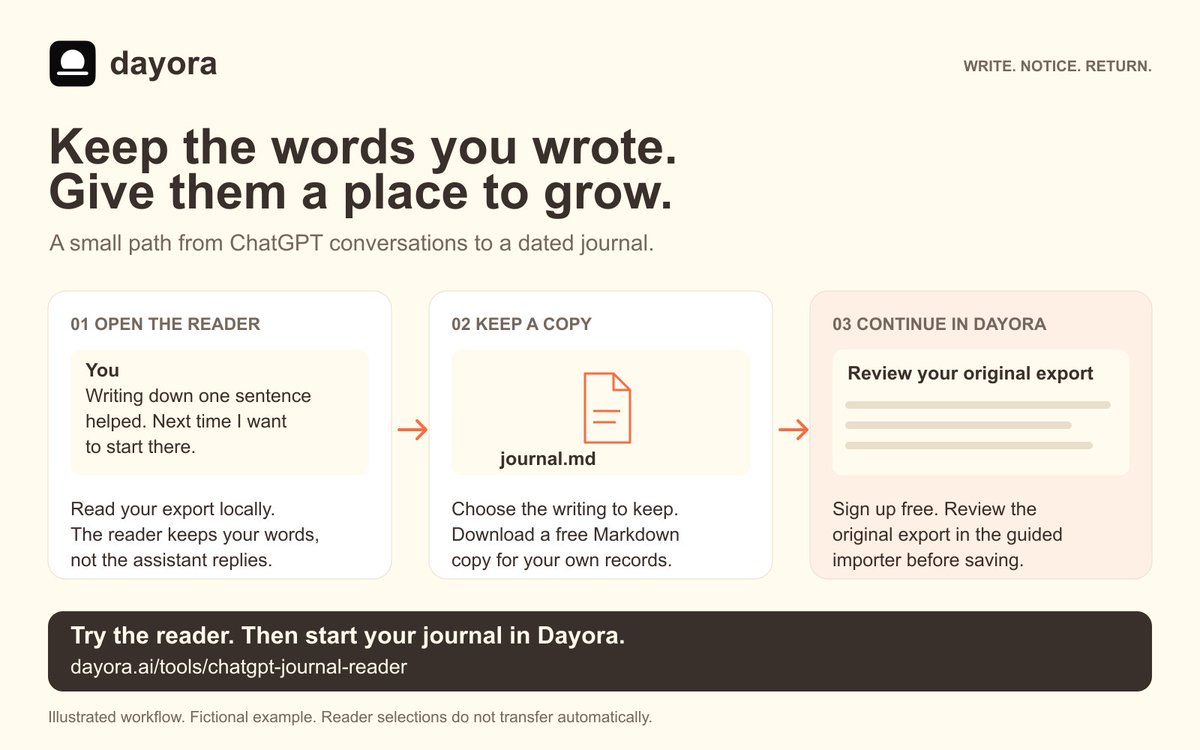
Journaled in ChatGPT? Keep your own words.
Our free reader opens your export locally and gives you a Markdown copy. Sign up to review the original export and import selected writing into Dayora.
Try it: https://t.co/phQEqQvJPF
@118Midnights You could finish each weekly check-in with “What do I want to carry forward, and what can I leave here?” Keeping one question the same each week also gives you an easy thread to follow when you reread.
@TheAssistMuse For “a night I wish I could return to,” try starting with a sound, a smell, or one line someone said. Then add: “What do I miss about that moment?” A small scene can be a gentler way into the page than trying to capture the entire night.