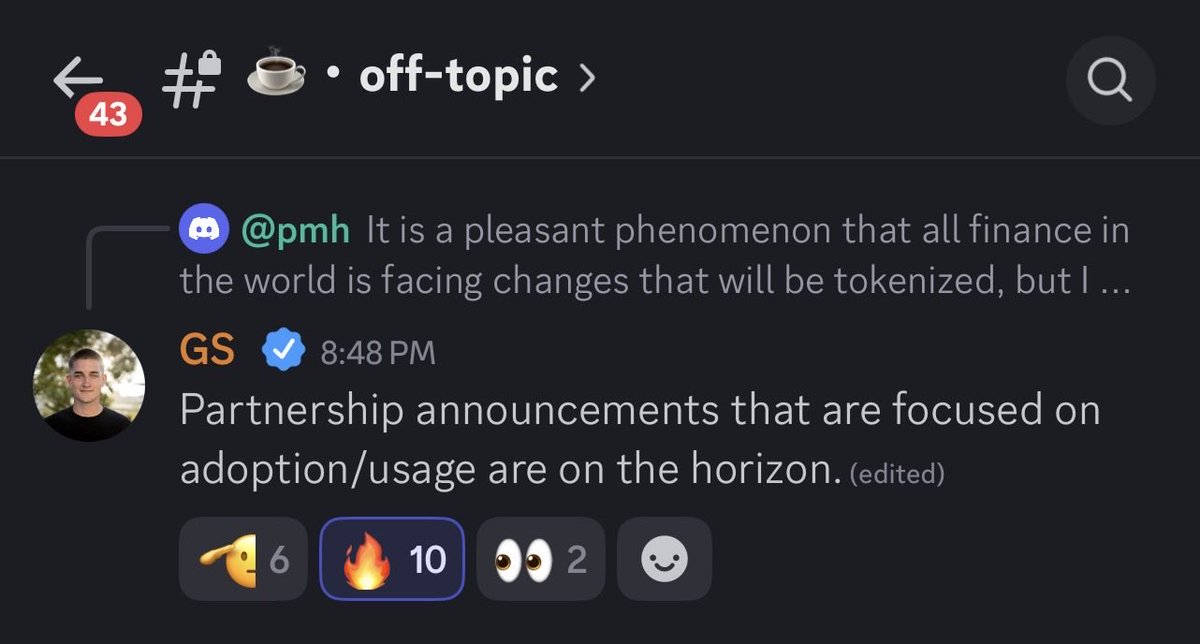
I’ve been thinking a lot this weekend about Gabe telling Discord the other day that partnerships focused on adoption and usage are on the horizon.
It got me thinking.
There are a handful of other chains that say they’re going to change finance.
They talk about tokenized stocks.
They talk about transforming global payments.
They talk about what they’re going to build.
What’s interesting to me is Keeta already shipped Keeta Personal.
And with that alone, they’ve already changed what’s possible in global payments.
Multi-currency accounts.
Cross-border payments.
FX conversion.
Traditional banking rails connected directly to digital assets.
If Keeta stopped everything today and simply expanded what has already been built, it would likely have a better real-world product than most of the networks still talking about what they hope to achieve someday.
But that’s not where they’re stopping.
Ty continues to say there’s so much more to Keeta than what we’ve seen so far.
We know tokenized stocks are on the horizon.
We know real-world assets are on the horizon.
We know the vision is to become a true network of networks that connects traditional finance, digital assets, and Web3 infrastructure.
The TPS, scalability, and privacy matter.
Individually they’re important.
Together they create opportunities that many other chains simply won’t have access to.
So when people ask what these upcoming partnerships might entail, it becomes a really interesting question.
I’m not someone who likes to speculate wildly. I prefer to stay grounded in facts.
But when a team has already shipped something that changes how global finance can operate, I think they’ve earned the right for people to start asking:
What if?
Because at this point the question feels less like what Keeta is capable of and more like what Keeta can connect.
What if these partnerships are bigger than any of us imagined?
Most projects don’t change the world.
Most companies don’t either.
Healthy skepticism is warranted.
But when I look at what has already been delivered, and when I listen to the ambition Ty talks about, I can’t help but come back to the same question.
What if?
@KeetaNetwork $KTA
what stands out to me:
partnership conversations are progressing.
the line about keeping them quiet until announcement dates is bigger than the engineering notes.
that supports the “many more coming” infrastructure buildout thesis.
keeta personal is not vaporware.
ios.
web wallet.
backend.
anchors.
auth.
conversion fees.
fx completion.
kyc anchors.
explorer backlog.
that is not vague hype.
that is shipping language.
the product is compliance heavy.
anchor disclaimers.
tos acceptance.
legal metadata.
service metadata.
document uploads.
kyc anchors.
this is not just a wallet.
this is regulated financial account infrastructure.
“anchor chaining improvements” is the phrase i keep coming back to.
multiple anchors.
ledger error recovery.
request tagging.
stable ids for kyc anchors.
that is plumbing.
not marketing.
the network of networks thesis keeps getting louder.
Imagine if a business only had to verify itself once.
Then it could use that verified identity across banks, payment providers, FX firms, brokers, fintechs, and financial services worldwide.
A truly universal financial layer.
That's what these 3 @keetanetwork PRs are moving toward.
A reusable identity layer for both people and businesses.
The kind of infrastructure needed before banks, payments, stocks, bonds, and real-world assets can move onchain at scale.
These 3 PRs might be some of the most important updates yet.
https://t.co/dC3tW2vIL8
https://t.co/Kkcfq9WAF0
https://t.co/hsNb9Cpvvy
Why?
Because before a bank, business, fund, payment provider, FX firm, broker, or fintech can move money...
They need to know who they're dealing with.
Traditionally, every institution does this separately.
Open a bank account? Fill out forms.
Open another account? Do it again.
Apply for a business account? Do it again.
Work with a payment provider? Do it again.
Trade internationally? More paperwork.
Every institution maintains its own siloed compliance system.
Slow.
Expensive.
Fragmented.
Keeta is taking a different approach.
Verify once.
Reuse everywhere.
The recent PRs show Keeta building a unified identity layer for BOTH people and businesses.
Not just KYC (Know Your Customer).
But KYB (Know Your Business) too.
That means a verified business can interact with banks, payment providers, FX providers, brokers, fintechs, and other institutions through the same network and identity framework.
Think about the possibilities:
• Tokenized bank accounts
• Global business payments
• FX settlement in seconds
• Trade finance
• Corporate treasury management
• Tokenized stocks
• Tokenized T-Bills
• Institutional liquidity networks
• Real-world assets moving 24/7
This is the kind of infrastructure you need BEFORE trillions of dollars can move onchain.
PR #353
→ Added KYB support.
PR #354
→ Unified business and personal identity into the same framework.
PR #355
→ Production-ready implementation.
This is the foundation for a global financial network.
keeta:native
Crypto has been a joke lately, that’s undeniable. Trash memes, rug pulls and bloated projects that do absolutely nothing. 🤡
It sounds like @KeetaNetwork is about to change the trajectory. $KTA has built 1 of the only platforms that can actually be used daily, by regular ppl.
You’ve been asking for it.
Well, according to Gabe in Discord, partnership announcement(s) focused on adoption and usage are on the horizon.
What exactly they entail? Nobody knows yet.
But if there’s one thing I’ve learned over the past year, it’s that Ty’s ambitions for Keeta aren’t small.
Are you excited?
Because I sure am.
@KeetaNetwork $KTA
Mastercard just announced stablecoin settlement. Big move. But most people don't understand where this sits in the payments stack or why it's still only half the answer.
Let me break down how a £3 coffee actually settles across three systems.
1/Today, when you tap your card, your bank authorises instantly but nothing actually settles. Mastercard batches everything end of day. Your coffee shop's bank receives funds 1 to 2 business days later.
Banks carry overnight risk on every single transaction. Weekends and holidays make it worse. This model is 30 years old and hasn't fundamentally changed.
2/What Mastercard just announced changes the interbank settlement layer, not the consumer experience.
Instead of batch clearing, your bank converts GBP to USDC on chain. USDC moves between banks near instantly via blockchain. The coffee shop's bank converts back to GBP.
Faster. Works 24/7. A genuine step forward.
3/But here's what nobody is talking about.
Both banks now have to trust Circle, the company behind USDC, to sit in the middle of every single transaction on the planet.
That's not decentralisation. That's replacing one intermediary with another. A faster one, yes. But still a third party with counterparty risk baked in.
4/This is where the architecture of tokenised fiat matters.
Instead of converting to a stablecoin issued by a third party, you tokenise the fiat itself. GBP stays GBP. It moves on chain represented as a token backed 1:1 by real reserves held in a regulated account.
No conversion. No Circle. No issuer risk.
5/For this to work at scale you need a network where:
Banks are verified participants with compliance baked in at the network layer, not bolted on afterwards.
Value moves anchor to anchor, each bank operating as a tokenised fiat anchor on the network.
Settlement is instant and final, not probabilistic, not batched, not dependent on a third party redeeming your stablecoin.
6/This is exactly the architecture Keeta Network is building.
Keeta isn't trying to replace Mastercard. It's building the settlement infrastructure that makes the next generation of payments actually work, for institutions, for cross border flows, and for any network that wants to settle value without a third party sitting in the middle.
7/Mastercard choosing stablecoins tells you the industry knows batch clearing is broken.
What it doesn't solve is the issuer dependency problem.
Tokenised fiat on a purpose built settlement network does.
The rails matter as much as the asset.
$KTA @KeetaNetwork@schenkty
Most projects are building products.
#Keeta Network is building infrastructure.
This is not just another chain competing for users, but infrastructure designed to connect banks, payment networks, blockchain ecosystems, stablecoins, and eventually AI-driven financial systems into one seamless framework.
The rails of tomorrow are already here today…
Opportunities don’t often shout over rooftops!!
$KTA
🤙
#WEB3 #BLOCKCHAIN #CRYPTO
SWIFT's new cross-border payments framework got me thinking about a bigger pattern.
Technology often moves from infrastructure you build to infrastructure you consume.
Companies used to run their own servers, storage, networking, and disaster recovery.
Then the complexity became too great.
The maintenance costs became too high.
So infrastructure moved to the cloud.
AWS, Azure, and Google Cloud became the layer everyone else builds on.
The same shift happened in narrower forms.
Payments moved toward embedded providers like Stripe.
Bank connectivity moved toward providers like Plaid.
The pattern is surprisingly consistent.
Build it yourself first.
Consume it as a shared layer later.
Now look at financial infrastructure.
SWIFT is investing in interoperability.
Banks are investing in interoperability.
Fintechs are investing in interoperability.
Keeta is building interoperability into the architecture itself.
Everyone seems to be working toward the same destination.
Identity.
Compliance.
Settlement.
Cross-border movement.
FX.
Traceability.
Interoperability.
The question is whether financial infrastructure eventually follows the same path.
From built to consumed.
From every institution maintaining its own stack to a shared network layer underneath.
The most interesting outcome may not be Keeta competing with legacy finance.
It may be legacy finance consuming infrastructure that looks increasingly like Keeta.
I want to be careful here.
Financial infrastructure is not the same as cloud infrastructure.
A server is relatively fungible.
Settlement carries trust, regulation, governance, and legal liability.
An institution cannot simply outsource responsibility the way it outsources compute.
So finance may not follow the cloud path at all.
Or it may follow it slowly and only in certain areas.
That caution is real.
But the pattern is real too.
And that is one reason I find Keeta interesting.
Not because I know how this ends.
Not because I know which architecture wins.
But because if financial infrastructure does move from built to consumed, networks positioning themselves as shared infrastructure layers become important to watch.
Will Keeta become the AWS of finance?
Only time will tell.
But it is the question Keetards are watching.
@RoarWeb3 Only one…
#KeetaNetwork
$KTA is building the rails of tomorrow.
Not another chain competing for attention. It’s an infrastructure layer connecting digital assets, banking, payments, and real world finance.
Real money movement~
That’s the bet 🤙
Seeing Ledger launch a new feature powered by Noah to connect traditional banking and stablecoins tells me where this industry is heading.
The focus is shifting from speculation to financial infrastructure.
Noah’s core offering is relatively simple:
Fiat (USD/EUR) to USDC.
That’s useful.
It creates a bridge between traditional banking and stablecoins.
But I think the bigger opportunity is what comes next.
The future isn’t just moving money into stablecoins.
The future is moving seamlessly between all forms of value.
Fiat.
Stablecoins.
Foreign currencies.
Treasury Bills.
Tokenized stocks.
Real-world assets.
That’s where Keeta stands apart.
Keeta isn’t building a one way on ramp into crypto.
It’s building infrastructure that allows value to move freely across an entire financial ecosystem.
Today users can already move between traditional banking rails and digital assets while accessing USD, EUR, GBP, AED, HKD, JPY, CAD, MXN, CNY, and additional currencies on the way.
Cross-border payments.
FX conversion.
Multi-currency accounts.
Banking and blockchain connected through a single network.
Treasury Bills are coming.
Tokenized stocks are coming.
Real world assets are coming.
That’s a much larger vision than simply converting dollars into a stablecoin.
The end game isn’t fiat versus crypto.
The end game is a world where moving between currencies, assets, and financial products becomes frictionless.
Looking across the industry, it feels like more and more companies are moving in that direction every day.
Keeta just happens to be building for that future already.
@KeetaNetwork $KTA @Ledger
One detail from the recent Medium article on Keeta and Visa stood out to me.
The story isn’t the partnership.
The story is what Keeta had to do to qualify for it.
To be listed on Visa’s global registry of service providers, Keeta underwent the PCI DSS Level 1 audit process, the highest security standard in the payments industry.
Think about that for a second.
This wasn’t a marketing announcement.
This wasn’t a press release.
This was an independent audit and compliance review tied to one of the largest payment networks in the world.
And according to the article, Keeta is the first blockchain network to achieve that designation.
Not Ethereum.
Not XRP.
Not Solana.
Keeta.
Why is that important?
Because institutions don’t move billions of dollars through infrastructure they haven’t vetted.
They care about security.
They care about compliance.
They care about risk.
Anyone can launch a blockchain.
Very few can meet the standards required to integrate with global payment infrastructure.
For years, the question has been whether blockchain technology could meet institutional standards.
Keeta didn’t answer that question with promises.
It answered it by passing the audit.
@KeetaNetwork $KTA @Visa
https://t.co/Frtqhox5Ov
Everyone seems excited that SWIFT is moving toward blockchain, interoperability, faster settlement, and more integrated financial infrastructure.
I’m looking at it differently.
To me, this highlights a major flaw in the SWIFT approach.
Their solution appears to be adding another layer that connects:
• Banks
• Payment networks
• Compliance systems
• Settlement systems
• Ledgers
• Blockchains
The problem is that complexity compounds.
Every institution has different rules.
Every jurisdiction has different regulations.
Every blockchain has different architecture.
Now compare that to Keeta.
Instead of trying to connect all of these systems after the fact, Keeta is building identity, compliance, payments, FX, settlement, and asset movement into the same network.
That’s why I don’t see this announcement as competition.
I see it as validation.
The biggest takeaway isn’t that SWIFT is getting into blockchain.
It’s that one of the largest financial networks in the world is moving toward many of the same capabilities Keeta has been building for years.
The difference is that SWIFT appears to be solving the problem by adding layers.
Keeta is solving it by removing them.
And in my experience, the biggest technological breakthroughs rarely come from adding more complexity.
They come from making complexity disappear.
@KeetaNetwork $KTA
Ok folks, I’m not technical enough to know why or how $KTA works, all I know is I set up a wallet, spent less than 2 mins getting a KYC certificate. Moved a few tokens in and now I have a full US bank account with KTA, USDC and something euro related. I can trade it or get it back in minutes for virtually £0 in fees and I suspect what I’ve here is scratching the surface. Welcome to the future kids.
keeta:native $HYPE is a top 10 coin ($18m market cap) because they developed a product people wanted. @KeetaNetwork has developed a product with 100x more use case IMO and currently a ~$100m market cap. What has more upside potential? 🤔
This is the positioning shift.
Stop calling it “crypto with financial features.” That is the old category.
The new reality is real-world finance
with infrastructure running on-chain underneath.
The user sees an account.
Verification.
Balances.
Rent.
Bills.
Global transfers.
Seamless web and mobile access.
The network handles the architecture
the user is never supposed to see.
Rails.
Settlement.
Identity.
Assets.
SDKs.
That is the point.
The best infrastructure does not need
to advertise itself as “crypto.”
It just needs to look like money
that actually works.
The new category is forming.
Real-world finance with on-chain infrastructure underneath.
I really like the video explaining the functionality of Keeta Personal below.
For years, crypto has talked about disrupting finance.
This is the first product I’ve seen that truly brings banking, payments, foreign exchange, cross-border transfers, and digital assets together into a single financial experience.
Think about what is being shown:
• Direct deposit from your employer
• Standard banking details
• Fiat and crypto in one account
• International transfers
• FX conversion
• Cross-chain interoperability
• Everyday spending through a card
All from a single account.
Today most people still need a bank, an exchange, multiple wallets, payment apps, and separate services for international transfers.
Keeta eliminates that fragmentation.
One account.
One identity.
One financial system.
And what’s even more interesting is that Keeta Personal is only a fraction of what is being built.
Additional anchors, institutional connectivity, treasury products, tokenized assets, and other infrastructure are still coming.
That’s why I believe many people are still misunderstanding Keeta.
They see a cryptocurrency.
I see the foundation for a new financial system.
@KeetaNetwork $KTA
One aspect of Keeta Personal that I think many people overlook is what it could mean for people outside the traditional banking system.
There are billions of people around the world who either don’t have access to a bank account or have access to banking services that are expensive, unreliable, or heavily restricted.
Imagine being able to hold digital USD, receive payments, convert currencies, and transact globally from a single account without needing access to a traditional U.S. bank.
For someone in a developed country, that may not sound revolutionary.
For someone in a country with limited banking access, capital controls, unstable local currency, or high remittance costs, it could be life changing.
Sometimes the biggest opportunities aren’t about making finance faster for people who already have everything.
They’re about giving financial access to people who never had it in the first place.
@KeetaNetwork $KTA
Keeta Personal is live.
I have been watching this network for months. I have traced the on-chain activity, read the whitepaper, decoded the GitHub. And I am telling you now. This is the moment the thesis becomes real.
Most people manage money across systems that were never built to talk to each other. A bank on one side. A crypto wallet on the other. A separate platform for investments. Every move between them costs you a fee, a delay, or another app to log into.
Keeta Personal deletes that entire problem.
One account. Your bank, your crypto, your investments, in the same place.
Here is what that actually means.
You get a US routing number and a European IBAN built in. Real banking details. Your salary can land straight into it. You can hold it as USD or convert it to USDC on the spot. No second app. No off-ramp.
It plugs into every rail that matters. Wire. ACH. ACH Debit. SWIFT. SEPA. PIX. Faster Payments. Interac. Visa Direct. Outbound payments to over 160 countries. Sending money across the world starts to feel like sending it across the street.
Bills get paid directly from your balance. No cashing out first. Your tokenised fiat is fully backed and held at regulated partners, so rent, subscriptions, autopay all come straight off your account.
Underneath it is a full crypto wallet. Hold, swap and send across Keeta, Ethereum and Base. Your everyday cash and your digital assets finally sitting in the same room.
And this is just what is live today.
What is coming. Physical and virtual spending cards. Native iOS and Android apps. Stock and T-bill investing from the same account. Savings and shared accounts. Instant funding and withdrawals via debit card. Real-time tokenised fiat transfers between Keeta users. Tools to create and manage your own tokens.
Then there is the part most people are sleeping on. Keeta Personal runs on open infrastructure. The same rails, the same multi-currency accounts, the same real-time settlement powering the app are available to builders through one SDK. Every product built on top makes your account reach further without you doing anything.
This is not a wallet. This is not another neobank. It is the moment banking and crypto stop being two separate worlds.
The product is live. The receipts are on-chain. Go and verify it yourself.
https://t.co/ju5Z8gHnbg
$KTA @schenkty@gabe_schenk@Syno_0x@xescure@Brown_Thunder76@KeetaNetwork