Keeta Personal is live.
I have been watching this network for months. I have traced the on-chain activity, read the whitepaper, decoded the GitHub. And I am telling you now. This is the moment the thesis becomes real.
Most people manage money across systems that were never built to talk to each other. A bank on one side. A crypto wallet on the other. A separate platform for investments. Every move between them costs you a fee, a delay, or another app to log into.
Keeta Personal deletes that entire problem.
One account. Your bank, your crypto, your investments, in the same place.
Here is what that actually means.
You get a US routing number and a European IBAN built in. Real banking details. Your salary can land straight into it. You can hold it as USD or convert it to USDC on the spot. No second app. No off-ramp.
It plugs into every rail that matters. Wire. ACH. ACH Debit. SWIFT. SEPA. PIX. Faster Payments. Interac. Visa Direct. Outbound payments to over 160 countries. Sending money across the world starts to feel like sending it across the street.
Bills get paid directly from your balance. No cashing out first. Your tokenised fiat is fully backed and held at regulated partners, so rent, subscriptions, autopay all come straight off your account.
Underneath it is a full crypto wallet. Hold, swap and send across Keeta, Ethereum and Base. Your everyday cash and your digital assets finally sitting in the same room.
And this is just what is live today.
What is coming. Physical and virtual spending cards. Native iOS and Android apps. Stock and T-bill investing from the same account. Savings and shared accounts. Instant funding and withdrawals via debit card. Real-time tokenised fiat transfers between Keeta users. Tools to create and manage your own tokens.
Then there is the part most people are sleeping on. Keeta Personal runs on open infrastructure. The same rails, the same multi-currency accounts, the same real-time settlement powering the app are available to builders through one SDK. Every product built on top makes your account reach further without you doing anything.
This is not a wallet. This is not another neobank. It is the moment banking and crypto stop being two separate worlds.
The product is live. The receipts are on-chain. Go and verify it yourself.
https://t.co/ju5Z8gHnbg
$KTA @schenkty@gabe_schenk@Syno_0x@xescure@Brown_Thunder76@KeetaNetwork
@JackieLouault@FreedomGoblin92 I guess him following me and a number of @KeetaNetwork supporters is also fabricated. Oh hold on, you can just check my followers. Whoops. Try harder.
You’ve been asking for it.
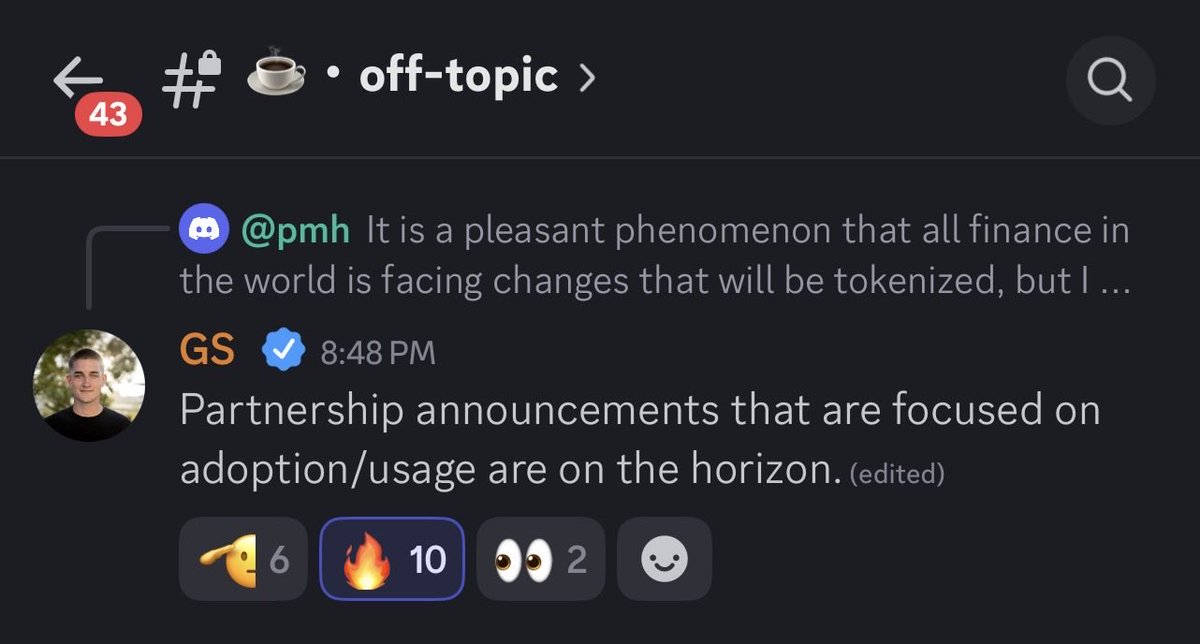
Well, according to Gabe in Discord, partnership announcement(s) focused on adoption and usage are on the horizon.
What exactly they entail? Nobody knows yet.
But if there’s one thing I’ve learned over the past year, it’s that Ty’s ambitions for Keeta aren’t small.
Are you excited?
Because I sure am.
@KeetaNetwork $KTA
Mastercard just announced stablecoin settlement. Big move. But most people don't understand where this sits in the payments stack or why it's still only half the answer.
Let me break down how a £3 coffee actually settles across three systems.
1/Today, when you tap your card, your bank authorises instantly but nothing actually settles. Mastercard batches everything end of day. Your coffee shop's bank receives funds 1 to 2 business days later.
Banks carry overnight risk on every single transaction. Weekends and holidays make it worse. This model is 30 years old and hasn't fundamentally changed.
2/What Mastercard just announced changes the interbank settlement layer, not the consumer experience.
Instead of batch clearing, your bank converts GBP to USDC on chain. USDC moves between banks near instantly via blockchain. The coffee shop's bank converts back to GBP.
Faster. Works 24/7. A genuine step forward.
3/But here's what nobody is talking about.
Both banks now have to trust Circle, the company behind USDC, to sit in the middle of every single transaction on the planet.
That's not decentralisation. That's replacing one intermediary with another. A faster one, yes. But still a third party with counterparty risk baked in.
4/This is where the architecture of tokenised fiat matters.
Instead of converting to a stablecoin issued by a third party, you tokenise the fiat itself. GBP stays GBP. It moves on chain represented as a token backed 1:1 by real reserves held in a regulated account.
No conversion. No Circle. No issuer risk.
5/For this to work at scale you need a network where:
Banks are verified participants with compliance baked in at the network layer, not bolted on afterwards.
Value moves anchor to anchor, each bank operating as a tokenised fiat anchor on the network.
Settlement is instant and final, not probabilistic, not batched, not dependent on a third party redeeming your stablecoin.
6/This is exactly the architecture Keeta Network is building.
Keeta isn't trying to replace Mastercard. It's building the settlement infrastructure that makes the next generation of payments actually work, for institutions, for cross border flows, and for any network that wants to settle value without a third party sitting in the middle.
7/Mastercard choosing stablecoins tells you the industry knows batch clearing is broken.
What it doesn't solve is the issuer dependency problem.
Tokenised fiat on a purpose built settlement network does.
The rails matter as much as the asset.
$KTA @KeetaNetwork@schenkty
Today, Mastercard is announcing plans to expand settlement capabilities to include stablecoin, intraday, holiday, and weekend options, giving partners more choice in how and when transactions are settled. That means we’re:
✅ Enabling greater choice to settle in fiat or regulated stablecoins
✅ Improving liquidity management for time sensitive, cross border flows
We’re supporting settlement with @Circle’s USDC, @Paxos-issued stablecoins including USDG,USDP and @PayPal’s PYUSD, @Ripple’s RLUSD and @SoFi’s SoFiUSD across a range of supported blockchain networks including Arbitrum, @Coinbase’s Base, @CantonNetwork’s Canton, Ethereum, @0xPolygon, @Solana, @Tempo and XRPL. ARQ Finance, CBW Bank, @crossriverbank, @Lead_Bank and @Nuvei will be among the first to support.
Circle, who issues USDC, holds the reserves backing every USDC in circulation in cash and short term US Treasury bills. As of recent reporting they hold tens of billions in reserves. They invest those reserves and keep the yield themselves. You as the holder of USDC get zero yield on that. Circle earns hundreds of millions annually just from the interest on money that technically belongs to the ecosystem.
Tether does the same with USDT but has historically held riskier assets in their reserve mix which is why they've faced more scrutiny over the years.
So the flow looks like this. Banks and institutions convert billions into stablecoins to use as settlement. That fiat sits in Circle's reserve account earning Treasury yield at around 4 to 5%. Circle keeps all of it. The institutions doing the settling get none of it and still pay FX conversion costs on both ends of the transaction.
At the scale Mastercard is talking about, trillions flowing through stablecoin settlement annually, the reserve yield being harvested by Circle becomes an enormous number. You're essentially gifting a private company billions in risk free yield in exchange for using their token as a settlement rail.
Tokenised fiat on Keeta doesn't work that way. The fiat backing stays with the anchor operator, which would be the bank itself. The bank keeps its own reserves, earns its own yield, and doesn't hand economic value to a third party issuer just to access settlement infrastructure.
That's not a small point. At institutional scale that's a fundamental question of who captures the economic value of the settlement layer. Right now with stablecoins the answer is Circle.
Currently they have "first mover advantage'. Here is a breakdown.
Liquidity. USDC already has billions in circulation with deep liquidity across dozens of chains and exchanges. If you need to move value today, the infrastructure exists. Keeta Network is still being built out. You can't use rails that aren't live yet.
Ecosystem. Every major exchange, wallet, DeFi protocol and payment processor already supports USDC. The network effects are enormous. Keeta starts from zero on that front.
Speed to market. Mastercard could announce stablecoin settlement because the asset already existed. They didn't need to build a new network from scratch. For institutions that need a solution now, stablecoins are available now.
Currency neutrality. USDC as a settlement layer works across currency pairs without needing a tokenised version of every fiat currency. Keeta needs anchor operators for each currency it supports. That takes time to build out.
The honest answer is that stablecoins win on availability and network effects today. Keeta's architecture is superior for what the industry actually needs long term, native compliance, no issuer risk, no double FX conversion, settlement finality baked into the network. But superior architecture doesn't automatically win if the incumbent solution is good enough and already everywhere.
That's why the Keeta build out and partner acquisition phase matters so much right now. The window exists because stablecoins haven't fully captured the institutional settlement layer yet. But it won't stay open indefinitely.
The GBP to USDC to GBP flow does look odd on the surface but it makes sense when you understand what USDC is actually doing here. It’s not acting as a currency, it’s acting as a settlement vehicle. Think of it like how international wire transfers often convert to USD in the middle even when sending euros to euros. The USD leg is just the common liquidity layer both sides agree on.
The FX conversion itself is handled by the banks on either end. Barclays converts GBP to USDC at the prevailing rate when it sends. HSBC converts USDC back to GBP when it receives. So there are actually two FX events happening, one on each side, with USDC as the bridge in the middle.
Is it odd? Yes, and that’s actually the point my thread is making. You’re converting perfectly good GBP into a dollar denominated stablecoin and then converting it back to GBP, paying FX spread twice, taking on stablecoin issuer risk in the middle, and ending up back where you started in terms of currency. It works, it’s faster than batch clearing, but it’s architecturally clunky.
Tokenised GBP moving anchor to anchor on Keeta skips both conversion events entirely. GBP goes in, GBP comes out, no dollar denominated intermediary in the middle, no double FX spread.
@kickbals@KeetaNetwork Im sure they are doing a number of things. Working through any bugs in KP, getting more announcements ready and continuing to work with partners to build and grow.
Seeing Ledger launch a new feature powered by Noah to connect traditional banking and stablecoins tells me where this industry is heading.
The focus is shifting from speculation to financial infrastructure.
Noah’s core offering is relatively simple:
Fiat (USD/EUR) to USDC.
That’s useful.
It creates a bridge between traditional banking and stablecoins.
But I think the bigger opportunity is what comes next.
The future isn’t just moving money into stablecoins.
The future is moving seamlessly between all forms of value.
Fiat.
Stablecoins.
Foreign currencies.
Treasury Bills.
Tokenized stocks.
Real-world assets.
That’s where Keeta stands apart.
Keeta isn’t building a one way on ramp into crypto.
It’s building infrastructure that allows value to move freely across an entire financial ecosystem.
Today users can already move between traditional banking rails and digital assets while accessing USD, EUR, GBP, AED, HKD, JPY, CAD, MXN, CNY, and additional currencies on the way.
Cross-border payments.
FX conversion.
Multi-currency accounts.
Banking and blockchain connected through a single network.
Treasury Bills are coming.
Tokenized stocks are coming.
Real world assets are coming.
That’s a much larger vision than simply converting dollars into a stablecoin.
The end game isn’t fiat versus crypto.
The end game is a world where moving between currencies, assets, and financial products becomes frictionless.
Looking across the industry, it feels like more and more companies are moving in that direction every day.
Keeta just happens to be building for that future already.
@KeetaNetwork $KTA @Ledger
Keeta Personal is starting to gain traction.
With a few more announcements on the horizon, I expect a fun ride this summer.
Saddle up.
@KeetaNetwork $KTA
Keeta Personal is live.
I have been watching this network for months. I have traced the on-chain activity, read the whitepaper, decoded the GitHub. And I am telling you now. This is the moment the thesis becomes real.
Most people manage money across systems that were never built to talk to each other. A bank on one side. A crypto wallet on the other. A separate platform for investments. Every move between them costs you a fee, a delay, or another app to log into.
Keeta Personal deletes that entire problem.
One account. Your bank, your crypto, your investments, in the same place.
Here is what that actually means.
You get a US routing number and a European IBAN built in. Real banking details. Your salary can land straight into it. You can hold it as USD or convert it to USDC on the spot. No second app. No off-ramp.
It plugs into every rail that matters. Wire. ACH. ACH Debit. SWIFT. SEPA. PIX. Faster Payments. Interac. Visa Direct. Outbound payments to over 160 countries. Sending money across the world starts to feel like sending it across the street.
Bills get paid directly from your balance. No cashing out first. Your tokenised fiat is fully backed and held at regulated partners, so rent, subscriptions, autopay all come straight off your account.
Underneath it is a full crypto wallet. Hold, swap and send across Keeta, Ethereum and Base. Your everyday cash and your digital assets finally sitting in the same room.
And this is just what is live today.
What is coming. Physical and virtual spending cards. Native iOS and Android apps. Stock and T-bill investing from the same account. Savings and shared accounts. Instant funding and withdrawals via debit card. Real-time tokenised fiat transfers between Keeta users. Tools to create and manage your own tokens.
Then there is the part most people are sleeping on. Keeta Personal runs on open infrastructure. The same rails, the same multi-currency accounts, the same real-time settlement powering the app are available to builders through one SDK. Every product built on top makes your account reach further without you doing anything.
This is not a wallet. This is not another neobank. It is the moment banking and crypto stop being two separate worlds.
The product is live. The receipts are on-chain. Go and verify it yourself.
https://t.co/ju5Z8gHnbg
$KTA @schenkty@gabe_schenk@Syno_0x@xescure@Brown_Thunder76@KeetaNetwork