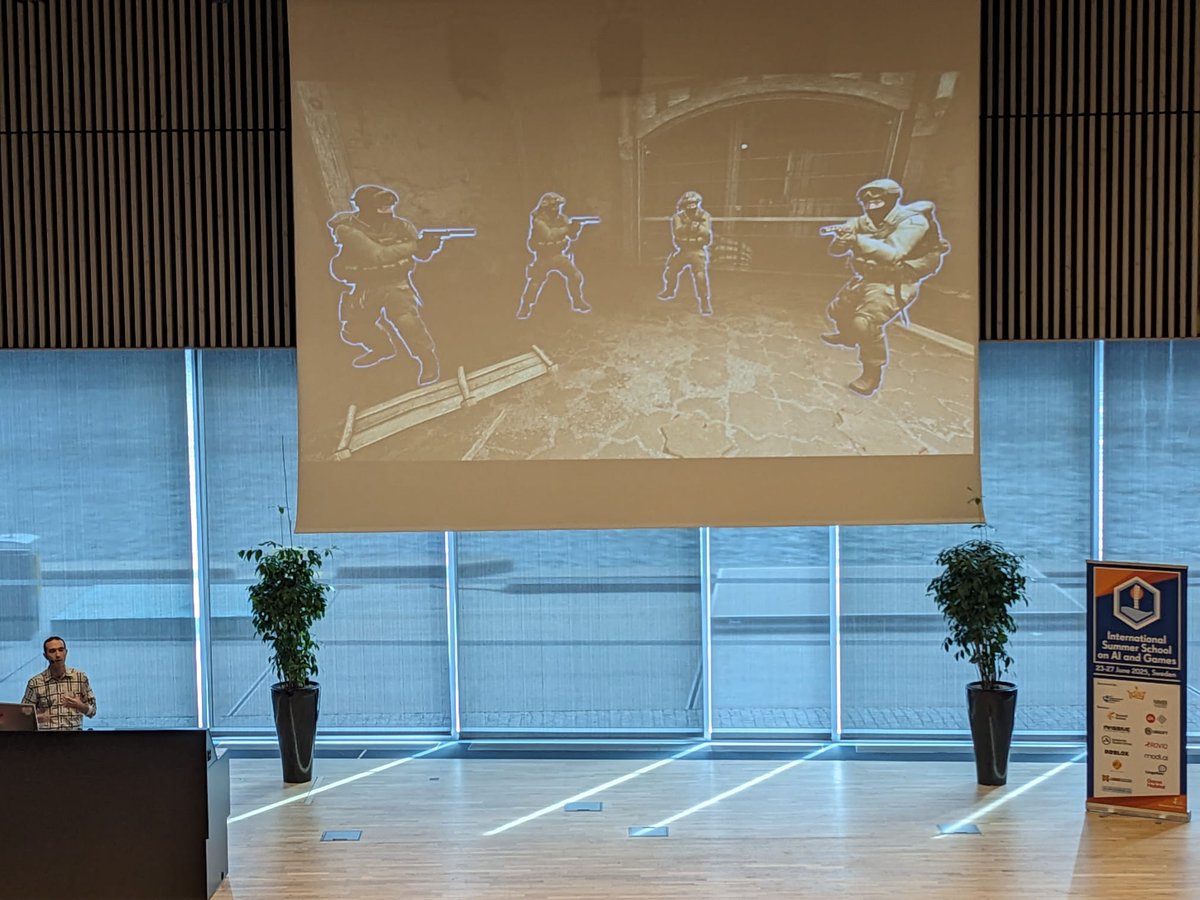
Want to learn more about Counter-Strike bots with human-like movement powered by a transformer running on one CPU core? Check out @AIandGames 's new episode on MLMove (my dissertation): https://t.co/DX2XUmWWdm . The interview for the episode was a lot of fun!
@zhongwen2009@_akhaliq@alexUnder_sky Got it, I missed this part. Interesting that a small model is able to handle move_to so well. I guess hard stuff (like waiting for teammates for a period of time) is in other parts of the tree.
@alexUnder_sky@_akhaliq They do use domain-specific models as well! See my new question 3 and section 3.3 of their paper. Doesn't fully address your question, just relevant info.
@_akhaliq 3. How do you select training data for training your neural network-based task nodes? Does the LLM select it? Or, have you previously trained these nodes and the LLM knows it can use them? (thanks @alexUnder_sky for inspiration for question)
@_akhaliq 2.Will you open-source your bot interface? When I did my PhD work on human-like bots in CSGO(https://t.co/KqfgAEpOFX), the bot interface took a long time(https://t.co/LZd1Y5f9Tr). Would be great to have a similar one for Yuan Meng Star!
Thank you for your time and the cool paper!
Learning to Move Like Professional Counter-Strike Players
discuss: https://t.co/5uCK3a2wVW
David Durst (the first author) plays with and against MLMove bots. The video is from David's perspective. The MLMove bots synchronize their attack so two of them fight David at the same time.
Do you work on AI/CV for videogames? The Second Workshop on Computer Vision for Videogames (CV2), held June 11th/12th 2025 in conjunction with CVPR 2025, is the perfect venue to showcase your research! Check out our CfP and submit your work at https://t.co/YYr83TR4A9!
@alexUnder_sky@BertramTimo@Tea_Pearce Join the CSKnow/MLMove discord (the discord I run for my PhD research): https://t.co/IRQpv1hohO . Also, my homepage has my email: https://t.co/kE2FQTqDjk
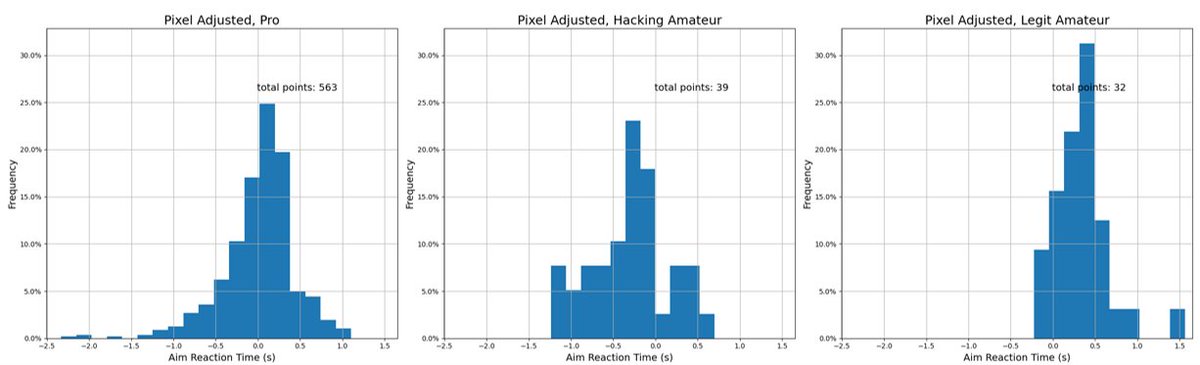
@alexUnder_sky@BertramTimo@Tea_Pearce For anti-cheat, the problem is that the skilled player and cheating player behavior distributions look very similar. For example, pros frequently pre-aim at an enemy by 100ms, similar to how cheating amateurs behave (note: data is rough and prepublication https://t.co/UVZzEIFs5a)
@Tea_Pearce@alexUnder_sky One alternative to detecting cheaters is using honeypot bots that cheaters must detect using models of human-like behavior (https://t.co/CTiUJxuN07). Ofc, then you need to generate human-like honeypot bots, but that's a separate problem.
@EloiAlonso1@Google Very cool work! Why do you think there are so few teammates/enemies in the map? @Tea_Pearce collected a DM dataset, so there should be a lot of enemies/teammates, right?
@paul_cal@ChenTessler@_akhaliq Thank you! I totally agree, there's a lot more work to be done on human-like agents for games, particularly if we had access to a lot more data over more game types/maps
@paul_cal@maxwellazoury@_akhaliq Here's our GDC talk on the hallucinations: https://t.co/Xkp2LTY4vf. https://t.co/gklgzBb4Nw demonstrated hallucinations in cs 1.6, but failed to address the challenge of where to put them so that (a) only cheaters can see them and (b) they seem human to cheaters
@ChenTessler@paul_cal@_akhaliq Also, here's some feedback from people who played with an earlier version of RuleMove (the hand-crafted baseline in the paper) https://t.co/eNpNPhM3am
@Max_Lindblad@_akhaliq I recorded without crosshair to focus on the bots' movement (this is from my perspective in a game where I play with and against my bots). The paper website has additional videos with lines showing where the bots are aiming (https://t.co/aJ4t1EuK2N)