@jessesingal Belgian reader here. It was not a red. However, nobody gets to have it overturned because their president is mates with Infantino. Blatant corruption, Belgium should refuse to play with Balogun on the pitch - or this'll only be the start of Infantino & mates stacking the deck.
Looking at the detailed Chinese trade data for May - some stunning numbers
Compared to May 2025, China's trade surplus with Germany rose by 31.6%...
With the EU as a whole, the surplus is up 15% year on year
China's exports to Austria up 50.8%, Portugal up 45.6%, Poland up 24%
In which case I feel more confident about this narrative: there is no relative decline until 2020 and thereafter it’s not ICT driven capital deepening but big fiscal.
Europe is stagnating and needs reforms—but not Americanisation.
14/
1/6
Financial Times: "A company-level OECD analysis of government subsidies across 15 key industrial sectors found that nearly 60 per cent of Chinese firms’ global market share gains since 2005 could be attributed to subsidies."
https://t.co/o2mcZeaagi
On the Krugman/DeLong/Aghion/Garicano/Bergeaud/et al debate on the central issue of pty US/EU.
Let me admit my total confusion (am I the only one?). There seems to be at least three relevant measurement dimensions: PPP prices versus national prices. Quality adjustments for each. Current versus constant prices. The discussions seem to mix them in various ways. And different concepts: productivity growth, standard of living, consumer surplus.
My plan is to sit down and understand it all. But I am not there.
@GillesStru@KevinSpiritus Zonder concrete maatregelen zal budget gewoon ontsporen. Ook naar overconsumptie wijzen is helaas niet genoeg. Je zal concrete dingen moeten doen: ingrijpen in de vrijheid van artsen & patiënten, prijzen verhogen of honoraria verlagen.
@GillesStru@KevinSpiritus Voorstellen te besparen op gezondheidszorg is zeker legitiem hoor. Maar allesbehalve concreet. 'Kader' is gewoon besparingsdoelstelling, je bepaalt er niet mee hoeveel budget stijgt. 1/2
@GillesStru@KevinSpiritus Exact wat Kevin benoemt: geen ernstig voorstel, maar equivalent van zeggen: 'besparen op gezondheidszorg'. Groeinorm is immers slechts besparingssleutel. Bij ongewijzigd beleid stijgen kosten veel sterker dan groeinorm, o.a. door vergrijzing. Welke ziekenhuizen ga je sluiten?
@schieritz When you read this thread as a non-German: rather shocking that there is not one mention of the fact that the technologically dominant economy depends on the planned build-out of specific sectors and supply chains. One doesn't have to copy, but at least acknowledge the facts.
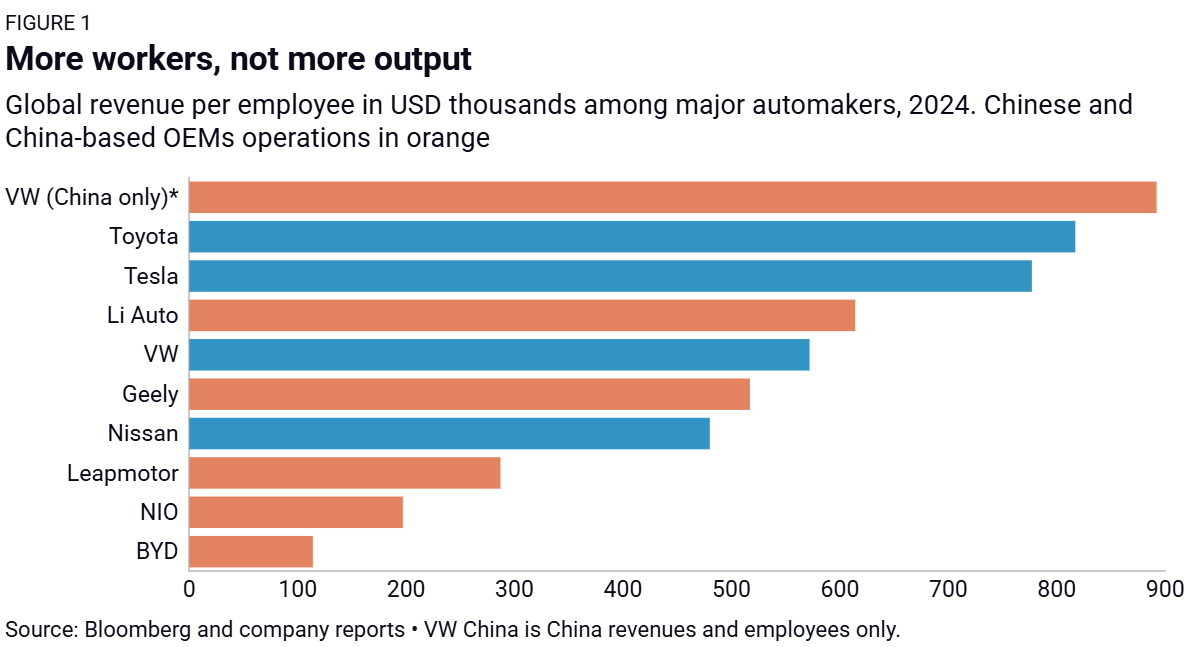
"A common assumption is that Chinese 🇨🇳 automakers are more competitive because they are more productive. Company data does not support this view. On standard metrics such as revenue per employee, Chinese OEMs significantly underperform Western peers. Tesla employees generate roughly six to seven times more revenue than BYD’s, and Volkswagen outperforms China’s largest OEMs by a wide margin. Similar gaps are visible at SAIC, Geely, and NIO (Figure 1). This is despite high levels of automation in Chinese plants, which often exceed those of foreign joint ventures in China."
https://t.co/Qa013dnYkP
Nice chart - unsurprising conclusion.
Germany and the EU are ploughing a lot of political capital into trade deals, and too little into making the most of domestic demand.
Please. before answering, read the proposal. 😀 The rate on eurobonds is likely to be lower than the bund rate. And, while the average rate will be lower for all countries, the marginal rate on national debt may indeed be a bit higher, giving incentives for governments to actually be more responsible.
@natanhertogen@bouwspiegel@koja1978@NeirinckMike Wil me hier niet aan eender welke kant scharen (m.i. hebben we meer van alles nodig), maar laten we a.u.b. niet kamperen op de absurde stelling dat meer market-rate aanbod slecht is voor betaalbaarheid https://t.co/5qFONMqPMT
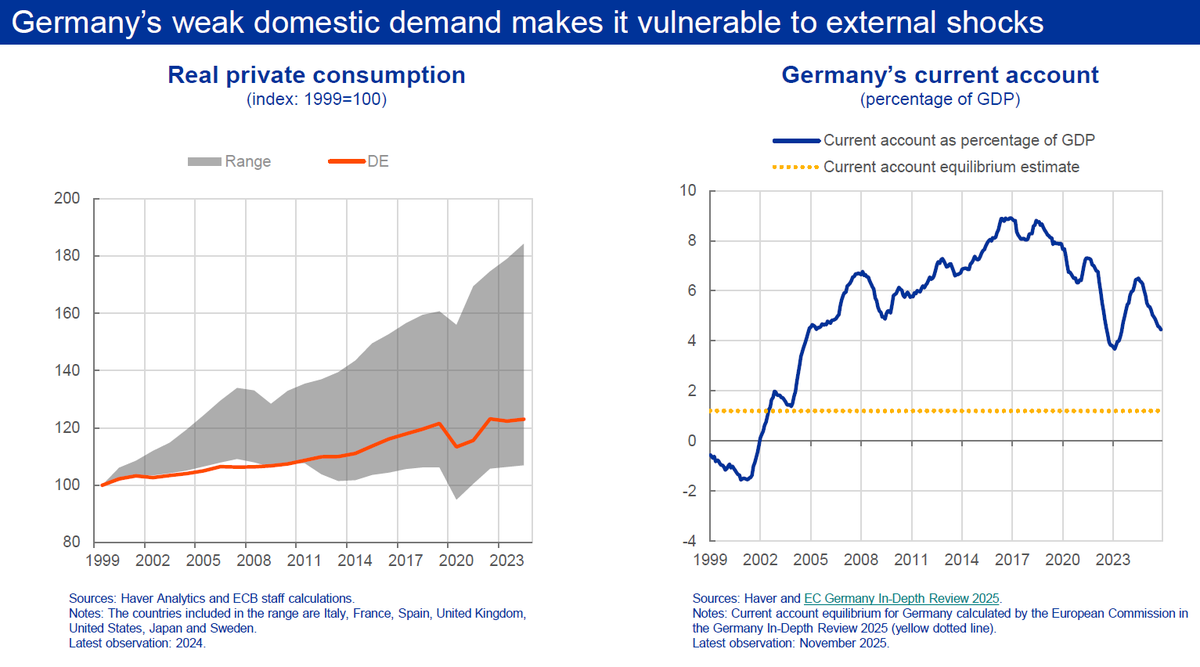
The key shortfall is a sustained weakness in domestic demand. Since 1999 real private consumption in Germany has grown by less than 1% per year. Domestic investment remained subdued as well. This is mirrored in the sharp rise in Germany’s current account surplus. 15/20
This is a frequent pattern with German politicians when they don't just disagree with a policy initiative (legitimately, as a politician should) but they feel like they have to declare it outside of the realm of the conceivable, the democratic and the constitutional.