If you're at the Pacific, please join me, Eric Schwitzgebel, and Brian Weatherson for a roundtable on the future of publishing in philosophy Thu 6pm (union square rm, 2nd floor). We will talk about the role of AI in publishing, the sustainability of open access, and more.
Today the PhilPapers team is launching Beat AI: A contest using philosophical concepts. Try to outwit AI models using your mastery of philosophical concepts. In the process, you will help us develop better AI models for search. #beatai https://t.co/73y0a7JE0k
Grasping ideas is having them in consciousness. We're not "just" large language models. I defend this view in "A phenomenal theory of grasping and understanding", forthcoming in Understanding and Conscious Experience, https://t.co/O2jjKK9hjN
Just released an improved version of the PhilPeople Widget. No more interference with third-party javascript frameworks (e.g. React). Use it to embed your PhilPeople-listed publications on a personal website. Demo: https://t.co/DNh8amXbd1 (you can style to your taste using CSS)
I hear that CIRA (@ciranews) is blocking https://t.co/OiZ7SPJhHF on its security product intended to protect users from malware sites. Why is that? PhilPapers isn't malware! It's a database of philosophy articles! Please stop!
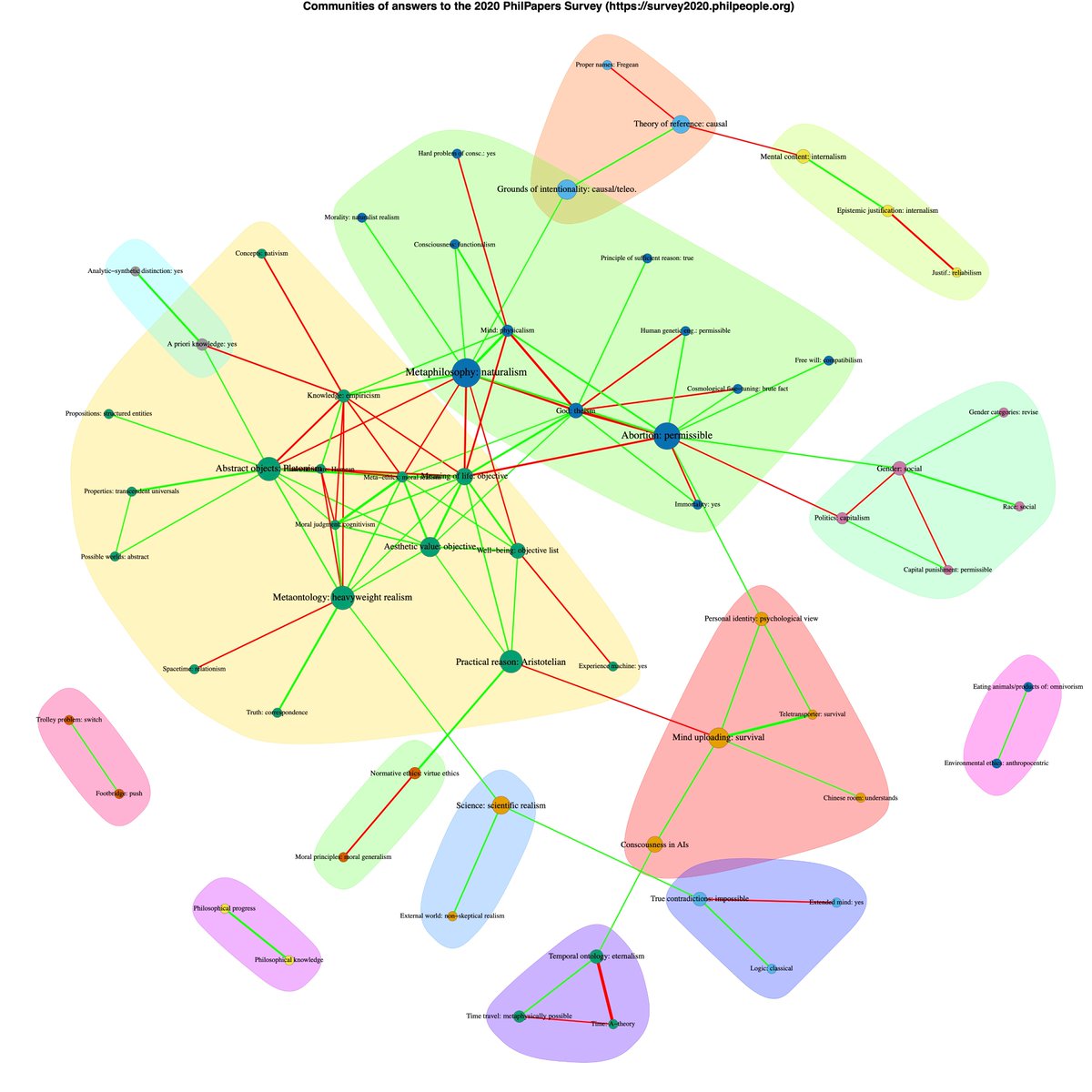
A comprehensive summary of philosophers' views in one bitmap image! It's noisy, and that's what I find interesting about it! It gives us a subjective sense of how diverse philosophers' views are. Follow link for full-size PDF and explanation. https://t.co/0EzDCVdlhR
Made by converting the answers of 1728 respondents to the 2020 PhilPapers Survey into 102 numeric values, color-coding them, and clustering the respondents by Euclidean distance. The selected respondents are those with > 25 non-"other" answers.
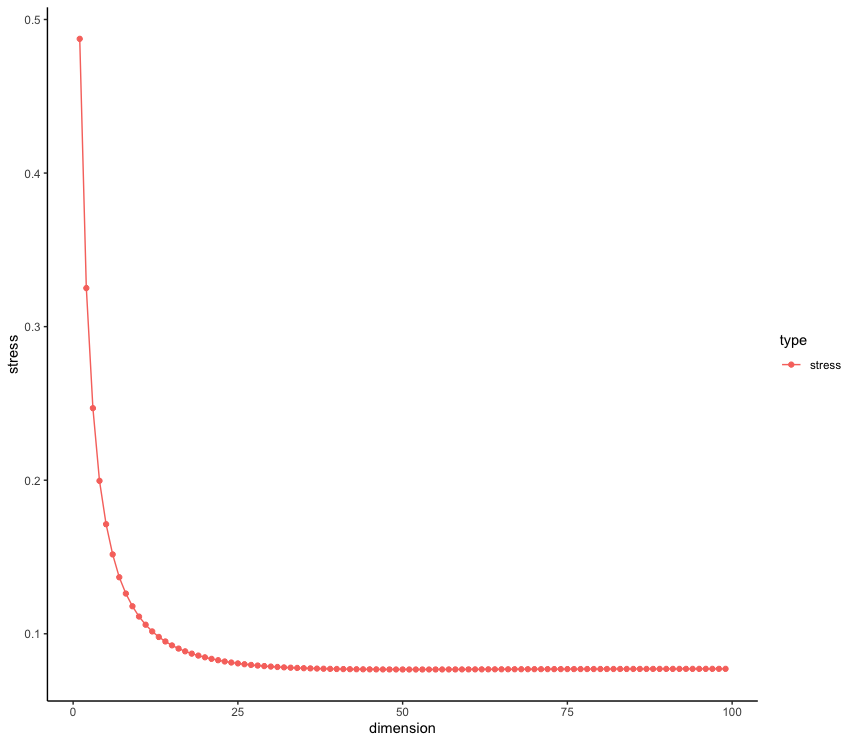
@ErgoEcho It turns out that, on this way of thinking about dimensionality, philosopher-space is about 25-dimensional (as far as our survey questions are concerned). Here is a graph of the stress for each number of dimensions with MDS.
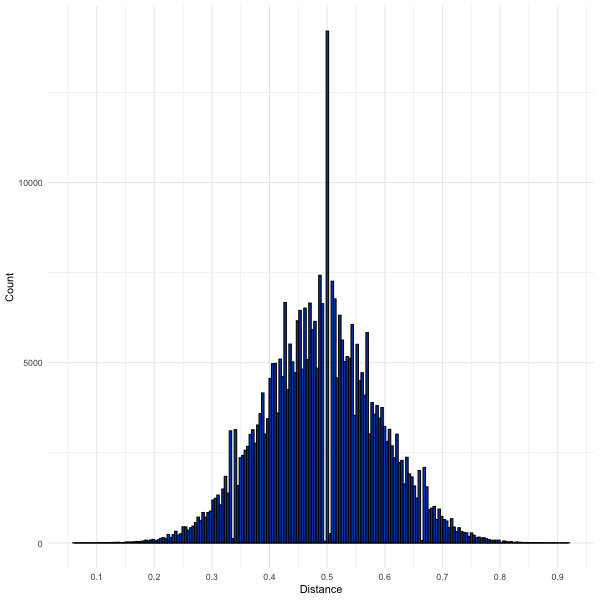
Here's something for data-oriented philosophers to ponder. This is a histogram of distances (calculated as proportion of agreeing answers) between all pairs of respondents to the 2020 PhilPapers survey (except respondents with very large numbers of skip/"other" answers).
@ErgoEcho True, that would be a better way of treating the dimensionality question. I’ll follow up with this information when I get to playing around with mds algorithms, hopefully tomorrow.
@NeilLevy10 @Utiliwood True, a high average disagreement between respondents was part of the design of the survey (but it's nice to confirm we achieved this aim). What is a little surprising here is the lack of clumping. I have other (better) visualizations of clustering I'm going to post shortly.
@ErgoEcho Good question! It's at least 100 from what we can see here since you can know a philosopher's answer to 99 questions and not be able to reliably guess their answer to the 100th. Relatedly, our paper talks about reducing the dimensionality of these answers. https://t.co/yZYxGvjGzT
We can also see that philosophers' views are quite varied. If there were two big "schools of thought" that dictated views across the board, the histogram would show a tall bar at 0 and another at the distance between the two schools. Turns out every philosopher is unique!
The main take away is if you pick a random philosopher, you're pretty likely to disagree with them on roughly half of the 100 questions of the survey. You're unlikely to agree or disagree on more than 75%.