New deadline for the call for papers for a special issue on Infant Consciousness that I am co-editing with/ Sascha Fink @joel_frohlich to be published in the journal Philosophy and the Mind Sciences. Submissions are due by November 30th 2025 ≠PhiMiSci
https://t.co/YxkR5rXW1w
"a survey of views about infant consciousness": by @cpassosf and me, just published in @NeuroConsc. we surveyed participants (phil, neuro, psych, etc) at ASSC 28 and the NYU conference on infant consciousness.
notable results:
1. a majority (75%) favor the view that newborn infants are conscious.
2. a plurality (44%) favor late pre-natal (after 24 weeks gestation) emergence of consciousness
3. a plurality (49%) favor late post-natal emergence (after six months old) of self-consciousness.
4. majorities (87%) favor newborns having sensory and affective consciousness, but not (~30%) cognitive or agentive consciousness.
plus questions on 5. the neural basis of infant consciousness, 6. methods, 7. animals and AI systems, 8. theories of consciousness.
https://t.co/PVbsSyOQX0
Longview Philanthropy is accepting digital minds proposals again! And @nonhumanminds is thrilled to host the next cohort of fellows at our spring 2027 summit, with all expenses paid.
I got tenure at NYU! A few brief reflections about my somewhat non-traditional path, along with a few expressions of gratitude.
I spent the first twelve years after my PhD in two postdocs and two non-tenure-track teaching and admin jobs. I finally landed my first tenure-track job — my third job at NYU Environmental Studies — only two years ago. So, for about a decade, I was at a disadvantage relative to some tenure-stream faculty — lower salaries, fewer benefits, no sabbaticals (this has still never happened), and more teaching and admin responsibilities.
But this path also had real upsides. It delayed the tenure clock, which gave me more freedom to explore different topics and fields, write and speak in a wider variety of venues, and combine my academic work with work that turned out to be equally important for me — like joining boards of animal protection NGOs, which gave me extremely valuable experience and connections for my current work on animal and AI welfare.
Had I received a tenure-track offer from a top research university right out of my PhD, I likely would have taken it, and my career likely would have followed a more traditional trajectory. The path I ended up on is not one I could have planned, but I feel very grateful to have taken it. It allowed me to discover what I most want to be doing, develop the ability to do it, and eventually be hired to do it. It also helps that by the time I finally got my first tenure-track job, I was far enough along that tenure was less of an open question. So I never quite experienced the dagger of the tenure clock hanging over my head, though I did spend many years struggling to get my foot in the door.
Tenure is always the culmination of a lot of hard work — as well as a lot of luck and support. There are too many people to thank individually, but I do want to generally thank my philosophy professors at TCU and NYU, my former colleagues at the NIH and UNC, my current colleagues at NYU (especially at CEAP and CMEP), our funders and collaborators, and everyone else who supported me along the way. Special thanks to my mentor Dale Jamieson, who hired me into my first postdoc and is likely the person most responsible for my trajectory over the past decade. Extremely grateful to all of you, along with many others, for making it possible for me to do this work :)
“We want the fundamental laws of consciousness —
something simple enough to fit on a T-shirt.”
David Chalmers (@davidchalmers42) on why consciousness is still an open scientific frontier.
https://t.co/5oDYsCLA4y
Tune in now to Futurology.
Read this to see why we don’t think P and A are two *types* of C, but two conditions for C. And why we think this can truly advance the field and solve controversies. Open access until Feb 5th:
https://t.co/x4wO1ZxnsU
With the great @NathanFaivre@schurgerlab and Michael Pitts
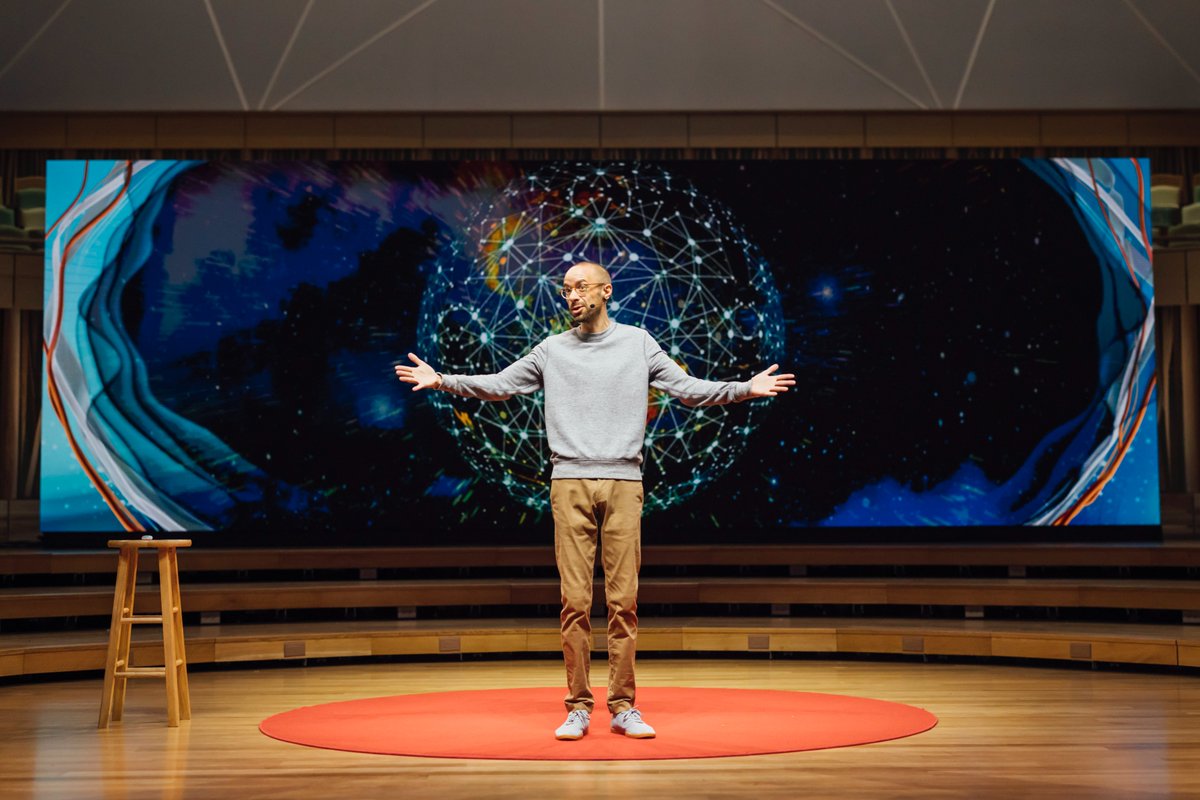
My TED2025 talk "Inside the mind of a newborn baby" is live! I discuss new evidence of consciousness in newborns, and why this matters for medicine, ethics, and the science of consciousness. Hope you enjoy! @TEDTalks
https://t.co/sFwDNwcXkN
@StuartHameroff Hi Stuart! I don't know this area well, but I'll link to a couple of relevant recent articles in the next message. @AnnaCiaunica might know better than me, as she has been working on fetal embodiment.
When I first came across the work of Claudia Passos Ferreira, I was pregnant with my second child. Her research made pregnancy feel even more magical. Her talk from #TED2025 is now live:
https://t.co/sUB9cCZiQv, @TEDTalks, #TED
🚨 Join us for GEMA’s 2nd Keynote Lecture!
We’re honored to host Prof. Claudia Passos Ferreira (NYU), known for her work on infant minds & bioethics.
📅Oct 16, 2025 1 P. M. (Brasília Time, GMT-3) 🌐 Online
🔗 Register: https://t.co/ToFlwDFZRy
1/ My @TEDx talk “What Do We Owe AI?” is now live! AI is advancing fast, and our relationships with AI systems are changing too. Some think AI could soon be sentient and deserve care. Are they right? What if the only honest answer is: maybe? 🧵+🔗👇
Excited to see this paper published on training children to serve as IRB consultants in pediatric research review co-authored with Samuel Asiedu Owusu @NYU_Bioethics@UCCGH_Official
Licensing competent children to assist institutional review boards https://t.co/iQfB1ooy9o