I’m not intimidated by this in the slightest. But important to record this so we can see the attitudes and behaviours that are being normalised, unleashed and frankly encouraged at the top of the DoD over the past 18 months.
Someone please explain to me the scenario where we need light attack drones with a range of a few hundred km at most in Washington DC. And even if so, why THE WHITE HOUSE ROOF is the best basing location vs say at Bolling or Andrews AFB?
Imagine you spent 40 years doing the boring, responsible thing.
You opened a 401k at 23. You contributed every paycheck. You ignored the noise. You bought the index because Bogle told you to, because Buffett told you to, because every honest piece of financial advice for 30 years told you the index was the safest, most diversified, most rules-based way to own America.
The whole point was the rules.
The rules said: a company must trade for 12 months before joining the S&P 500. The rules said: it must show four consecutive quarters of GAAP profitability. The rules existed because in 1999 the index quietly bought a lot of stocks at the top, and pensioners paid the bill.
After the dot-com crash, S&P tightened the rules. Nasdaq tightened the rules. FTSE Russell tightened the rules.
For 23 years, those rules held.
Then SpaceX filed for IPO.
And the rules changed.
The S&P 500 waived the profitability requirement. Nasdaq cut its trading-history window from 90 days to 15. FTSE Russell cut its to 5.
Bloomberg Intelligence estimates the major index funds will absorb between 19% and 24% of SpaceX's float within six months. That's over $30 trillion of passive 401k and retirement money, mechanically buying a single newly public company at IPO valuations, because the rules said they had to.
Except the rules used to say they didn't.
Here's the thought exercise:
If you spend 40 years building a system designed to protect ordinary savers from buying overpriced stocks, and then you waive the protections the moment a sufficiently large stock asks you to, what was the system actually protecting?
Most of investing is about understanding what's a rule and what's a guideline.
A rule binds the rule-maker.
A guideline binds the saver.
You're allowed to find out which is which only after the fact.
It is hard to downplay the wealth transfer and liquidity event upcoming with the SpaceX IPO.
The rules were changed specifically for SpaceX to be included in the major indices before profitability and before extended public trading.
That means nearly half of all early SpaceX shares will be required to be bought by passive index funds (think QQQ, VOO, SPY, VTI).
The holders of these funds (401Ks, ETF holders, savers) will be auto-buying the SpaceX float, teeing up exit liquidity for Silicon Valley and Elon-adjacent insiders who own the majority of SpaceX shares and will be able to sell after 3 months.
This will be a major, major event for widening the already extreme wealth gap between insiders/elites and the rest of the world.
@AriDavidPaul When benchmark rules are adjusted around megacap listings, passive investors are no longer just tracking the market.
They are helping validate the price that private markets already set.
https://t.co/XQTWbJpxI2
@RadioFreeTom As Clausewitz always said, the fog of war begins with blowing smoke in your own eyes. Or Sun Tzu, "how shall your enemy know you if you are unknowable even to yourself?"
@RadioFreeTom Typical, you (retired) war college professors do not understand the value of surprise and deception in the conduct of military operations.
Rule changes for the SpaceX $SPCX IPO:
Index providers waived the profitability requirement and cut the seasoning window from 90 days to 5.
This forces over $30 trillion in passive 401k and retirement money to buy SpaceX at IPO valuations.
Bloomberg Intelligence estimates S&P 500 funds must absorb 19% of SpaceX's float within 6 months.
Russell 1000 and Nasdaq 100 funds will absorb 24%.
The rules built to protect passive investors:
1. S&P 500 has required 12 months of trading and 4 quarters of GAAP profitability since 2002. Both waived.
2. Nasdaq cut its inclusion window from 90 trading days to 15.
3. FTSE Russell cut its to 5.
All three benchmarks are now structured to buy SpaceX at IPO pricing.
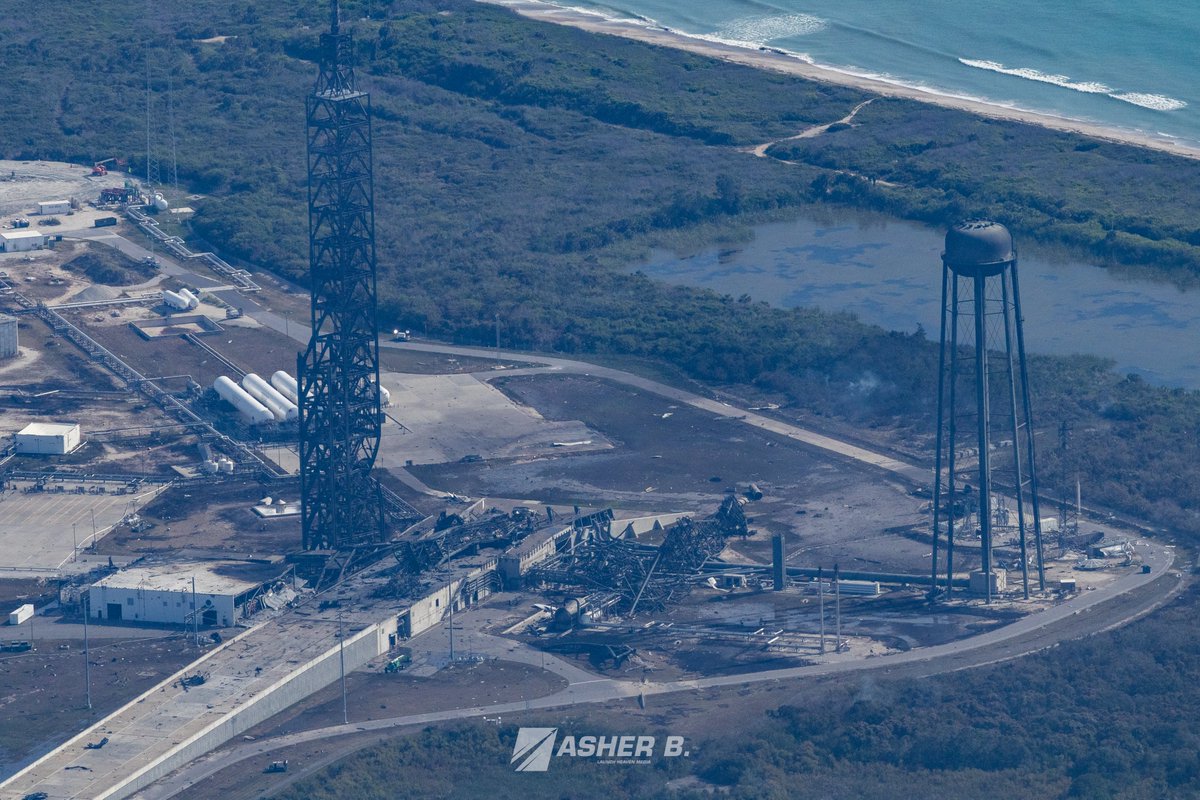
First look at LC-36 from the air this morning after the explosion of New Glenn last night during a failed hotfire test.
Visible is the wreckage from the destroyed TE as well as the fallen lightning tower. More to come soon.
📸 - @LaunchHeavenX
@DrChrisCombs I wonder how far away from the pad there will be significant pieces of debris?
And can't help but think of SpaceX which packs infrastructure considerably closer to an even bigger methalox rocket
@ESGhound You will be unsurprised that the reply guts in a Berger thread are mostly saying this looked a lot better than they would have guessed and now safety zones probably can be *reduced*
Congratulations to SSP’s PhD graduates! We are honored to celebrate the hard-earned achievements of doctors Nicholas Blanchette, Wenyan Deng, Suzanne Freeman, Eleanor Freund, Eyal Hanfling, Wright Smith, Raymond Wang, and Diana Zhu. We look forward to your ongoing contributions to security studies and political science!
And congratulations to Raymond Wang for receiving the Lucien Pye Award for the Best Doctoral Thesis!
@eyalhanfling@soraywang@DTingxuan@WrightLSmith@SuzBFreeman