@illscience Cool! I think a few folks have pointed out that the idea is not new but there are many unexplored details and directions for touch/gesture-controlled text UIs! We also worked on this (incl. a design space in the paper): https://t.co/fIYG621QY0
📱How might mobile text UIs better integrate LLMs? We designed “spread-to-generate”: Spreading fingers on a draft, bubbles show expected length, then get filled with generated words. This achieves continuous control UX despite LLM token streaming latency. #CHI2025 preprint👇
📱How might mobile text UIs better integrate LLMs? We designed “spread-to-generate”: Spreading fingers on a draft, bubbles show expected length, then get filled with generated words. This achieves continuous control UX despite LLM token streaming latency. #CHI2025 preprint👇
A key challenge with UIs using rapid text iteration via AI is how users "catch up" on changes without requiring word-by-word reading. We worked on sth similar for touch gesture-controlled generation: https://t.co/fIYG621QY0
one of the most brilliant takes i've seen as of late on HCI in the era of LLMs
Attention steering by Sun Chuanqi. Actually operating an LLM's attention and token generation. the concept, UX and sound design are just amazing. There are still so many unexplored patterns. this one's particularly inspiring
https://t.co/46s8HCZQh9
📱How might mobile text UIs better integrate LLMs? We designed “spread-to-generate”: Spreading fingers on a draft, bubbles show expected length, then get filled with generated words. This achieves continuous control UX despite LLM token streaming latency. #CHI2025 preprint👇
@philippepage A key challenge with UIs using rapid text iteration via AI is how users "catch up" on changes without requiring word-by-word reading. We worked on sth similar for touch-gesture-controlled generation: https://t.co/eeuHxtPhiK
@NilsEdison Cool! You use the canvas for externalising structure, if I understand it correctly. You could also extend it to externalising action potentials, i.e. actionable UI elements. We've explored this recently here: https://t.co/CBnuzCTzcq
Love to see canvas concepts like this! These UIs are very flexible. We can lean even more into user-defined UIs, e.g. let users turn the sticky notes into actionable UI elements (e.g. a button delegating the noted todo to AI) - as in our recent work: https://t.co/CBnuzCTzcq
@narphorium@NilsEdison Thanks for linking me here - cool tool @NilsEdison! I also shared some reflections from my own writing on a canvas here: https://t.co/NHDSEIxOhm
Introducing OpenCHIReviews, a crowdsourced database of reviews for ACM HCI conferences, chiefly CHI. Submit anonymized reviews and paper decisions, and see what other HCI papers' reviews look like, in the spirit of open science:
It's the season of #CHI writing again, so here's some writing support for #CHI2027 from my Medium blog with three articles:
1. My annual reminder that you should really discuss things in your discussion section:
https://t.co/uNxKLInQJ8
Have you also experienced a “paradox of the perfect start” in a university design project? Students skipping to final-looking apps with AI but struggling to articulate their own ideas, and accidentally excluding team members. Thoughts & ideas here: https://t.co/ZPmRs39fcN
Fun fact for #CHI2026 folks: The generated "Session Summary Podcasts" in the ACM DL "cite" the session's papers and are picked up by Google Scholar, so all papers get +1 citation automatically now!
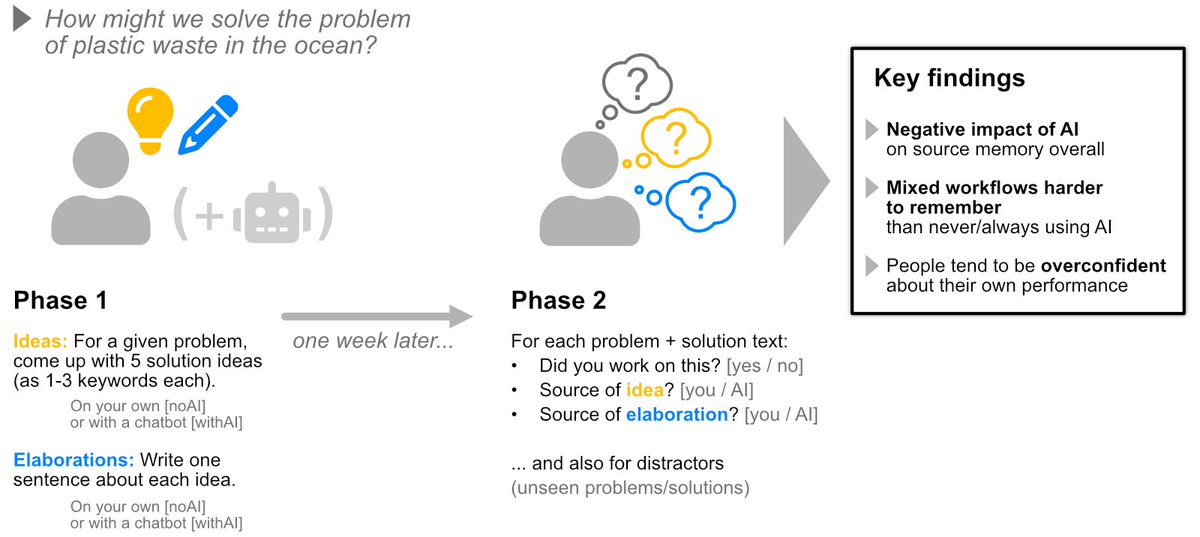
The "memory gap" was most acute in mixed workflows:
1️⃣ If you elaborated on an AI idea, there's a 37.7% chance you remember the idea came from AI.
2️⃣ If you used AI to elaborate on your idea, there's a 64% chance you remember the idea as yours.
Preprint: https://t.co/h1ruwxLXZx
Can you remember which ideas & sentences were your own and which were generated with AI?
In a controlled study (n=184), we found that AI use significantly reduces the accuracy of content attribution after one week.
#CHI2026 preprint & numbers in 🧵
@welsch_robin@danielaDSF17