I wrote a new post about the privacy risks of on-phone agents like Apple’s new Siri, and how private inference isn’t any sort of silver bullet. https://t.co/91ydRo9HRn
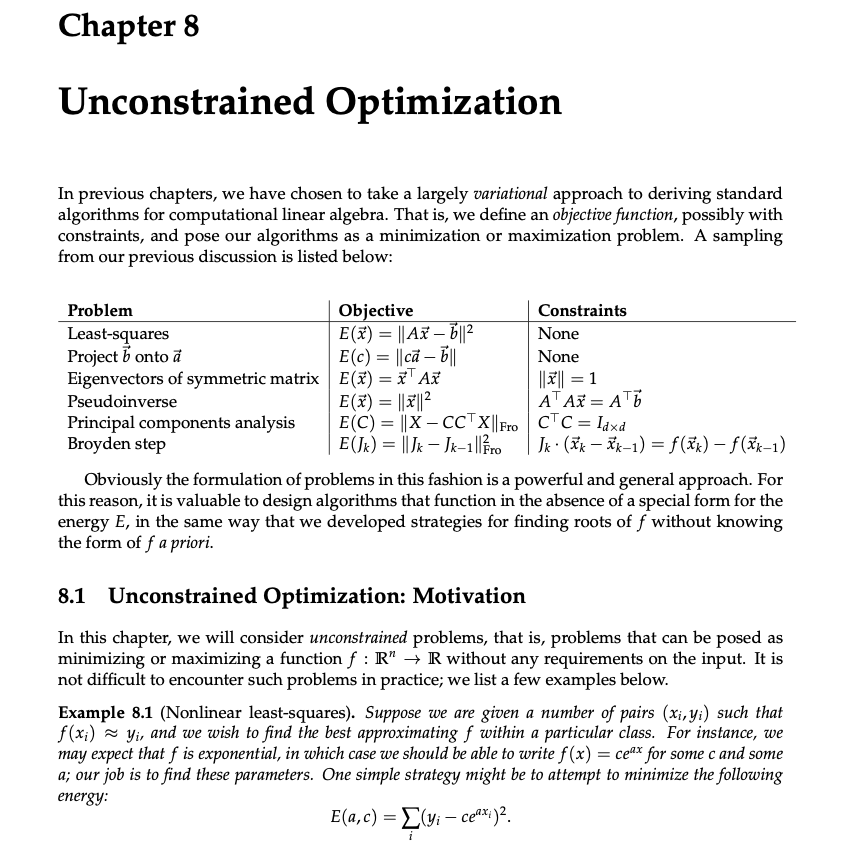
"Mathematical Methods for Computer Vision, Robotics, and Graphics" is a free Stanford resource with more than 200 pages of applied mathematics for modern technologies.
The notes cover linear algebra, multivariable calculus, optimisation, differential equations, numerical methods, Fourier analysis, and geometry, always with a strong connection to real computational problems.
What makes this material particularly interesting is that it bridges the gap between abstract mathematics and the technologies behind modern robotics, computer vision, computer graphics, and AI systems.
It is a resource I strongly recommend to both readers who already have a solid mathematical foundation and those who want to deepen their understanding through a rigorous yet accessible treatment of the subject.
https://t.co/yEEPWDqiH0
"Algebrica" is a free and open mathematical knowledge base. All entries are progressively being released in Markdown format on GitHub for anyone who wants to study mathematics freely and openly.
Alongside the texts, the individual SVG illustrations are also made freely available. They are minimal, mathematically accurate, and designed to be easily reusable in notes, lecture material, or educational resources. Since they are vector-based and code-driven, they can also be modified or improved simply by editing the source.
Another step toward making the knowledge base more open, transparent, and genuinely useful over time.
🚨BREAKING: Anthropic just published a study mapping exactly which jobs its own AI is replacing right now.
The workers most at risk are not who anyone expected. They are older. They are more educated. They earn 47% more than average. And they are nearly four times more likely to hold a graduate degree than the workers AI is not touching.
The argument is straightforward. Anthropic built a new metric called "observed exposure." Not what AI could theoretically do. What it is actually doing right now in professional settings, measured against millions of real Claude conversations from enterprise users.
For computer and math workers, AI is theoretically capable of handling 94% of their tasks. It is currently handling 33% of them. For office and administrative roles, theoretical capability is 90%. Current observed usage is 40%. The gap between what AI can do and what it is already doing is enormous. The researchers are explicit about what comes next. As capabilities improve and adoption deepens, the red area grows to fill the blue.
The demographic finding is what makes the paper uncomfortable. The most AI-exposed workers earn 47% more on average than the least exposed group. They are more likely to be female. They are more likely to be college educated. This is not a story about warehouse workers or truck drivers. It is a story about lawyers, financial analysts, market researchers, and software developers. The exact group whose education was supposed to insulate them.
Computer programmers showed the highest observed AI exposure at 74.5%. Customer service representatives at 70.1%. Data entry keyers at 67.1%. Medical record specialists at 66.7%. Market research analysts and marketing specialists at 64.8%. These are not predictions. These are measurements of work that is already happening on AI platforms right now.
Then there is the pipeline finding nobody is talking about loudly enough.
Anthropic's researchers found a 14% decline in the job-finding rate for workers aged 22 to 25 in highly exposed occupations since ChatGPT launched. No comparable effect for workers over 25. Entry-level roles were never just jobs. They were the training ground where junior analysts became senior analysts, where junior lawyers learned how arguments hold together. If that layer disappears, nobody has answered the question of where the next generation of senior professionals comes from.
The detail buried in the paper that most coverage missed: 30% of American workers have zero AI exposure at all. Cooks. Mechanics. Bartenders. Dishwashers. The technology reshaping professional careers is completely irrelevant to roughly a third of the workforce. The divide is no longer between high skill and low skill. It is between presence and absence.
The company publishing this study is the same company selling the AI doing the replacing. Anthropic had every commercial incentive to soften these findings. They published them anyway.
If you spent four years and $200,000 on a degree to land a white collar career, the company that builds Claude just confirmed your job is more exposed than the bartender pouring drinks at your graduation party.
Source: Anthropic, "Labor market impacts of AI: A new measure and early evidence"
PDF: https://t.co/taYgsIfiTj
China acaba de publicar su XV Plan Quinquenal (2026-2030).
El documento que fija las prioridades económicas, industriales y tecnológicas del país para los próximos cinco años.
Hilo con las claves que marcarán el futuro de China y del mundo 🧵
🎉 New submission record at VehicleSec! We received a total of 56 regular paper submissions! This is a 20% increase compared to last year.
Next up: the Technical Program Committees take the stage. Let the review process begin! 🚀
Black-box AI? Not anymore.
Researchers at the Georgia Institute of Technology created ZEN — a framework that can trace a proprietary AI model back to its open-source origins.
Details were presented at @NDSSSymposium
Read the story: https://t.co/twbahHk0jo
@zhouxinan presented a paper at @NDSSSymposium about our discovery of some serious wifi flaws. An excellent article about our work:
https://t.co/9h0TB9XTpN
Paper: https://t.co/mDdoBhi8uY
GitHub (tool for testing your own network): https://t.co/0DbwL7brU4
While not the first demonstration, this is one of a few known incidents that targeted a system's long-term memory for 𝗽𝗲𝗿𝘀𝗶𝘀𝘁𝗲𝗻𝗰𝗲 using prompt injection, turning systems into trojans to affect recommendations.
https://t.co/6FCXxa94r5
#promptware#trojans#persistence #infsec #LLM #persistence
🚨 After 40 years of research, Brazilian scientist Dr. Mariangela Hungria wins the World Food Prize for pioneering a $2 nitrogen-fixing bacteria treatment that replaces costly fertilizers, saves farmers $25 billion annually, and cuts 230 million tons of CO₂ emissions.