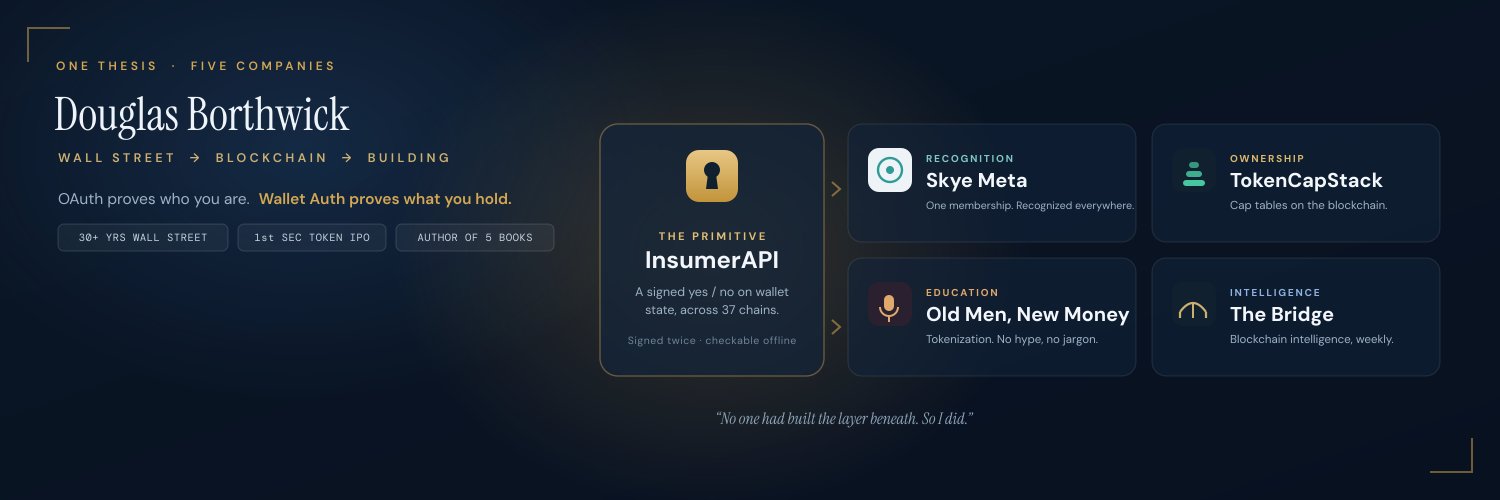
CEO @skyemetacorp, @TokenCapStack | Founder @TheInsumerModel | 30+ years in markets | Helped bring the first IPO on the blockchain | Six books | @OldMenNewMoney
Something my company has in production, live on x402: an agent opens a room with a rule, every agent that wants in is measured against live chain state, and one that stops qualifying is out at the next check. We published a live run, every step on Base. Useful to you?
Singapore's MAS says it will build a Know Your Agent protocol: who the agent is, whom it represents, what authority it holds.
The field I'd add: what the person behind it has earned. Memberships, holdings, perks.
Should your agent carry that proof, or ask for it each time?
@0xCabana Whom it represents is the field I'd watch. Once that's verifiable, an agent can show up and claim the member price or holder perk on its owner's behalf.
@scottmelker Know Your Agent covers who it is and who it acts for. The useful next field is what that person qualifies for, proven without handing over a balance.
We read seven agent and commerce protocols: UCP, MPP, A2A, AP2, ACP, x402 and Verifiable Intent.
Each one dates the payment or the authorization. None defines a signed record that the buyer still qualified when the agent acted. Link in 1st Comment
Visa opened Agentic Ready to 85+ merchants and payment firms across Europe, like Stripe and Adyen, to test how AI agents get recognized.
Recognizing the agent is step one. Step two: knowing who it's buying for. A member? A holder owed a perk?
What should your agent unlock?
@iiam_Akshay No wallet is the right on-ramp. The wallet pays off later, when holding the deposit can get you something from someone other than the bank.
@SuperstateInc@InvescoUS Registered fund, onchain shares, verifiable reserves. The next useful step is letting a holder prove they own it to unlock something, without exposing the balance.
Strategy's premium just hit 1.09x, the tightest of this drawdown. MSTR fell 13.4% this week while bitcoin fell only 9.2%. Shareholders are absorbing more pain than the asset underneath. Breakdown inside.
@Rosaaa Tokenized assets that do something for the holder. A share that gets you in the door or a discount at the point of sale beats one that just sits in a wallet.
Hi, @tempo is built for stablecoin payments. A payment tells you someone paid. It doesn't tell you whether they qualify.
InsumerAPI (@TheInsumerModel) now reads Tempo (chainId 4217). Conditions in. Signed attestations out. 37 chains.
https://t.co/f2A0ROSIMQ
When I traded on FX desks at Morgan Stanley and Merrill. The big risk was never just price. It was paying one currency and waiting for the other to arrive - Especially during the Asian Crisis.
The Bank of England, MAS and Bank of Thailand just tested settling both legs at once, old rails and tokenized.
Which pair goes first?
Deutsche Bank's digital asset custody went live today. The bank holds the keys, and a tokenized money market fund is next.
If the custodian signs for you, your tokens can't open a door, a discount or a members' page on their own.
Who builds holder proof for custodied assets first?
Our agent vetted another agent before hiring it: 50 reviews, 25 clients, none flagged. Then it asked if that wallet held 10x the job's value in USDC. Signed answer: no. It walked away, for $0.052.
What x402 doesn't tell your agent: https://t.co/vti50oGBgF
We ran five x402 recipes for AI agents on Base today, with every payment on Basescan.
One agent bought a $5 Amazon gift card, and we redeemed it. Another checked an agent before hiring it and walked away. $5.62 total.
x402 moves the money. InsumerAPI checks the conditions.
https://t.co/FQGR7Jyn2H
NYSE picked Avalanche to settle tokenized stocks, with shares issued on many chains.
The part I'm watching: once your stock sits in a wallet, a company can finally recognize its own shareholders directly.
If you ran a public company, what would you give holders first?
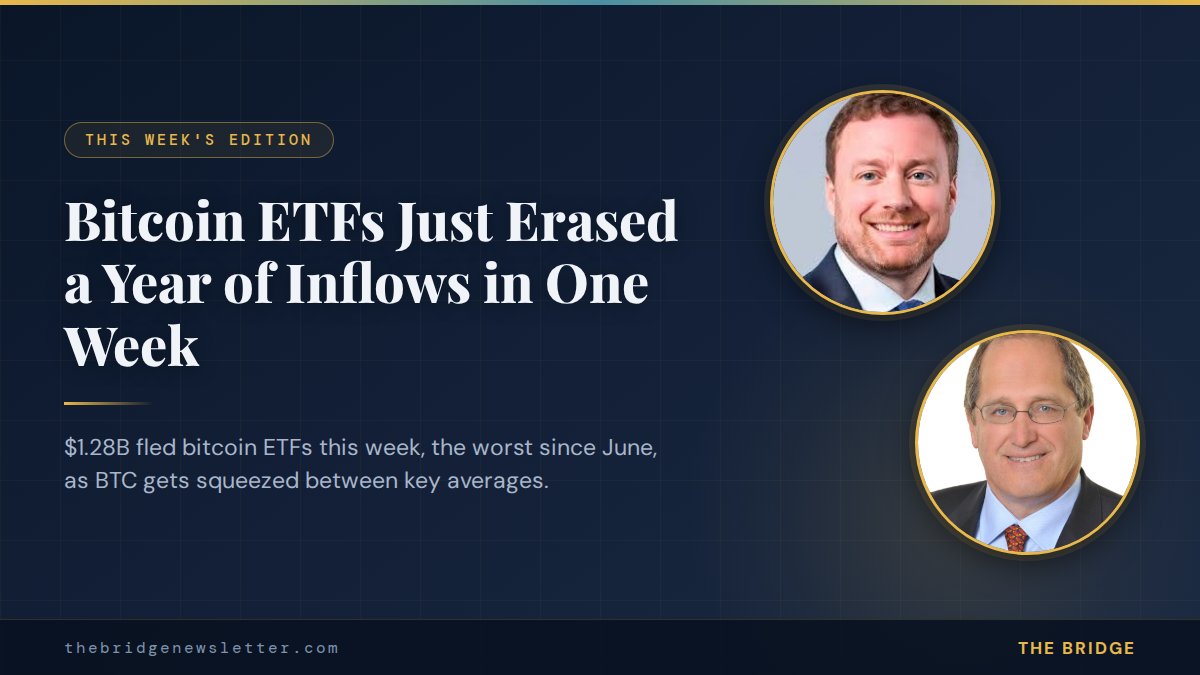
$1.28B fled spot bitcoin ETFs this week, the worst outflow since June, wiping out 2026's entire inflow. IBIT alone lost $403M Friday. BTC's pinned between its 200-day and 50-day averages. Why it matters, in this week's Bridge.