@MSBL_National Update: Congratulations to the 2025 Utah AABL 45+Spring Champion Utah Ducks who took down hall of famer Randy Miles' Undefeated Utah Pirates in the Spring Championship Game 8-0 The team is led by coach Brandon Snow
@Brandon71533180@dchat10 threw a CG, 5 hit Game for the win
Yeah, I think Utah Jets should at least be a consideration. The franchise was once named the Jets when it was in Winnepeg and Utah has a long history and pride in Hill Air Force base and their fighting wings.
Utah Jets.
Prediction:
Vehicle leasing will make a roaring come back in the next 18 months.
I'll even take it a step further.
Vehicle lease penetration will reach all-time highs in the coming years.
And here's why -
The numbers on traditional vehicle financing just don't make sense for most Americans.
As I like to say:
We've eclipsed the "vehicle affordability hurdle" for most consumers.
Basically, this means that saving 10-25% on a vehicle's monthly payment by leasing instead of buying outright is no longer a 'want'—it's a 'need' for most people.
Just look at the data:
In Q1, the share of new vehicle shoppers opting for $1,000+ monthly payments was 17.3%—the fourth consecutive quarter above 17%...
That's a $1,000+ monthly payment before insurance—an extremely heavy lift for the *majority* of consumers.
And while lease payments *have* risen in the past couple of years as well...
Leasing is still a less expensive option compared to traditional financing.
So how did we get here? A combination of many things, but to list a few:
1) Automakers focused on bigger / well-equipped vehicles (which are more expensive)
2) Higher interest rates have driven up monthly payments
3) Low supply of vehicles has driven up prices
And more...
There's no easy way to put the genie back in the bottle, but here's my takeaway:
— Four years ago, leasing was an attractive option for transportation that allowed most consumers to commit to a lower monthly payment.
— Today, with vehicle prices declining *but* still hovering near all-time highs, leasing is a much-needed, incrementally important necessity for consumers and society.
Love it or hate it... It's reality.
(Data via Edmunds, Experian #edmundspartner #experianpartner)
Here’s what auto insiders are talking about…
3 potential black swan events for the car market:
1) Used car leasing cliff
We under-produced 10M+ vehicles since 2020. That meant we had fewer vehicles to sell. And that means that fewer used cars are making their way back into the secondary market.
Potential impact on market:
Rising used car prices (again) due to fewer used vehicles available.
2) Underwater auto loans
Since 2020, consumers have paid record high prices for vehicles. Now prices are dropping, leaving many “underwater” on their loans. Basically, people owe more on their loans than their vehicles are worth.
Potential impact on market:
Rise in vehicle repossessions and insurance fraud (as consumers can’t trade their way out of their vehicles without significant amounts of money down)
3) Electric vehicles don’t sell (even after steep discounts)
Electric vehicle prices are down, but they may not be down enough. With prices slashed as much as 50% in some cases, EVs are by far the best “deal” in the market. But inventory days’ supply is still high. If sales don’t rebound even after such steep discounts, most car manufacturers (and dealers) will deal with even bigger losses.
—
What’d I miss?
Falling car prices have (yet again) led to weird behavior in the car world:
1) Smart dealers are taking the medicine and accepting lowering prices.
More importantly, they’re laser-focused on inventory management and maintaining a quick turn-time.
2) Foolish dealers are playing wait-and-see. They’re waiting for a miracle that won’t arrive.
3) Dumb dealers are removing online prices completely.
Be a smart dealer.
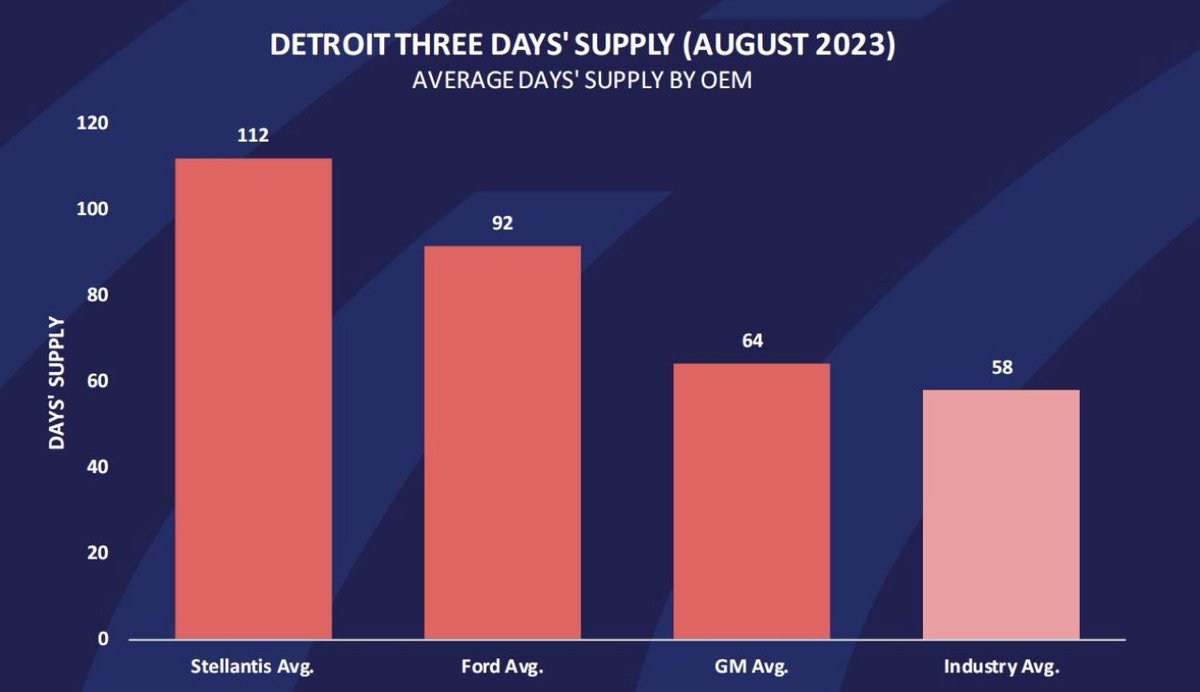
Who will suffer the most from extended auto worker strikes?
Insightful chart showing inventory availability for each car manufacturer:
- GM is under most pressure to 'strike' a deal
- Stellantis has the most breathing room.
- Ford is... being Ford.
(chart from @HaigPartners)