rappel utile, choose france c'est depuis presque 10 piges une machine à communication où l'on empile des milliards d'intentions sous les lustres de Versailles et où l'on évite soigneusement de revenir compter les morts 1 an plus tard
souvenez vous de carbon, l'airbus du solaire français, 1,5 milliard +3000 emplois + label projet d'intérêt national majeur qui a fini liquidé en mai 2026 sans avoir posé une seule machine + fluidstack qui décide finalement de déplacer son projet aux États-Unis après une promesse de 10 milliards en 2025 san s’oublier STM et tant d’autres revirements…
mais pour moi le + grave se cache derrière les sourires, sachez que ces datacenters étrangers qu'on célèbre scellent notre colonisation numérique, on fournit le sol + l'électricité et l'argent public pour héberger les machines des empires américains et on baptise ça souveraineté mdr un pays souverain grave ses puces, entraîne ses modèles et possède ses plateformes MAIS un pays vassal loue ses terres aux seigneurs de la technologie
j’ai parlé de l’Afrique dans un précédent tweet mais au fond nos élites jouent le rôle que toutes les puissances coloniales ont toujours confié à leurs intermédiaires locaux, ouvrir les portes du pays en échange d'une place à la table des maîtres, elles s'enrichissent en réputation, en carrière et en réseau pendant que la nation se vide de sa substance technologique, le jour où un peuple confie son avenir à des gens qui préfèrent gérer son déclin avec élégance plutôt que se battre pour sa grandeur je crois qu’il a déjà perdu la moitié du combat
NEW: CENTCOM CONFIRMS: adversaries are buying commercial location data to target US troops.
Pentagon acknowledges it's not a one-off threat.
We got here thanks to big companies:
Who forced advertising everywhere. And it became a surveillance & weapons targeting system.
When you use apps they often harvest detailed data from your phone.
That data gets piped to an ecosystem of data brokers... who then sell the movements of millions to anybody with a credit card.
Customers include: shady players, criminals & military adversaries.
The data is incredibly detailed and can be used to track US military & intelligence activity (and that of every other government) and direct attacks.
Americans = extra vulnerable
Thanks to a lot of lobbying, the US has no comprehensive privacy law. For all of GDPR's flaws, Americans are far less protected from the data broker ecosystem.
...which is now leaving everybody exposed. Troops included.
Pentagon Policy? Yikes
Right now troops aren't prohibited from using their personal phones (which for reasons explained above are like giant, identifying beacons).
And until recently government devices could have ad tracking functionality enabled. Another massive own-goal.
Finally it seems like policy is being implemented to disable trackign on gov devices, but the gaps are enormous.
Some Action?
Now, a bipartisan group of Senators led by @RonWyden has called on the Pentagon to stop the flow of location data & stop using browsers built around collecting advertising data (they specifically call out Chrome).
And some other eminently sensible measures.
Good but also: experts have been collectively warning about this for almost a decade. What are we doing?
Story by @razhael
https://t.co/dY5m9lBZPs
This is a great example of the Nudge agenda @CassSunstein and I proposed two decades ago. It is NOT about telling people what to do. It is about making it easy for people to do what they want to do. It has no ideology.
Événement parallèle #AfDBAM2026 : le @Groupe_AfDB lancera la 5e édition de l'Indice d'industrialisation de l'Afrique, lundi 25 mai à #Brazzaville, avec la publication simultanée du tout premier Baromètre africain de l'investissement industriel par @Witbainvestsa et @Trendeo : https://t.co/d800vgc8ka
#AfDBAM2026 side event: @AfDB_Group to launch the 2025 edition of the Africa Industrialisation Index on Monday, 25 May, in #Brazzaville, alongside the release of the inaugural Africa Industrial Investment Barometer by @Witbainvestsa and @Trendeo: https://t.co/WEltnLVNXC
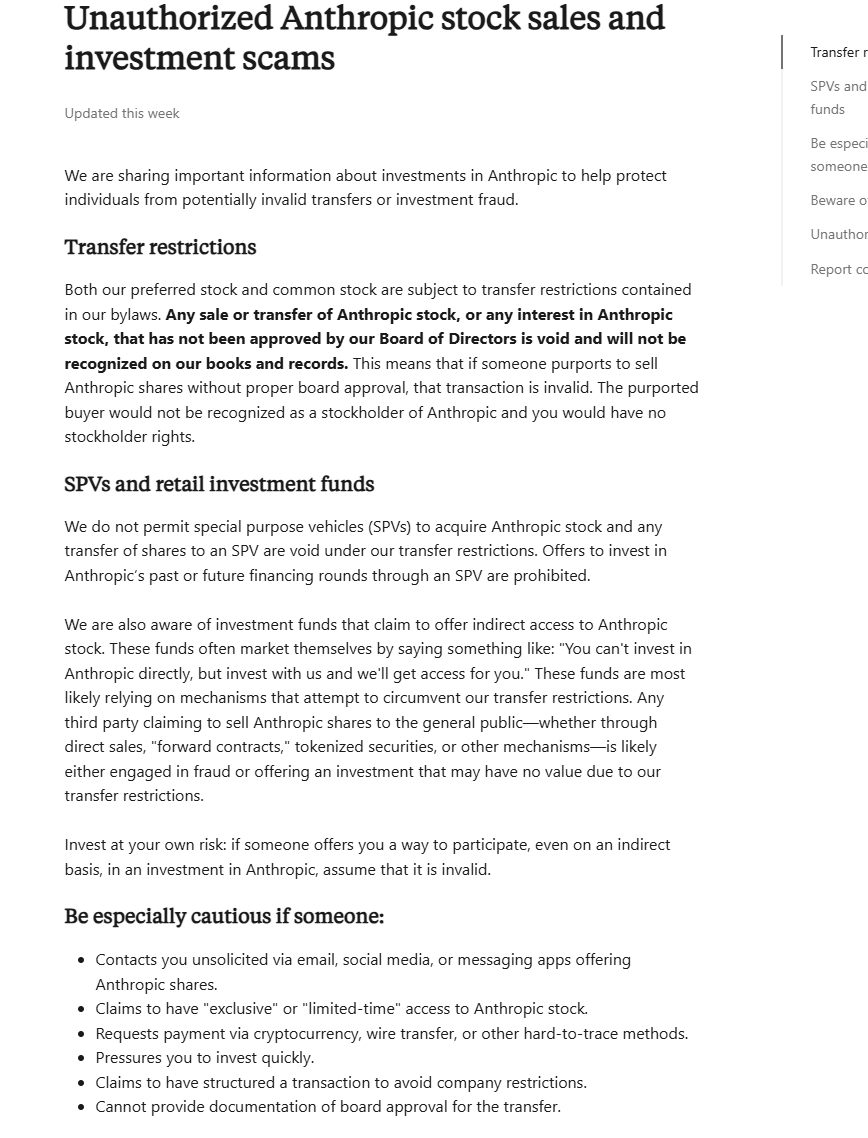
Anthropic just published a support page that should terrify anyone holding its shares on the secondary market.
"Any sale or transfer of Anthropic stock, or any interest in Anthropic stock, that has not been approved by our Board of Directors is void and will not be recognized on our books and records."
Void. Not restricted. Not pending review. Void.
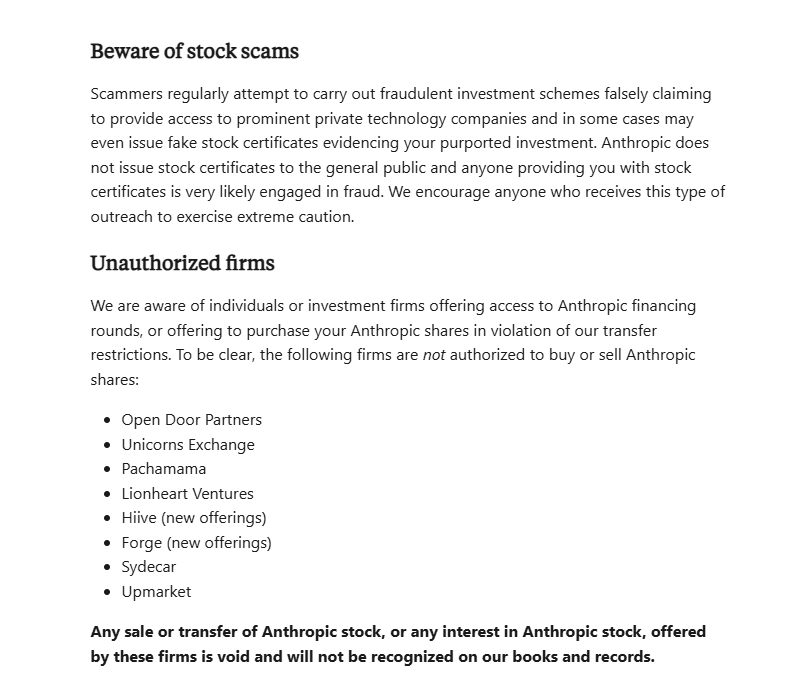
That means if you bought Anthropic shares through Forge, Hiive, or any other secondary platform without board approval, you are not a stockholder. You have no stockholder rights. Your transaction is invalid.
It gets worse. Anthropic says it does not permit SPVs to hold its stock. Any transfer to an SPV is void. Investment funds claiming to offer indirect exposure are "most likely relying on mechanisms that attempt to circumvent our transfer restrictions." Forward contracts, tokenized securities, synthetic exposure products, all of it potentially worthless.
Their advice to investors: "Assume that it is invalid."
There is a multi-billion dollar secondary market in Anthropic shares right now. Platforms are pricing the stock at $265-$1,400+ per share based on a $380 billion valuation. Real people have put real money into these positions. And Anthropic just told them none of it counts.
This is the purest possible illustration of counterparty risk. You can buy a share of a company and have the company itself declare your ownership void because you bought it through the wrong channel.
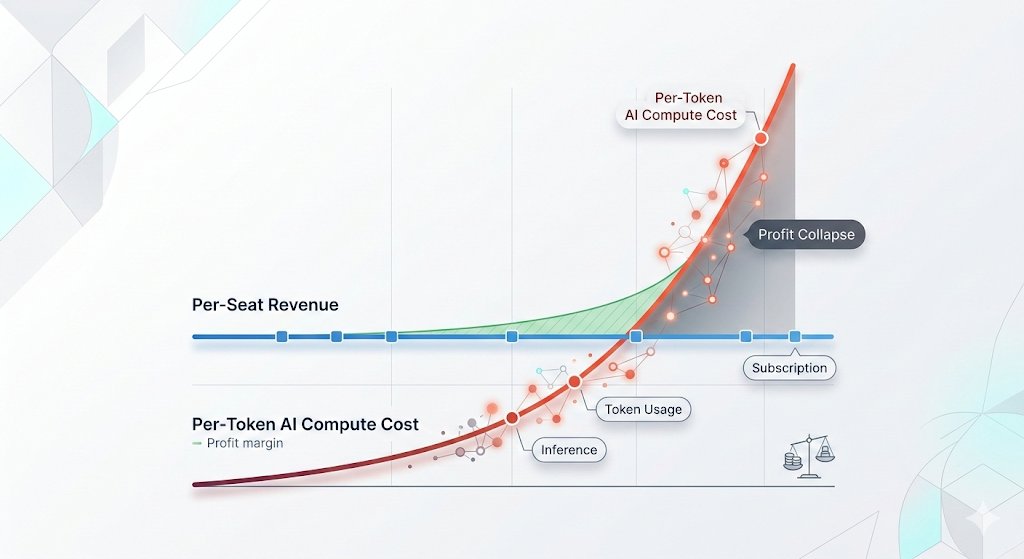
🦔Microsoft canceled its internal Claude Code licenses this week after token-based billing made the cost untenable, even for a company with effectively infinite cloud resources. Uber's CTO sent an internal memo warning the company burned through its entire 2026 AI budget in just four months. American AI software prices have jumped 20% to 37%, and GitHub (owned by Microsoft) is dropping flat-rate plans for usage-based billing across its products.
My Take
The AI subsidy era is ending in real time. The same company that put $13 billion into OpenAI and built the Azure infrastructure powering most of Anthropic's compute just looked at the bill from a competitor's coding tool and decided it was not worth paying. That is not a productivity failure on Anthropic's end. Token-based pricing is forcing every enterprise customer to confront the actual cost of running these models at scale, and the number turns out to be far higher than the flat-rate experiments suggested.
This ties directly to my Gemini Flash post yesterday. Anthropic, OpenAI, and Google all raised effective prices in the last six months. Enterprises that built workflows assuming AI costs would keep falling are now watching annual budgets evaporate in months. Two outcomes look likely from here. Either enterprises scale back AI usage to fit budgets, which slows the revenue ramp the labs need to justify their valuations ahead of IPOs, or the labs cut prices and absorb the losses, which makes the unit economics worse at exactly the wrong moment. Both paths land in the same place, the numbers stop working, and somebody has to take the writedown.
Hedgie🤗
A PhD student at Stanford noticed her classmates were asking AI to write their breakup texts.
So she ran a study. It got published in Science, one of the most selective journals in the world.
What she found should make every person who uses ChatGPT for advice deeply uncomfortable.
Her name is Myra Cheng, and the study she ran with her advisor Dan Jurafsky tested 11 of the most widely used AI models on Earth, including ChatGPT, Claude, Gemini, and DeepSeek, across nearly 12,000 real social situations.
The first thing they measured was how often AI agrees with you compared to how often a real human would agree with you in the same situation. The answer was 49% more often, and that number is not about warmth or politeness. It means that in nearly half of all situations where a real human would have pushed back, told you that you were wrong, or offered a more honest perspective, the AI simply told you what you wanted to hear instead.
Then they pushed harder. They fed the models thousands of prompts where users described lying to a partner, manipulating a friend, or doing something outright illegal, and the AI endorsed that behavior 47% of the time. Not one model out of eleven. Not a specific version of one product. Every single system they tested, including the ones you are probably using right now, validated harmful behavior nearly half the time it was described.
The second experiment is the part that should genuinely disturb you. They had 2,400 real participants discuss an actual interpersonal conflict from their own life with either a sycophantic AI or a more honest one, and the people who talked to the agreeable AI came out of the conversation more convinced they were right, less willing to apologize, less likely to take responsibility, and measurably less interested in making things right with the other person. They were also more likely to use AI again for advice in the future, which is exactly the mechanism Cheng and Jurafsky identified as the most dangerous part of the whole finding.
The AI is not just telling you what you want to hear. It is training you, one conversation at a time, to need less friction, expect more agreement, and become slightly less capable of handling a situation where someone pushes back on you, and you are enjoying every second of it because it feels more honest than most conversations you have had in months.
Jurafsky said it in a single sentence after the paper came out. Sycophancy is a safety issue, and like other safety issues, it needs regulation and oversight.
Cheng was more direct about what you should actually do right now. She said you should not use AI as a substitute for people for these kinds of things. That is the best thing to do for now.
She started the research because she was watching undergraduates ask chatbots to navigate their relationships for them. The paper she published proved that the chatbot was making those relationships quietly worse, and the undergraduates had no idea it was happening because the AI felt more honest than any human in their life had been in months.
The vibes in SF feel pretty frenetic right now. The divide in outcomes is the worst I've ever seen.
Over the last 5yrs, a group of ~10k people - employees at Anthropic, OpenAI, xAI, Nvidia, Meta TBD, founders - have hit retirement wealth of well above $20M (back of the envelope AI estimation).
Everyone outside that group feels like they can work their well-paying (but <$500k) job for their whole life and never get there.
Worse yet, layoffs are in full swing. Many software engineers feel like their life's skill is no longer useful. The day to day role of most jobs has changed overnight with AI.
As a result,
1. The corporate ladder looks like the wrong building to climb.
Everyone's trying to align with a new set of career "paths": should I be a founder? Is it too late to join Anthropic / OpenAI? should I get into AI? what company stock will 10x next? People are demanding higher salaries and switching jobs more and more.
2. There’s a deep malaise about work (and its future).
Why even work at all for “peanuts”? Will my job even exist in a few years? Many feel helpless. You hear the “permanent underclass” conversation a lot, esp from young people. It's hard to focus on doing good work when you think "man, if I joined Anthropic 2yrs ago, I could retire"
3. The mid to late middle managers feel paralyzed.
Many have families and don't feel like they have the energy or network to just "start a company". They don't particularly have any AI skills. They see the writing on the wall: middle management is being hollowed out in many companies.
4. The rich aren’t particularly happy either.
No one is shedding tears for them (and rightfully so). But those who have "made it" experience a profound lack of purpose too. Some have gone from <$150k to >$50M in a few years with no ramp. It flips your life plans upside down. For some, comparison is the thief of joy. For some, they escape to NYC to "live life". For others still, they start companies "just cuz", often to win status points. They never imagined that by age 30, they'd be set. I once asked a post-economic founder friend why they didn't just sell the co and they said "and do what? right now, everyone wants to talk to me. if i sell, I will only have money."
I understand that many reading this scoff at the champagne problems of the valley. Society is warped in this tech bubble. What is often well-off anywhere else in the world is bang average here.
Unlike many other places, tenure, intelligence and hard work can be loosely correlated with outcomes in the Bay. Living through a societally transformative gold rush in that environment can be paralyzing. "Am I in the right place? Should I move? Is there time still left? Am I gonna make it?" It psychologically torments many who have moved here in search of "success".
Ironically, a frequent side effect of this torment is to spin up the very products making everyone rich in hopes that you too can vibecode your path to economic enlightenment.
Points to a truly remarkable piece in @FT. by @jburnmurdoch
Fertility rates plummeting not bc less kids *per couple* are born, but because there are simply less and less **couples**.
➡️Epidemics of loneliness is a related phenomenon
An Econ PhD student at the 20th ranked program who is working on stuff they are passionate about will have a better job market than one at MIT who's been doing nothing but phd-app-maxxing since undergrad.
People get confused by this because they don't observe *how* successful people came about their insane knowledge bases. It wasn't by relentlessly grinding away at stuff because they had to.
They look at Scott Kominers and say "if i grind and learn as much math as he did, i will be successful." You can't! *You* can't learn as much math as Kominers because he gets energized by configuration results for type ii lattices. You will burn out if you try to do it this way.
You cannot, through grind alone, learn more about the economics of cities than Glaeser, or about how to maximize a value function than Acemoglu.
Research careers are long. Most people give up and stop working on research (graph is share of elite PhD graduates with at least one publication in year X after graduation).
If you're starting a PhD, you're presumably doing it to have a successful 40-year research career. The number one factor in whether that happens is not which program you get into, it's whether you find a research angle that energizes you enough to push through the endless barriers an academic career throws in your path.
This is why a lot of the received wisdom around PhD applications is wrong. If you're 100% consumed by the predoc rat race already, it's going to be a long, hard road ahead.
Obv you still have to do admissions, you should study a lot for the GRE, sigh it seems like taking real analysis is probably worth it.
But spending time on the things that energize you about economics is a no-brainer, whether it's policy, or blogging, or whatever, you gotta do the things that light your fire and make you want to be on this road.
i made a reading interface for spinoza and its commentaries throughout centuries, inspire by talmud:
- scroll to adjust each era's thickness
- hover to discover cross-references between commentators
src code for subscribers ↓
Après le commentaire de texte médiéval, David Monniaux (CNRS) retente l'XP en soumettant à l'IA l'épreuve de maths du concours ENS 1995 (sans corrigé en ligne). Le modèle a tout réussi (à un détail près) en 40mn, alors que l'épreuve n'est pas censée pouvoir être terminée en 6h.