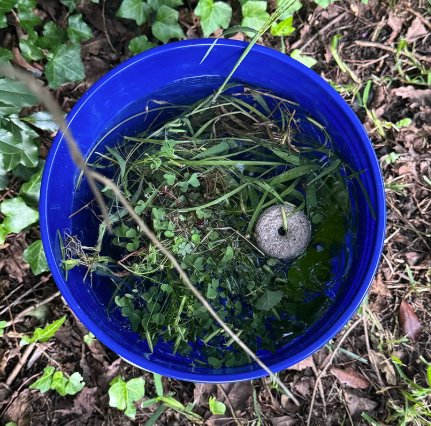
You can crash your yard's mosquito population without spraying a single chemical with a Mosquito Bucket of Doom.
Fill a 5-gallon bucket about two-thirds with water. Drop in a handful of grass clippings, leaves, or hay. Let it sit for a day, then drop in a Bti dunk (also called Bacillus thuringiensis israelensis, sold at any hardware store as "mosquito dunks," about $10 for six).
Mosquitoes are powerfully attracted to fermenting water and will lay their eggs in your bucket. Bti is a naturally occurring soil bacterium that produces a toxin that kills mosquito, blackfly, and fungus gnat larvae only.
This method doesn't harm bees, butterflies, fireflies, fish, frogs, birds, pets, or people. BTI dunks are EPA-approved for organic use and safe in animal water troughs and birdbaths.
One dunk lasts about 30 days. Top off the water as it evaporates. Cover with 1/2-in Mesh Hardware Cloth to prevent animals from getting trapped and put the bucket somewhere shady where pets and kids won't get into it.
The bucket becomes a mosquito magnet and a dead end. Compare that to fogging the entire yard with pyrethroids, which kills every insect in it, including the predators that eat mosquitoes.
Doug Tallamy's Homegrown National Park has been running the "Mosquito Bucket Challenge" since 2021. The more buckets in a neighborhood, the bigger the dent. One bucket per yard is a great start.
@DisneyParks I reject this w/ every fiber of my being. Carousel of Progress is literally my all-time fave attraction anywhere on earth. Part of the greatness is seeing the significant contrast from a world prior to electricity, to modern times. That’s now lost. Rethinking our yearly fam vacay
@Jrbacon50@evo4g63t@WSJ I did go for about 2.5 years with zero sodas. I still craved the carbonation, so I slammed Pellegrino all day every day. But I fell off the wagon. Been on ye olde phosphate ever since.
@timedclassic@BamChudley@MattZeitlin I will say that aspartame & neotame are two flavors I can’t embrace. To me, they taste like a headache on an overcast day. But I have tried to acquire a taste for it a few times in life.
@Bauerpower10@evo4g63t@WSJ Tbh I haven’t had a Coke Zero in a couple years. Back when I last tried it, I was repulsed & journeyed into the woods to a cave where I sat & reflected on what Conan the Barbarian said was best in life. Maybe they e changed the recipe since then? Perhaps I’ll give it a 2nd chance
@ratpatootie69@evo4g63t@WSJ Idk what that means, but I do enjoy badminton. At least until the tape starts coming off the racket. That drives me nuts. & I always use that as the excuse if one of my girls beats me.
@leaf_4@evo4g63t@WSJ I’ve had one cavity ever in my life. 20 years ago. Regularly get cleanings. Literally floss abt 5x per day (I’ve always been kinda addicted to the feeling of flossing), & brush 3x/day. Bro-in-law is dentist. Fluoride. Wife’s grandpa was a dentists. It’s a whole thing in our fam.
@BamChudley@MattZeitlin I exclusively drink Coke. Have for years. 1-2 per day. Not excessive. & I can tell you that Zero tastes nothing like original to anyone who drinks it. Diet is disgusting too. But Zero is in no way a suitable alternative to OG. Oh, & Pepsi can go light their hair on fire.
@evo4g63t@WSJ I exclusively drink Coke. Have for years. 1-2 per day. Not excessive. & I can tell you that Zero tastes nothing like original to anyone who drinks it. Diet is disgusting too. But Zero is in no way a suitable alternative to OG. Oh, & Pepsi can go light their hair on fire.
That water clarity is an engineering decision, and the math behind it is wilder than the video.
Roman aqueducts ran on gravity alone. No pumps, no pressure systems. Engineers carved channels with a gradient so shallow it borders on absurd. The Pont du Gard in southern France drops 2.5 centimeters over 275 meters. That's roughly the thickness of a coin over the length of three football fields. They surveyed that accuracy with plumb lines and wooden leveling instruments.
The clarity you're seeing is a direct product of flow velocity. Too steep and the water erodes the channel walls, picks up sediment, turns brown. Too flat and it stagnates. Roman engineers targeted a slope of about 20 centimeters per kilometer, which kept the water moving fast enough to stay fresh but slow enough to stay clear. Before the water reached the city, it passed through multi-chamber settling tanks where velocity dropped near zero. Suspended particles sank. Clean water flowed out the top into the next chamber. Repeat three or four times.
Pliny specified the minimum slope in writing. Vitruvius published the exact mortar ratio for hydraulic cement: one part lime to two parts volcanic ash for underwater work. The pozzolana from Pozzuoli reacted with water to form a calcium-aluminum-silicate compound that actually gets stronger the longer it sits submerged. Modern concrete degrades in water. Roman concrete bonds with it.
Scale the whole system and it gets harder to process. Eleven aqueducts fed Rome at its peak. Combined output: roughly 1 million cubic meters of water per day. That works out to about 250 gallons per person for a city of one million. Modern New York delivers about 125 gallons per person per day. Ancient Rome had access to double the per capita water supply of the largest city in the United States, running entirely on slope and stone.
The Trevi Fountain in Rome is still fed by one of them. Two thousand years, same source, same gravity, same water.