Under the SBA rulebook that starts Oct 1 (SOP 50 10 8.1), a mixed real-estate and business loan can no longer stretch the whole balance to 25 years. Only the real estate piece can.
VerSquare checked 12,281 SBA acquisition loans. About 15.5% of those deals (and 27.5% of the dollars) used a 25-year term. For a deal right at the old 51% real-estate line, blending the new terms lifts the median monthly payment about 12%.
That means coverage (cash flow vs loan payment) gets worse on the same earnings. A deal that penciled at 1.25x coverage falls to about 1.12x. That is under the new 1.25 floor for an initial buyout.
So the capital stack has to change: less senior debt, more equity, or a smaller price. The thesis is not just what you buy. It is whether the payment math still works after Oct 1.
https://t.co/6uyQVCXyH5
@EdWeeksJr Exactly. If the underwriting model still needs that operator in the seat, treat retention as a closing condition, not a post-close hope. Money in the account does not replace the plan you bought.
About 6 in 10 portfolio company CEOs get replaced within the first year after a buyout.
That figure comes from AlixPartners survey data, cited by Independent Sponsor News.
Most deal teams treat this as bad luck. It is usually a diligence gap. One analysis puts leadership and org checks at less than 1% of deal diligence costs.
If your deal thesis needs the current CEO to deliver the plan, test that before close. After close, a leadership change means you are rewriting who runs the business with money you already put in.
https://t.co/1Ja8YMTh6f
PitchBook: 75% of U.S. PE deals in 2024 were add-ons. That means a smaller company bolted onto a platform the fund already owns. In the lower middle market it runs above 80%.
GF Data: businesses with $1M to $5M of earnings often clear near 5.5x. Scaled platforms with $30M+ often exit at 9x to 12x.
So the deal thesis is the structure. Buy small, integrate, exit as one bigger company. Roughly 30% to 40% of roll-up returns come from that price gap.
Independent sponsors buy one company at a time and raise equity deal by deal. They do not sit on a big committed fund.
IPC and SBIA studied 846 of those deals. Median IRR (the annualized equity return) was 23.8%. Matched traditional buyouts sat at 18.5%. Median money back was 2.1x invested capital. Loss rates looked about the same.
Structure matters. Deal-by-deal capital can still beat fund buyouts on return without taking more risk.
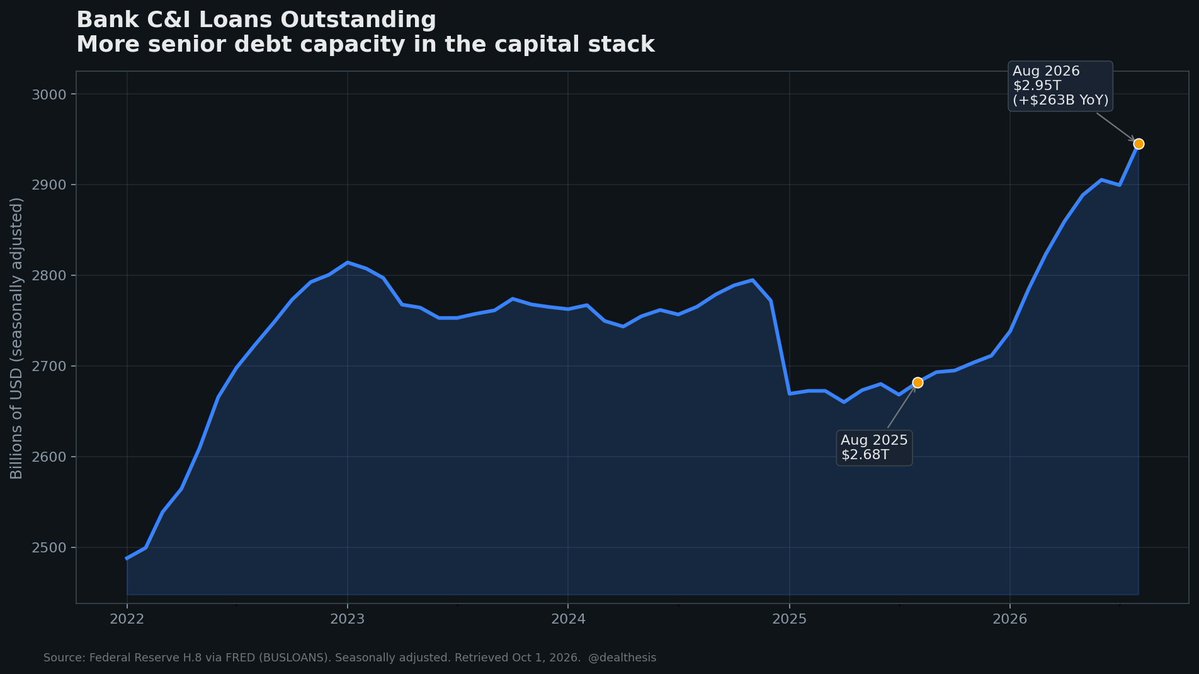
Bank C&I loans at U.S. commercial banks hit $2.95 trillion in August 2026.
That is up about $263 billion from August 2025 (nearly 10%).
C&I loans are the business loans banks make to companies. In an acquisition, senior debt (the bank loan that gets paid first) often comes from this pool.
So when bank C&I books are growing again, there is more room in the capital stack (the mix of bank debt, other debt, and equity that pays for a deal) for senior debt. Buyers may need less equity and seller paper to fill the gap.
Source: Federal Reserve H.8 via FRED (BUSLOANS).
EBITDA gaps found in diligence caused 21.3% of broken letters of intent last year, per Axial's 2025 Dead Deal Report, up from 10.6% in 2023. A quality of earnings report is an independent check on whether seller earnings are real. Soft numbers kill deals before close.
SBIC funds backed 53% of Independent Sponsor deals in 2025, up from 34% three years earlier (Citrin Cooperman).
An SBIC is a licensed lender for smaller buyouts. That means more of these capital stacks now include a specialist debt source. So raising senior debt is less often the blocker. Choosing the right equity partner is.
Promote (carry) is the sponsor's share of profits after investors get their money back plus a preferred return. Citrin Cooperman 2025: median Independent Sponsor promote is 15% to 25% on a tiered waterfall; 64% hit 25%+ at the top tiers. Equity stack, not senior debt.
An escrow holdback is a slice of the purchase price that does not go to the seller on closing day.
It sits with a third party. The usual window is 12 to 18 months. If a problem from before the sale shows up, that pot pays the claim first.
CT Acquisitions puts most lower middle market deals at about 8% to 12% of deal value. On a $10 million sale, that is roughly $800,000 to $1.2 million still sitting off to the side after close.
That money is still part of the price. The seller just has not collected it yet. Bank debt, equity, and any seller note still fund what clears at closing. The holdback is delayed seller cash, not a new layer of capital.
So when you read a deal thesis, ask what share of price is held back and for how long. Headline price and cash at close are not the same number.
LockRoom 2026: one customer above 25% of revenue usually cuts the purchase price 15% to 30%. Above 40%, many buyers walk. Customer concentration means too much of the business hangs on one account. That risk shapes price and structure before the bank loan and equity get sized.
Axial just posted a record quarter for lower middle market deal flow.
3,523 businesses came to market in Q2 2026. That is up 4.79% from a year ago.
But volume is not the same as demand.
Industrials ranked 1st in both deals for sale and buyer pursuit rate. That means supply and demand are lined up in that sector for the fourth quarter in a row.
Transportation ranked 7th in deal volume but 2nd in pursuit rate. That means too few sellers for how many buyers want in.
Food & Hospitality and Consumer Goods were near the top in supply and near the bottom in buyer interest. So buyers are pickier where consumer spending can swing.
Pursuit rate is how often buyers raise their hand when a deal hits their desk.
So the deal thesis starts before the capital stack. Why this industry matters as much as how you finance it.
Source: Axial SMB M&A Pipeline, Q2 2026
The buyer's first working capital true-up claim averages 0.9% of deal value, per SRS Acquiom data on 1,200+ private deals.
Working capital is the cash tied up in inventory and unpaid customer bills, minus what the company owes suppliers. The true-up is the check 60 to 90 days after close. If actual working capital is below the agreed target, the seller usually pays the difference.
On a $30 million deal, 0.9% is about $270,000. About one in four claims exceeds 1% of deal value. Closing day is not the last day the price can move.
SOFR is the overnight rate that sits under most acquisition loans.
It peaked at 5.40% in late 2023. As of Sep 23, 2026 it sits at 3.87%. That is 1.53 points lower (153 bps).
Senior debt (the first bank or private-credit slice of the capital stack) usually prices as SOFR plus a credit spread. That means for the same spread, the all-in cost of that senior piece is still well below the peak.
So coverage math is easier. Or the stack can carry a bit more debt without breaking interest coverage.
Source: FRED / NY Fed (SOFR)
https://t.co/znGY4bjbre
Starting October 1, about one in ten SBA buyouts needs a Quality of Earnings report.
That is an independent check on whether the company's earnings are real and can keep going. The buyer usually pays $5,000 to $30,000 for it.
Here is the catch. The report has to be written for the lender, not for you.
You fund the diligence. The bank owns the finding.
https://t.co/6uyQVCXyH5
Axial tracked buyer pursuits in the first half of 2026. A pursuit is when a buyer asks for more info on a deal that just hit the market. It is early interest, not a signed letter of intent.
Deals with $5M to $10M of EBITDA drew the most interest per listing. Those averaged 37.1 pursuits each.
The $1M to $5M band still took most of the volume. Those 1,092 deals got about 72% of all pursuits, or 31.9 per deal.
Sub-$1M deals averaged only 10.8 pursuits. Deals above $10M EBITDA averaged 21.0.
So the hottest competition is not the smallest searcher check. It is the $5M to $10M EBITDA slot, where more buyers show up on each process.
Source: Axial Pursuits Report 1H 2026
https://t.co/SaS6yyr6FI
A seller note is a loan from the seller to the buyer after the sale closes.
It shows up in about 31% of lower-middle-market deals. When it is used, the median size is about 10% to 12% of the purchase price (Glacier Lake Partners).
That note usually sits behind the bank loan. If the business struggles, the bank gets paid first. A bigger note can push the headline price up. It also leaves more of the seller's money tied to how the company runs after they leave.
https://t.co/aNA8TICiKB
Rollover equity is ownership the seller keeps after the business sells.
They do not take all cash at close. They convert part of their sale price into shares in the buyer's new company.
That means they still own a slice and share in future growth.
Buyers use rollover equity to reduce cash needed at close and keep the seller aligned with the plan.
Sellers accept it when they trust the next owner and want upside later, not only cash today.
In many lower-middle-market deals, the rollover is about 10% to 30% of what the seller would otherwise take in cash. The exact share is negotiated.
The deal thesis question is simple. Is the seller staying because the capital stack needs their money, or because their continued ownership is part of why this deal works?
Independent sponsors earn a promote only after they clear a return hurdle for their capital partners.
That hurdle used to be mostly IRR (the annualized return). Now it is mostly MOIC.
MOIC means Multiple on Invested Capital: how many times your cash comes back. Citrin Cooperman's 2025 survey put MOIC as the main hurdle on 54% of independent-sponsor deals, up from 27% in 2019. IRR-only fell to about 20%.
That means a fast exit at a soft multiple can miss the bar even when the annualized return looked fine. Absolute dollars returned now matter more than speed.
https://t.co/uYv5FMTIG4
GF Data's Q2 middle-market read (via Mercer Capital):
85 deals closed. Same count as Q1.
The average purchase multiple slipped from 7.3x to 7.0x EBITDA. That means buyers paid a little less for each dollar of earnings.
The bigger move was in the capital stack (how the purchase is paid for). Average total debt on new platforms fell from 3.4x to 2.9x EBITDA. Senior debt fell from 2.5x to 2.0x.
So deals are still getting done. Lenders are just funding less of each one. Equity has to cover more of the price even when the multiple barely moved.
https://t.co/P2FWmqJVHj