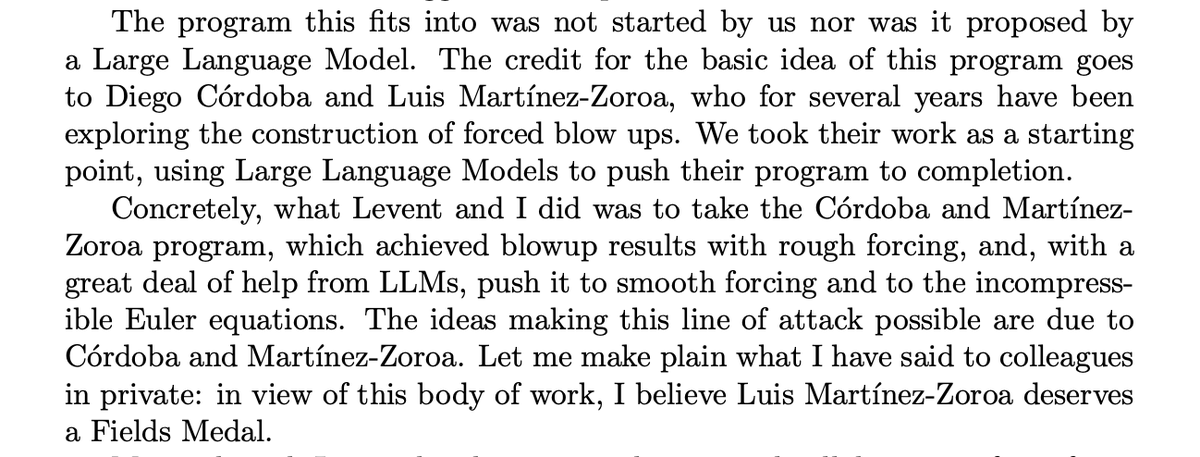
Worth noting: Tristan and Levent’s spectacular work used only commercially available models. No internal models were used. It was all funded by Tristan’s grant money.
@nihilunbounded It's real. These are two very serious mathematicians. AI played a significant but NOT dominant role. If you read Tristan's statement, you'll see that he gives credit to the two people who really made this possible.
@rperezmarco For which? In all of the examples I know, the mathematical community dismissed the proofs well before the errors were found. There are cases where the error was never found, but no one believes the proof anyway.
@rperezmarco Before AI, there were already useless proofs. If a human proves the Riemann hypothes without using AI and it's just a long sequence of inscrutable definitions, calculations and estimates, few will pay attention to it. That's what happened to DeBranges. And now to Mochizuki
@rperezmarco That's why when you state a conjecture, you say what you want to learn about it and any proof. The answer to a conjecture should never be, AI or not, just a proof.
@rperezmarco There's never been full disclosure. If there were, then every paper would say explicitly what each co-author contributed to the paper.
"Basic rules of research": Any chance you could point me to where the ones for math are stated?
@cg_geometry I also did it when I was young and got away with it. But not everyone does. I would strongly discourage any young person from doing it, even if they felt pressure to have something to show.
In case you haven't seen this before. Vladimir Voevodsky (Fields Medalist) on why he started to verify all of this proofs using Coq. https://t.co/KL1bzdSW0U