The feeling of that day is still with me.
There are billions of us in the world, all living different lives. It amazes me how just a few things in common can make you feel like you’ve known someone for years.
Here’s to the people who paved the way in a field I love. I look up to them, and I feel lucky to call them my peers.👏
I believe the work we’re all doing, each in our own way, can help make the world a little better.
P.S. They shared so many good tips that I actually took notes!
@piriya@Teruko21M@bitgould@dearezkitha@luisschwab_@powdae@dongguri2100 at @BtcCtrSeoul 🍊
Dread (@PoleVaultDream) introduces Fedimint Card, a new way to pay offline with ecash ⚡️⚡️⚡️
Just hold the card next to a device with a Fedi / @fedimint wallet and, voilà, your payment is made.
Check it out 👀
I’m traveling abroad solo for the first time without my baby, and I just realized how much stress a mother goes through when traveling with her child.
She has to stay on top of everything, keep her baby safe, and do her best to make sure the journey is enjoyable for other passengers, too.
Traveling solo is so much easier in comparison.
It was an honor to share our Bitcoin journey in Indonesia with the My First Bitcoin team and talk about how @fedibtc is helping drive Bitcoin adoption through local communities.
The documentary is now out! Watch it to learn more about our story and the people building Bitcoin adoption in Indonesia.
In Indonesia, you can own Bitcoin, but you can't legally spend it. Yet across the world's largest Muslim country, a grassroots education movement is challenging the status quo. 🇮🇩
🎬 BIGGER THAN BITCOIN - EPISODE 2: INDONESIA IS OUT NOW!
40+ meetups. 100+ Bitcoin Diploma graduates at a single event. And a growing movement of people who believe education is the key to financial freedom.
But standing up for what you believe in takes courage.
In a country where Bitcoin payments are prohibited and its place in Islamic finance is still debated, speaking publicly about Bitcoin isn't always easy.
A massive THANK YOU to Dimas, Bitcoin Indonesia, and every educator, student, and community builder who welcomed us, shared their stories, and stepped in front of our cameras despite the challenges. 🧡
Your courage, passion, and dedication are what make this movement possible.
This is YOUR story. We're honored to share it with the world.
@bitcoinindo21@Silatoshi_id@aadbitcoin
🚨 INSIGHT: After every major crypto hack, $BTC has gone on to new highs
Mt. Gox (2014): $BTC roughly halved. It hit $19.7k by 2017, nearly 100x off its post-collapse low.
Bitfinex (2016): $BTC fell ~20%. It was back above pre-hack levels within 3 months and hit new all-time highs in 2017.
Coincheck (2018): The hack hit during the 2018 bear market. $BTC climbed from its $3.1k bottom to $29k by the end of 2020, then reached $69k in 2021.
Binance (2019): $BTC dipped ~4%. It rallied ~136% in just 7 weeks.
FTX (2022): $BTC fell ~22% in a week to ~$15.5k. It was up ~134% a year later and hit a new ATH of $73.7k by March 2024, ~375% off the low.
Bybit (2025): The largest hack on record at the time. $BTC dipped ~5%, hit a new ATH exactly 3 months later and went on to $126k, ~70% above its 2025 low.
Binance (2026): $BTC is down ~3% so far, Binance says user funds are SAFU, and ~$2.4B of the stolen funds is already frozen.
Not financial advice, and past performance doesn’t guarantee future results. But the pattern speaks for itself.
How safe is your bitcoin?
After the recent bitcoin software hacks, it’s worth asking whether your custody setup still works for you.
Our latest article walks you through seven questions to help you determine how safe your bitcoin is.
The link to the article is in the thread.
@arshmolu Arsh, you are truly inspiring! I’m always impressed by how capable you are at solving problems while keeping a cool head. I really admire you and will miss you. What’s next for you? Wishing you all the best!
The currency exchange business should be on notice... Trading sats for local currency (rupiah) in Indonesia @Silatoshi_id
60,000 sats made me a rupiah millionaire.
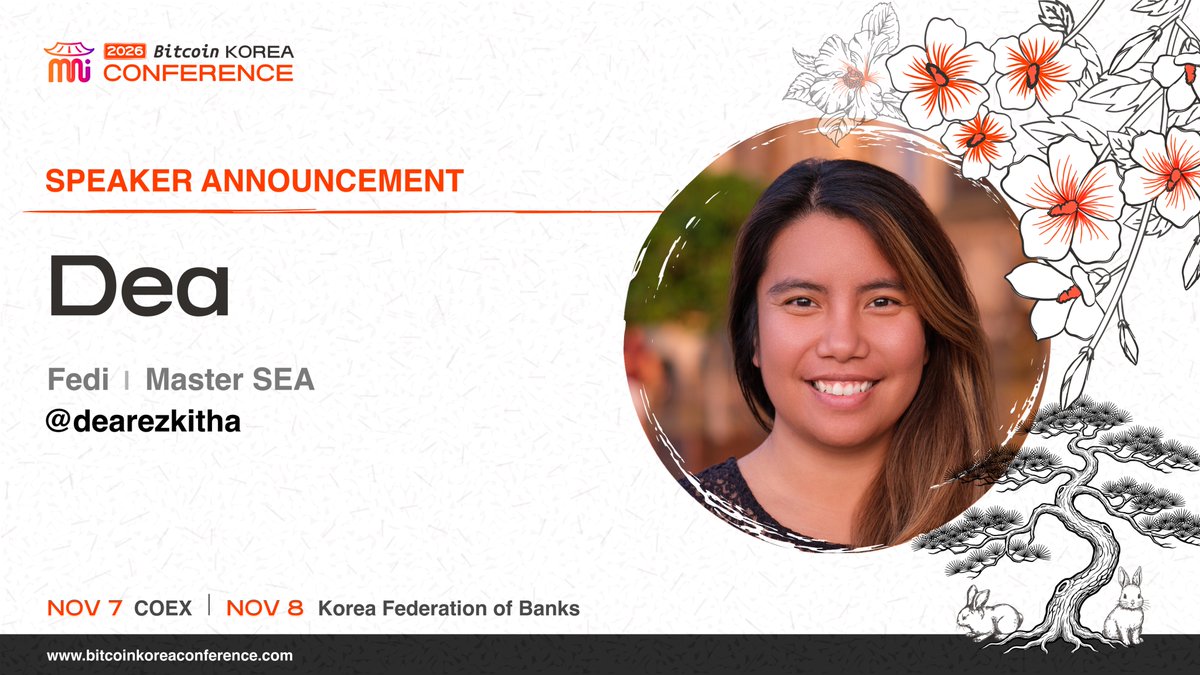
🎉SPEAKER ANNOUNCEMENT
🎙 데아 레즈키타(Dea Rezkitha, @dearezkitha) | 페디(@fedibtc ) 동남아시아 커뮤니티 마스터
데아 레즈키타는 인도네시아에서 비트코인 커뮤니티를 직접 만들어 온 사람입니다. 인도네시아 비트코인 컨퍼런스(Indonesia Bitcoin Conference)와 인도네시아 비트코인 커뮤니티(Indonesia Bitcoin Community)를 함께 세웠고, 지금은 페디(Fedi)에서 동남아시아 커뮤니티를 이끌고 있습니다.
거래소에 맡기자니 불안하고, 키를 혼자 지키자니 부담스럽습니다. 비트코인을 보관하는 방법은 이 두 가지뿐일까요?
이번 컨퍼런스에서 데아 레즈키타가
'키를 가진 사람. 거래소와 셀프커스터디 사이, 제 3의 선택지'를 주제로 강연합니다!
Calling on fellow cypherpunks to build alternative Fedimint implementations.
The Liquid hack shows once again that single points of failure are what will break our systems and that includes the code we write.
Security is an asymmetric game: an attacker has to find one weakness, while defenders have to find all. AI has permanently changed the attacker-defender balance for the worse. This is a fundamental problem for the entire freedom tech space and only mitigatable by aggressively reducing single points of failure. Federations are meant to do exactly that, but just like Liquid, Fedimint shares the “single implementation” problem.
If we still want to bring privacy and freedom to the world we need to work together more than ever to reduce these single points of failure. For me that means seeking help to bootstrap independent Fedimint implementations. We are still early, but I've started extracting a specification that others could build off and would love to collaborate with any fellow cypherpunks who want to join us in that mission. In particular, I’d love to work with @callebtc and the @CashuBTC team, who have much more experience with a multi-implementation ecash protocol while the Fedimint team brings federation experience to the table.
While AI exposes existing vulnerabilities and wreaks havoc in our ecosystem, it is also an opportunity for talented engineers to be far more productive than ever before. I’ve been talking with @fedibtc and there is funding for a small, crack team to pull this off. If this sounds interesting as a funder, please reach out! The idea is for the teams to be purposefully disconnected from the existing Fedimint implementation and to work autonomously, communicating mainly through the spec process.
If you too believe that privacy and freedom are needed more than ever, please join us!
When I read the news, the world feels like it’s all filled with doom, hacks, and ever-growing oppression. Everything feels so dark and looming.
But then I look at my baby sleeping peacefully beside me, and suddenly, the world feels like a fairy tale—soft, innocent, and full of wonder.
Two contrasting realities, indeed.
A topic this critical deserves my first long-form post.
The real question is not trusted vs trustless. It's how many independent things have to go wrong before you lose money.
@TheBlueMatt said it in one sentence. Run the same software, suffer the same bugs.
⬇️
Think about what actually happened. Liquid was an 11-of-15 multisig. Fifteen independent signers. No keys were compromised. Nevertheless, eleven honest signers approved a withdrawal that emptied 95% of the reserves, because every one of them was running the same code, and the code had the same bug.
A few weeks before that, one firmware flaw swept thousands of Coldcard cold wallets. Different product, same lesson from the other side.
Before anything else, none of this is abstract. Coldcard victims lost savings they stacked over years. LBTC holders woke up to frozen funds through no fault of their own. And anyone who has ever shipped code that holds other people's money can and should empathise with the engineers at Blockstream. I do.
But we have to be honest with ourselves here. The world has changed. AI tooling is surfacing bugs that sat dormant for years, a point Matt also made after Coldcard. Five year old vulnerabilities are getting weaponised. Supply chains are getting attacked. "Secure so far" doesn't mean much anymore.
So let's also retire a comforting fiction. There is no such thing as “trustless.” There never was. It was always shorthand for trust-minimised. Every system puts trust somewhere: in code, in firmware, in the people who write, ship, and run both. Liquid users trusted Elements. Coldcard users trusted a random number generator they never saw.
Don't get me wrong. We should keep doing everything possible to make our code, our systems and the people behind them as trustworthy as we can. Audits, reviews, security culture, all of it. But trustworthiness is not the same thing as fault tolerance, and we need both. Fault tolerance only comes from having independent failure domains. In other words, no single point of failure.
So what does this look like in practice:
1. Multiple implementations of every protocol that holds funds, with the power to reject and not just observe.
2. Multiple wallet implementations. We mostly have this already.
3. Keys generated on hardware from different vendors.
4. Multiple independent, trustworthy humans behind every system that holds money.
5. Geographic and jurisdictional distribution as one jurisdiction's rules can change overnight.
And to be clear, Matt's sentence currently applies to @Fedimint too. Fedimint was designed to remove single humans and single institutions as points of failure. That's the whole point of a constellation of federations. But today there is only one implementation of the protocol: every guardian runs the same software. Federated humans, monoculture code, and it's not good enough.
So I'm calling on the Fedimint community to lead by example and fix this as quickly as we can.
And to everyone else, tell me where I'm wrong. If I am, propose something better. If I'm not, then let's stop debating trusted vs trustless and start demanding independence at every layer. Software, hardware, humans, jurisdictions. All the way down.
That's how Bitcoin stays worth the highest confidence as we enter this new age.
HERE’S⚡️🎥 INDONESIA'S @MyFirstBitcoin_ UNCONFERENCE IN MOTION!
Learning about Bitcoin is one thing. Building a community around it is another. 🧡 So many conversations, new connections, and unforgettable moments.
Surabaya, we made some memories. 🇮🇩
I am currently learning french, is there any bitcoiner who would like to have 30 minutes - 1 hour call with me every week so I can practice my french. I will tip you with sats 😊
Goddess Feronia and Bitcoin Circular Economy
I’ve always been fascinated with mythology in general. I think through their stories, there is a lot of meaning and “encryption” left for generations to understand.
Recently, I learned about Goddess Feronia, an ancient Italic goddess whose worship predates many of the traditional Roman gods and goddesses we know today.
Feronia is the goddess of wild nature, fertility, abundance, and freedom.
Feronia is not a regular domesticated goddess of crops and agriculture. Her sanctuaries existed at the conjunction of civilization and wild nature, often around forests, groves, springs, and rivers.
In her views, humans can benefit from nature, while nature remains free.
But what is particularly interesting about Feronia is her association with freedom.
Her temples was known as a place connected with the liberation of enslaved people. A person who had been enslaved could become a freedman by coming to her temples.
And interestingly, Feronia’s sanctuaries were also surrounded by markets.
Once you are granted freedom, what do you do with it?
You start exercising it.
It’s all tied together: Freedom. Property. Markets. Commerce.
And this is where I see a connection with Bitcoin and the circular economy.
Bitcoin is freedom money. You can hold it yourself. Its monetary policy cannot simply be changed by a government or central authority. It gives you stronger property rights over your money.
But freedom doesn’t end with simply holding Bitcoin.
If you receive Bitcoin, understand its value, hold your own keys, but still depend entirely on fiat for everything you earn, buy, sell, and build, then that freedom is still limited.
Just like the freedmen around Feronia’s sanctuary, the next step after gaining freedom is to exercise it.
Own your property.
Provide value.
Offer your skills and services.
Participate in commerce.
Earn more money.
This is why Bitcoin circular economies is so important. It is the way freedom spreads
It doesn’t make sense for Bitcoin to only become just an asset that everyone accumulates and nobody uses. If Bitcoin represents freedom, then that freedom needs somewhere to be exercised.
Spend Bitcoin with someone who can then use that Bitcoin to trade with someone else.
Someone earns Bitcoin.
They spend it at a local business.
The business pays a supplier.
The supplier pays a worker.
The worker saves some and spends some.
And slowly, more people can participate in an economy that doesn’t require them to surrender control of their money.
Freedom shouldn’t end with possession.
Freedom should circulate.
Thank you @CoinfestAsia for the opportunity to share what we’re building at @fedibtc with @fedimint, and how we empower communities with freedom technology