@andeNHS While awaiting trial in Washington, Wirz wrote: “Up to this day I am unable to say why I was arrested or why I am kept a prisoner.” Guess he was only following orders while 13000 Union soldiers died—and while Wirz was holed up in his Star Fort.
The Massachusetts monument was erected in 1900 through the efforts of the Union Ex-Prisoner of War Association. The group included two former Andersonville prisoners.
Image credit: NPS/ANDE
Clara Barton described the cemetery at Andersonville a “holocaust” to love and freedom. “Never again in the deadliest hour should we be so beset,” she prayed. But it happened again, at Auschwitz and elsewhere. Man’s inhumanity to man.
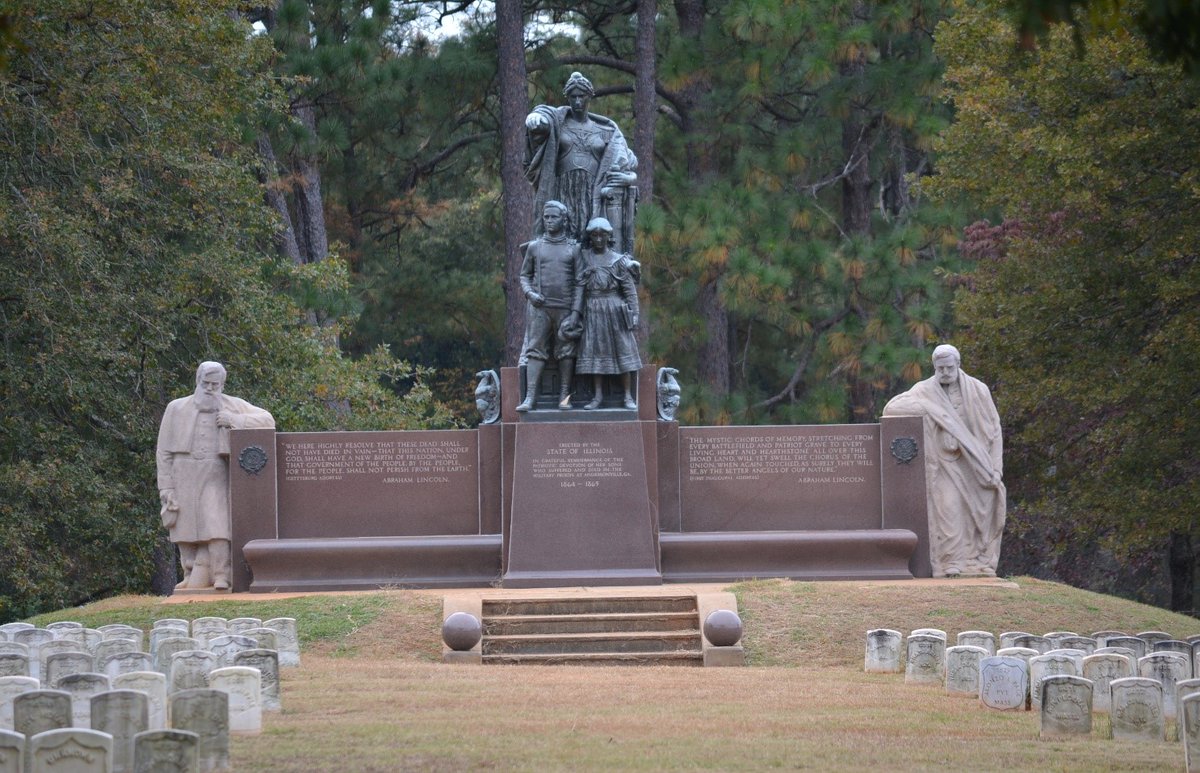
The Illinois monument erected in Andersonville National Cemetery is powerful. Among other interpretations, one might say Columbia stands pointing toward soldier's graves, instructing two children that this tragedy cannot happen again.
Lincoln's Telegram to McClellan
To Major Genl. McClellan Oct. 24 or 25. 1862
I have just read your despatch about sore tongued and fatigued horses. Will you pardon me for asking what the horses of your army have done since the battle of Antietam that fatigue anything? A. LINCOLN
The War Outside My Window: The Civil War Diary of Leroy Gresham. He was “young privileged white teenager” living in Macon, Georgia, watching the demise of his world even as his injured body failed him. A remarkable chronicle.
Abraham Lincoln, of course. Then it’s a toss-up between Clara Barton and Walt Whitman. Would also want to break bread with anyone who survived Andersonville prison. You talk. I’ll listen.
If you could have dinner with someone from the Civil War, a big talk with this person, maybe while enjoying some adult beverages, who would you choose and why? What would you ask him/her? Don't worry, there are no wrong answers here. ;-) Have fun!
Those are rail-splitter hands. The same hands he used to welcome countless thousands to the aWhite House, the same hands that signed the Emancipation Proclamation, the same hands that penned the Gettysburg Address.
French depicted the president as a worn but strong individual who had endured many hardships. He positioned Lincoln's hands in a manner that displayed his two leading qualities...strength & determination to see the war to a successful conclusion & compassionate, warm nature.
What a fabulous activity. No one could hear this news with equanimity, North or South. Clara Barton wrote the following in her diary: Nobody knows what to do.
NEW for Students! How did people react to the news of President Lincoln's Assassination? Designed for students to complete independently, this activity is printable, interactive online, or you can incorporate it into your Google Classroom. https://t.co/eCONmM1jxg #FordsFromHome
Just look at how closely those headstones are aligned. The same wagon that carried the dead to the cemetery was loaded with raw meat for the return trip. We can forgive but we must never forget.
Atop the New Jersey Monument, a silent bronze solider gazes over the graves of brave men who lost their lives at Andersonville. A total of 209 men from New Jersey died while imprisoned at Andersonville.
#FindYourPark#NewJersey#CivilWarHistory
@ClaraBartonMSO Which makes me wonder why Clara didn’t attend the Grand Review... Was she too busy back at Annapolis? Or was she too aware of the many absences in the ranks to “celebrate” this victory parade?
Join Garry Adelman of the American Battlefield Trust as he gives a brief synopsis of what happened to killed, wounded, and captured soldiers during the Civil War.
The Trip is on for the Western Battlefield Experience!
Wow! Just days after we sent an email requesting your support for members of the Trust’s education team to shoot a slew of videos in the Western Theater, we've met our goal.
We know that education amid the pandemic is incredibly difficult.
That's why the education team at the National Museum of Civil War Medicine designed digital resources to help educators and students discover & share the history of Civil War medical care.
https://t.co/HLm8OX7c32
Citizen Taney
Supreme Court Chief Justice Roger Taney died on October 12, 1864, at the age of 87 the same day his home state of Maryland passed an amendment abolishing slavery.
President Lincoln attended the funeral and made no public statement in response to Taney's death.
Now more than ever, all learning can be distance learning! Watch to see our programs and resources for teachers and students https://t.co/28095JsWvg #FordsFromHom#RemoteLearning#LincolnLegacy
#OTD in 1864, Maryland voters approve a new state constitution abolishing slavery. The vote is close: 30,174 to 29,799. Meanwhile, John S. Mosby and his partisan Rangers destroy part of the Baltimore and Ohio RR near Harper's Ferry and capture a train carrying $173,000 #CivilWar
Major advancements in germ theory came too late to save the wounded who suffered with horrific infections at the hands of their surgeons and nurses during the #CivilWar. #HistMed
https://t.co/VbmXhbo9rA
Amos Humiston was killed at the Battle of Gettysburg in July 1863.
A photograph found in his possession proved to be an important clue in reestablishing his identity. Humiston died clutching a photograph of his three children. #CivilWar#Gettysburg
https://t.co/JkKG2MLxE4