Check out Allison Nixon in HBO Max's latest tv series, "Most Wanted: Teen Hacker", on the true story of Julius Kivimäki.
Allison & Ben Coon joined us this year to discuss the "Com", an online phenomenon consisting of fraud, hacking, & violence.
https://t.co/nkEVIYJzFf
Honored to attend @NCFTA’s DISRUPTION conference this year supporting @TheHackingGames.
The Cyber-Enabled Harm track brought together investigators, intelligence analysts, #OSINT professionals, #cybersecurity leaders, nonprofits, and law enforcement focused on addressing some of the most serious harms online — especially crimes against children.
Grateful to witness the collaboration, expertise, and humanity in this space. Thank you to @WillMcKeen, @AlexanderSlotnick, @fergushay, @Unit221B, and NCFTA’s Japanese counterparts.
Too many others to name, and too many whose work must remain unseen. From one mother: thank you for protecting children and pursuing accountability against the darkest harms online.
I just learned the sad news that Peter Neumann has passed away.
Peter Neumann shaped how a generation of security people learned to think about risk. As editor of RISKS Digest, he gave many of us coming up in the 1990s and early 2000s a steady education in the real-world consequences of computer failures. His work made the field more serious, more thoughtful, and more honest. He will be missed.
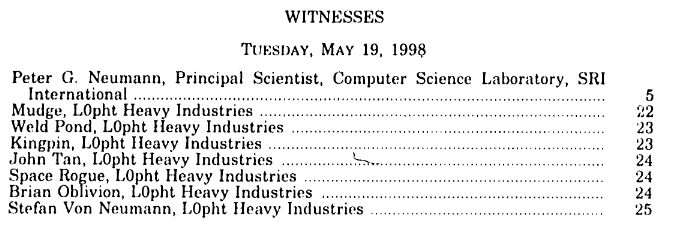
I first met Peter when we both testified at the 1998 Senate Governmental Affairs Committee meeting on Government Security where the L0pht testified. The combination of Peter and the L0pht made the hearing more powerful even if us hackers stole the spotlight.
Neumann and the L0pht made the same argument from two different directions. Neumann gave the institutional, systems-engineering view: the country was becoming dependent on brittle, interconnected systems that were never designed for security, reliability, or survivability. The L0pht gave the field evidence: here are the actual flaws, here is how attackers think, here is how cheaply and quickly these systems can fail in practice.
Neumann supplied the credibility of a long-time researcher warning that this was not just “hackers breaking into things,” but a structural failure of technology markets, procurement, engineering discipline, and risk management. The L0pht supplied the proof that the warnings were not theoretical. Together, we made the hearing unusually powerful: the academic risk community and the hacker community were telling the Senate the same thing, in different languages, before the rest of the world had fully caught up.
I can NOT overemphasize this enough:
DO NOT TRUST EMAILS
DO NOT TRUST PHONE CALLS
DO NOT TRUST SMS MESSAGES
DO NOT TRUST CHAT MESSAGES
DO NOT TRUST INCOMING COMMUNICATIONS!
Any message saying there is a security problem with an account that needs to be urgently fixed is a 🚩
Last night’s reunion was exactly what my soul needed.
Three decades in, Big Wreck still puts on one of the best live shows I’ve ever seen. I could watch them forever.
Incredible night at Paradise Rock Club 🎸🩷
@bigwreckmusic@ThornleyMusic
NEW EP: DPRK has been embedding IT workers in DeFi protocols since DeFi Summer 2020. They’re pretty good devs.
@bax1337 of SEAL 911 joins The Breakdown on how crypto crime has evolved from SIM swaps to nation-state social engineering.
We cover:
◆ SEAL 911: 30-person crypto emergency response team
◆ Monero’s 2017 inflation bug
◆ Arbitrum’s 9/12 multisig vs. 2/5 disaster
◆ DPRK red flags: bad GitHub hygiene, bad geography
◆ AI in cybersecurity — attackers are winning right now
@dcanellis