Most students who take math classes aren't going to be mathematicians. They're going to be engineers, statisticians - in many ways, that's the more important mission of math education.
— Terence Tao
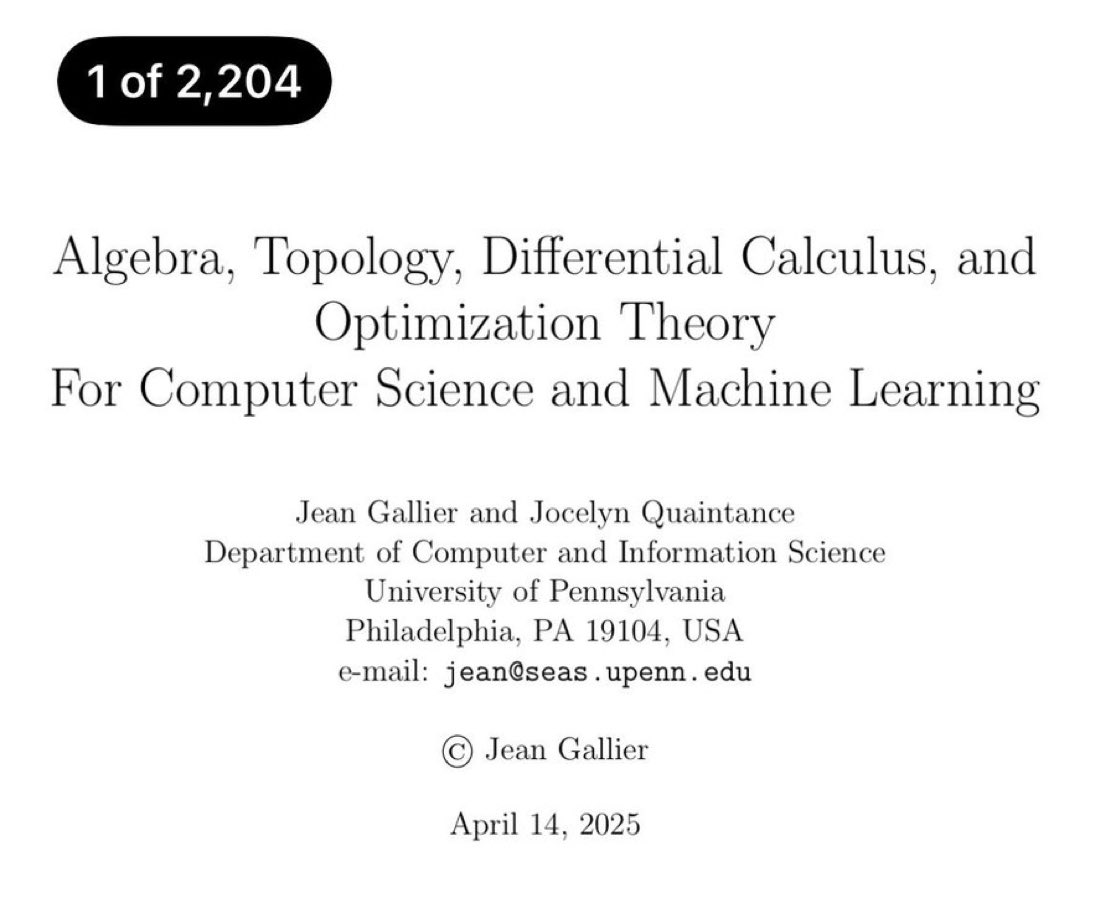
Updated 2204-page PDF Mathematics ebook:
"Algebra, Topology, Differential Calculus, and Optimization Theory For Computer Science and Machine Learning"
Find it here: https://t.co/HZc0LRoD7R
Jonathan Gruber, MIT economics professor:
"Jane Street can quote billions a day and still get picked off by one trader who knows more than they do. That risk has a name, adverse selection, and it's lecture 24 of a free MIT course."
this free MIT lecture holds the most important half of the "avellaneda-stoikov market making" framework the thread sells you. gruber explains adverse selection: when one side of a trade knows more than the other, the uninformed side systematically loses, and good markets can collapse entirely. that's not a finance trick, it's foundational economics, taught for free.
it's also the exact risk the thread's whole spread exists to survive. the post lists two market-making risks, inventory and adverse selection, and adverse selection is the one that actually kills you. the reservation price and the optimal spread are clever, but they assume every trader hitting you is uninformed. this lecture is about what happens when they're not.
so the math was never the moat. the avellaneda-stoikov equations have been public since 2008, and the deeper idea underneath them, that information asymmetry sets the real price of liquidity, has been textbook economics for fifty years.
and here's the honest part. you can implement the model perfectly and still bleed, because the base version assumes informed flow doesn't exist. it does. the edge was never quoting the optimal spread. it's sensing when the person lifting your offer knows something you don't, and widening before they take your whole inventory. the lecture is free. reading that, live, is the job.
Charlie Munger spent 50 years studying why intelligent people make catastrophically stupid decisions.
It is the most useful thing I have ever watched:
1. Incentives are more powerful than anyone thinks. Munger says he has been in the top 5% of his age cohort his entire life in understanding the power of incentives and he has still underestimated it every single year. Federal Express could not get their night shift to work efficiently until someone realized they were paying by the hour. They switched to paying by the shift. The problem disappeared immediately.
2. People rationalise terrible behavior when their incentives point that way, and they do not even know they are doing it. A doctor in Nebraska was removing perfectly healthy gallbladders for years. When Munger asked an old colleague whether the doctor knew he was harming patients, the answer was no. he genuinely believed the gallbladder was the source of all medical evil and that removing it was an act of love. That is incentive-caused bias at its most extreme.
3. Psychological denial is real, and it is not just for weak people. A family friend's son flew off a carrier in the North Atlantic and never came back. His mother, a completely sane woman, simply never believed he was dead. Reality was too painful, so she distorted it until it was bearable. Munger says we all do this to some extent, and it causes terrible problems.
4. Consistency and commitment tendency are one of the most powerful forces in the human mind. Once you have stated a position publicly, you are psychologically locked into it. Max Planck said the really important new physics was never accepted by the old guard. A new guard came along that was less brain blocked by its previous conclusions. If this happened to the deans of physics, Munger says, imagine what it does to ordinary people.
5. The Chinese brainwashing system used on prisoners of war worked better than torture. They did not start with big demands. They maneuvered people into making tiny little commitments and declarations and slowly built from there. The same mechanism operates in every cult, every sales system, and every ideology that gets deeply embedded in people's heads.
6. Pavlovian association shapes buying behavior at a level most people never consciously process. Munger estimates three quarters of all advertising works on pure Pavlov. Coca-Cola does not want to be associated with funerals. They want to be associated with the Olympics, wonderful music, heroics. The association itself changes how people feel about the product at a subconscious level. Raising the price of a product can actually increase its market share because price and quality are associated in the human mind, and people use price as a signal of value.
7. Persian messenger syndrome is alive and running every major organization. The Persians killed the messenger who brought bad news. Bill Paley in his last 20 years, did not hear one thing he did not want to hear. everyone around him knew bringing bad news was dangerous. The result was that one of the most powerful men in media made terrible decisions for two decades because reality never reached him.
8. Social proof causes otherwise intelligent people to follow each other off cliffs. When one oil company bought a fertilizer company in the 1970s, practically every other major oil company rushed out and did the same. There was no rational reason for oil companies to own fertilizer companies. But if Exxon was doing it, it was good enough for Mobil. Every single acquisition was a disaster.
9. The efficient market theory persisted in academia for decades despite Berkshire Hathaway existing as a living contradiction. One economist kept adding sigmas to explain away the anomaly. two sigma, then three, then four, eventually six sigma. Munger's observation: It is better to add a sigma than change a theory just because the evidence comes in differently. That economist later went into money management himself and sank like a stone.
10. Contrast bias warps perception constantly and invisibly. Put your hand in hot water, then room temperature water. It feels cold. Put your hand in cold water, then room temperature water. It feels hot. same bucket. The human sensory apparatus has no absolute scale, only a contrast scale. Real estate agents exploit this deliberately. They show you two overpriced, awful houses first, then take you to a merely overpriced house, and it feels like a bargain.
11. The frog in slowly heating water is the business version of contrast bias. If something bad comes to you in small pieces, you are likely to miss it entirely. Munger says he has known many high-powered brilliant businessmen who were destroyed this way. not because they were stupid but because each incremental change was too small to trigger alarm. The contrast was never large enough to notice.
12. Authority bias is so powerful it can make trained professionals watch a plane crash. In flight simulator experiments, when the pilot, the authority figure, does something that any trained co-pilot knows will crash the plane, 25% of the time, the co-pilot sits there and lets it crash anyway. They have been trained to know better. The authority relationship overrides the training.
13. Deprivation super reaction syndrome explains why people go insane over small losses. Munger's neighbor had a 180 degree view of the harbor. the neighbor put in a pine tree about 3 feet high that turned it into a 179 and three-quarter degree view. They had a blood feud that went on for years. The New Coke disaster is the corporate version. Coca-Cola told customers they were changing a flavor and triggered a deprival super reaction so powerful that Pepsi was weeks away from releasing old Coke in a Pepsi bottle. smart engineers. brilliant lawyers. armies of psychologists. All missed it.
14. Envy and jealousy are far more powerful than greed and almost entirely absent from psychology textbooks. Munger says Warren Buffett has said half a dozen times that it is not greed that drives the world but envy. In a thousand-page psychology textbook, the index entry for envy and jealousy is blank. One of the most powerful forces in human behavior and academia essentially ignores it.
15. Gambling addiction is not explained by variable reinforcement alone. Skinner thought he had fully explained gambling by showing that variable reward schedules pound in behavior more powerfully than fixed ones. But the people who design modern slot machines know things Skinner did not. Lotteries where you pick your own number get far more play than lotteries where the number is assigned to you. People who commit to a number believe it has more validity because they chose it. Near misses on slot machines trigger deprival super reaction syndrome. It is four or five psychological tendencies working together, not one.
16. The most dangerous situations are when multiple psychological tendencies combine toward the same end at once. Munger calls this the lollapalooza effect. Tupperware parties use four or five tendencies simultaneously. Moonie conversion methods combine multiple tendencies and work extraordinarily well. alcoholics anonymous achieves a 50% no drinking rate when everything else fails because it also combines multiple tendencies toward a constructive end. The Milgram experiment is not just about obedience. it involves authority bias, consistency and commitment tendency, and contrast effects all working together. That combination turns human brains into mush.
17. Boards of directors are structurally designed to fail as corrective mechanisms. The top executive is the authority figure. He is doing something questionable. You look around, and nobody else is objecting, which is social proof that it is fine. He flies you around in the corporate jet and raises your director fees every year, which triggers reciprocation tendency. Munger's rule: boards only act when the behavior gets so bad it starts making them look foolish or threatens legal liability. That is the only forcing function that reliably works.
18. John Goodfriend of Salomon Brothers destroyed his career and reputation because he did not fire a trusted employee who had lied to the government. Every psychological tendency pointed toward keeping the man. He was a close colleague. His wife was known. He was part of a group that had made over a billion dollars for the firm. He said he had never done it before and would never do it again. Goodfriend looked into his eyes and believed him. The man did it again. The lesson: everyone who gets caught embezzling says they have never done it before and will never do it again. That is what they all say.
19. Darwin avoided confirmation bias by deliberately seeking out disconfirming evidence. Munger says Darwin was not especially smart by ordinary standards of human acuity. Yet he is buried in Westminster Abbey. Munger studied how Darwin worked and realized he had psychological tricks worth learning. Darwin always paid extra attention to evidence that contradicted his theories. Munger started doing the same and credits it as one of the most important intellectual habits of his life.
20. Why is the most important word in communication? Carl Braun designed oil refineries with spectacular skill, and you got fired in his company if you wrote a communication without explaining why. not just who, what, where, and when, but why. Braun knew that in a complex system where things can blow up, a communication system that always explains the reason behind an instruction works dramatically better than one that does not. Forstein, the general counsel of Salomon, told Goodfriend on multiple occasions that he had to report the employee's misconduct. He explained it was the right thing to do. He never explained what would happen to Goodfriend personally if he did not. he failed to use the most powerful tool of persuasion. Goodfriend ignored him. When Goodfriend went down, Forstein went with him.
🚨 Anthropic just showed a 27-minute workshop on how to actually do prompts for Claude.
Taught by the people who built it.
Free. No registration. No paywall.
I've seen $300 courses that don't cover what they teach in the first 8 minutes.
Watch it and bookmark it now.
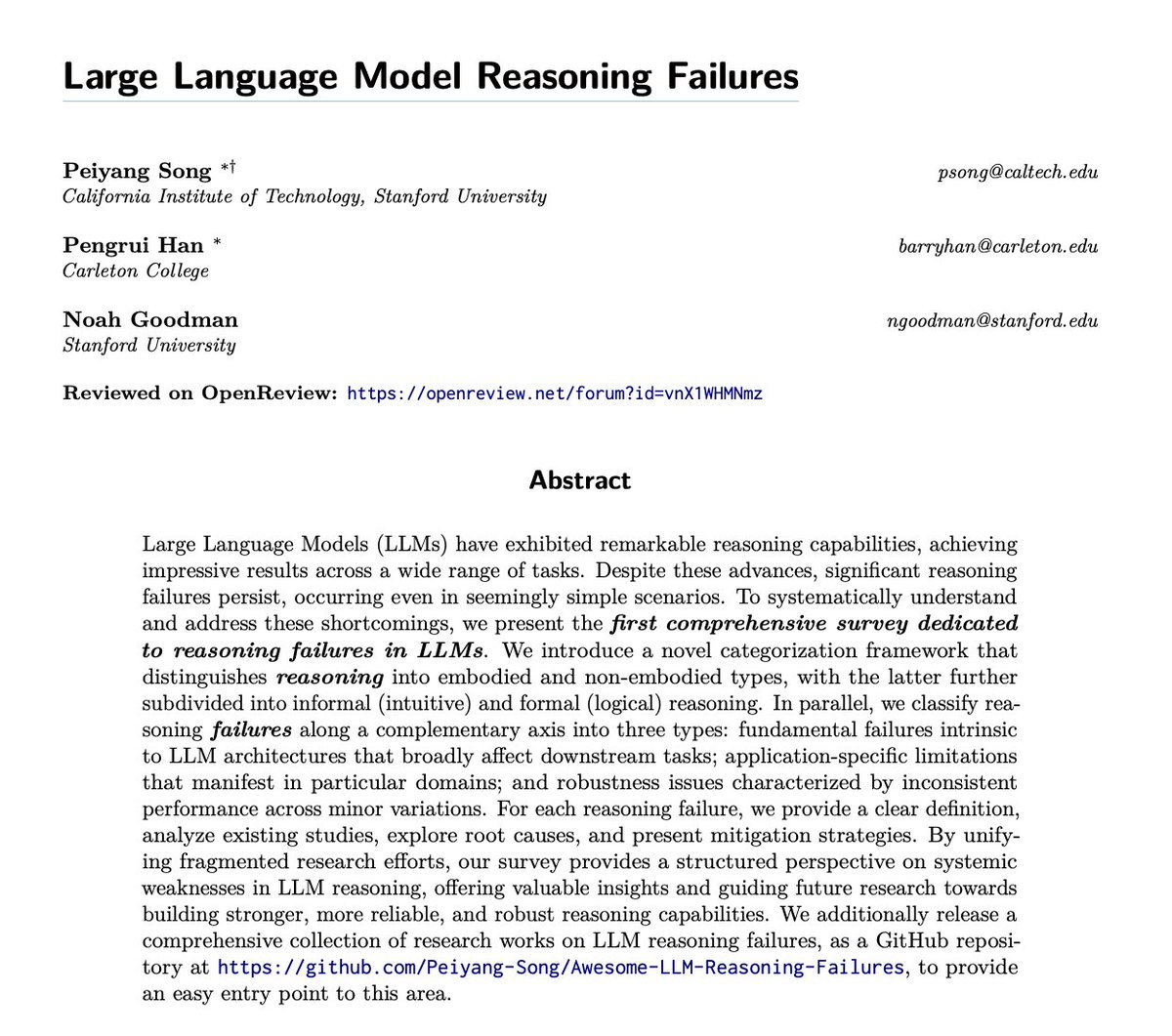
🚨 Holy shit… Stanford just published the most uncomfortable paper on LLM reasoning I’ve read in a long time.
This isn’t a flashy new model or a leaderboard win. It’s a systematic teardown of how and why large language models keep failing at reasoning even when benchmarks say they’re doing great.
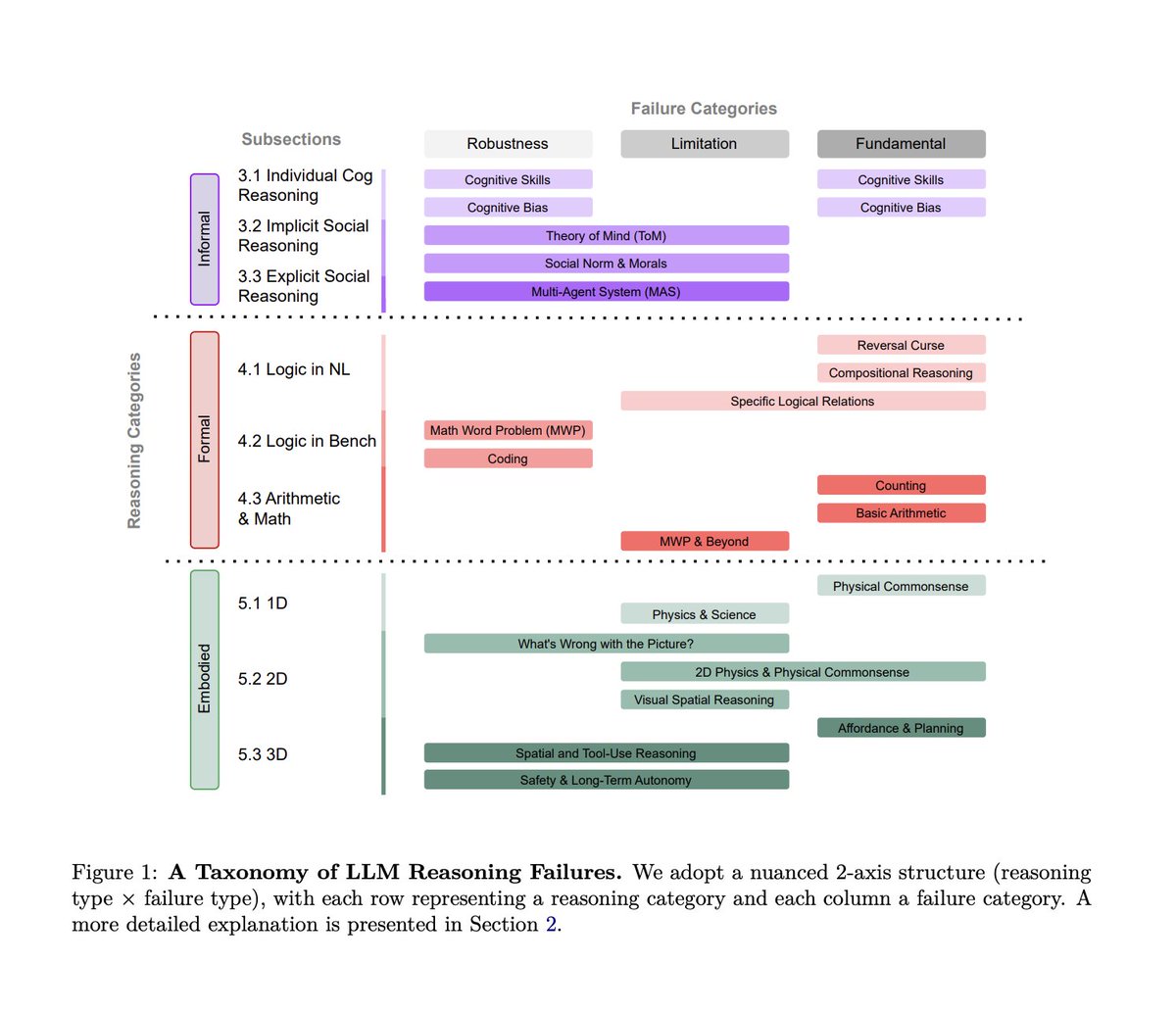
The paper does one very smart thing upfront: it introduces a clean taxonomy instead of more anecdotes. The authors split reasoning into non-embodied and embodied.
Non-embodied reasoning is what most benchmarks test and it’s further divided into informal reasoning (intuition, social judgment, commonsense heuristics) and formal reasoning (logic, math, code, symbolic manipulation).
Embodied reasoning is where models must reason about the physical world, space, causality, and action under real constraints.
Across all three, the same failure patterns keep showing up.
> First are fundamental failures baked into current architectures. Models generate answers that look coherent but collapse under light logical pressure. They shortcut, pattern-match, or hallucinate steps instead of executing a consistent reasoning process.
> Second are application-specific failures. A model that looks strong on math benchmarks can quietly fall apart in scientific reasoning, planning, or multi-step decision making. Performance does not transfer nearly as well as leaderboards imply.
> Third are robustness failures. Tiny changes in wording, ordering, or context can flip an answer entirely. The reasoning wasn’t stable to begin with; it just happened to work for that phrasing.
One of the most disturbing findings is how often models produce unfaithful reasoning. They give the correct final answer while providing explanations that are logically wrong, incomplete, or fabricated.
This is worse than being wrong, because it trains users to trust explanations that don’t correspond to the actual decision process.
Embodied reasoning is where things really fall apart. LLMs systematically fail at physical commonsense, spatial reasoning, and basic physics because they have no grounded experience.
Even in text-only settings, as soon as a task implicitly depends on real-world dynamics, failures become predictable and repeatable.
The authors don’t just criticize. They outline mitigation paths: inference-time scaling, analogical memory, external verification, and evaluations that deliberately inject known failure cases instead of optimizing for leaderboard performance.
But they’re very clear that none of these are silver bullets yet.
The takeaway isn’t that LLMs can’t reason.
It’s more uncomfortable than that.
LLMs reason just enough to sound convincing, but not enough to be reliable.
And unless we start measuring how models fail not just how often they succeed we’ll keep deploying systems that pass benchmarks, fail silently in production, and explain themselves with total confidence while doing the wrong thing.
That’s the real warning shot in this paper.
Paper: Large Language Model Reasoning Failures
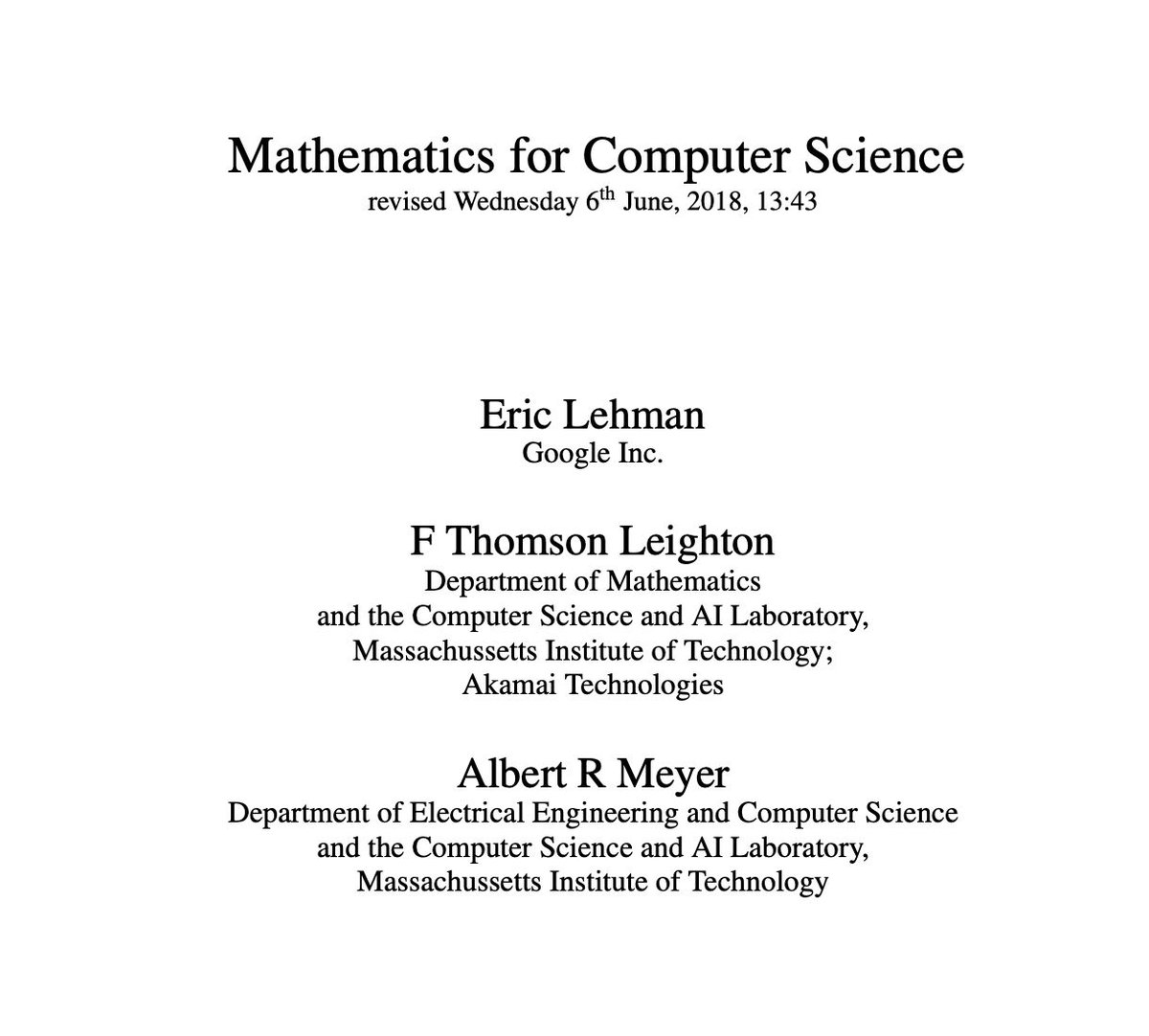
One of the best math books I've ever read:
MIT's "Mathematics for Computer Science"
Its writing style is brilliant, and it covers everything:
- Linear algebra
- Series
- Logic
- Probability
- Number theory
- Graphs
You can find the PDF here:
https://t.co/iQvaflkDPD
Fasting can expand your lifespan.
But if you do it wrong, it leads to hormonal imbalance, insomnia, and metabolism problems.
Here’s everything you need to know (& how to avoid the toxic effects)
Check Thread 👇
Kant & the Path of German Idealism: Competing Accounts of Cognition.
"This book examines the revisionist developments of the immanent systems of Kant’s German Idealist successors, presenting their systematic efforts as cautionary tales in to reject Kant’s epistemic wisdom."
Why do humans get stuck in Trauma while wild animals recover naturally?
In the 1970s, Dr. Peter Levine noticed something remarkable:
Wild animals face death daily yet don’t develop PTSD, depression, or anxiety.
His discovery revolutionized how we understand trauma forever:🧵
This book has absorbed me for the past month. Each essay has sent me down a few rabbit holes, and so many explore questions that speak to where I am at in my own thinking these days. And it has the best title! Translated from the Hungarian by @caringerel@yalepress
One of my favorite Philosophy YouTube Channels "Pessimistic Idealism." @Neo_1dealism This episode is key for anyone interested in the British Idealist, Francis Herbert Bradley.
F.H. Bradley | Absolute Idealist Philosophy. https://t.co/BerGPuVR2S