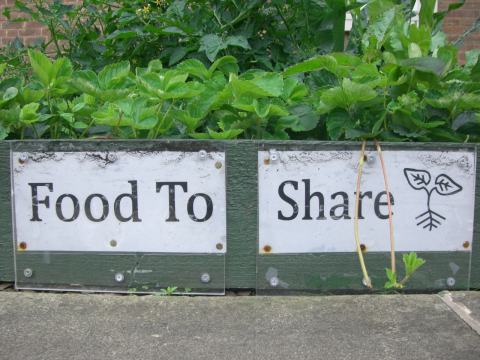
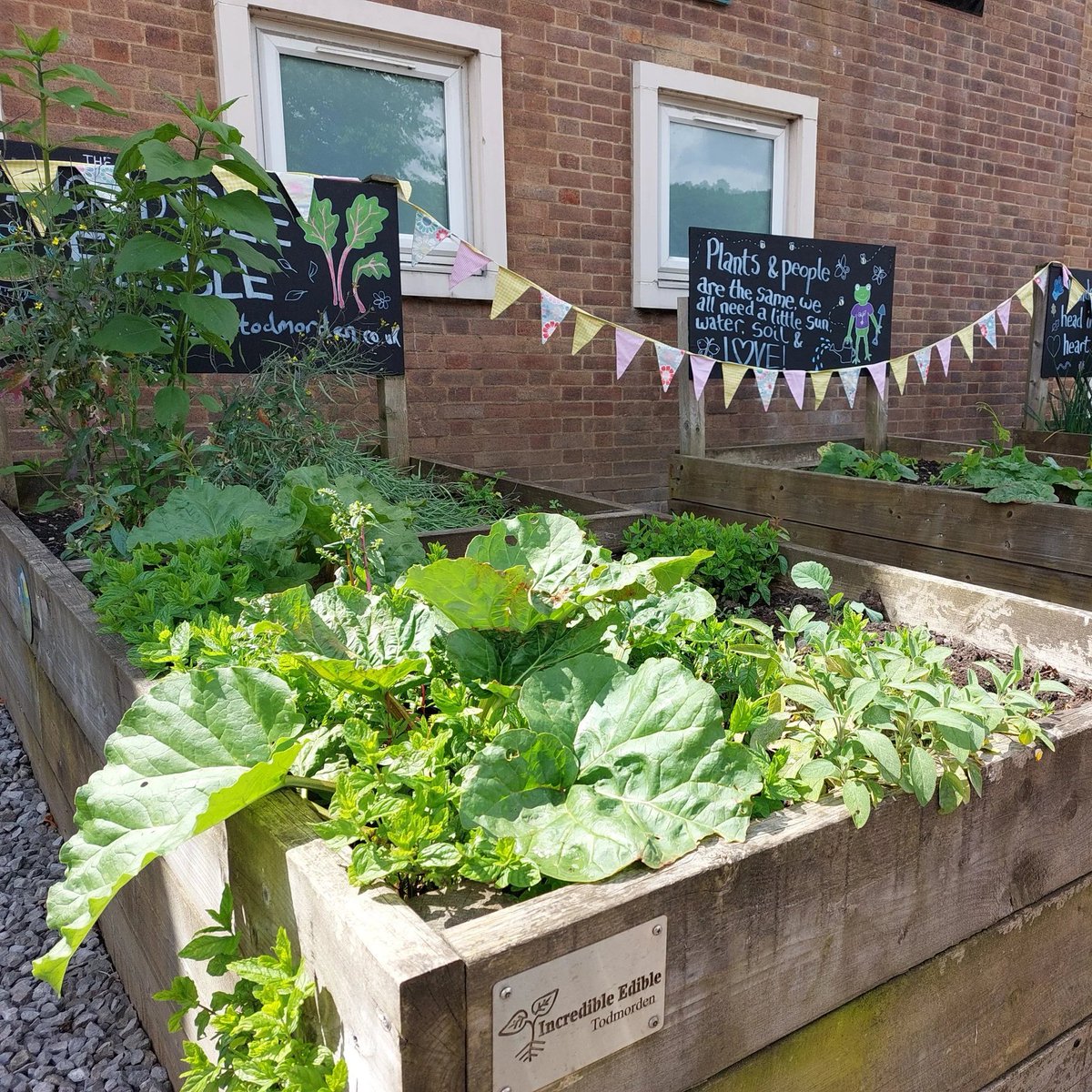
In 2008, a group of friends in a small Yorkshire town decided to start planting food in unused public spaces.
The town is Todmorden, population about 15,000, tucked into a valley between Burnley and Halifax. The group is Incredible Edible Todmorden. Their motto is "if you eat, you're in."
Today the railway station beds grow herbs. The fire station is surrounded by fruit trees. The canal towpath is lined with edible plantings. The forecourt of the local police station has been transformed into what's now called "possibly the finest and greenest looking police station in the UK," with a small library of crime novels installed for good measure. Everything is free to harvest.
They have no paid staff, no buildings, and no public funding. They've operated this way for almost two decades. Their guiding principles: "believe in the power of small actions," "kindness underpins everything we do," and "it's sometimes better to ask for forgiveness, not permission."
Over the years they've added a Tool Library, a Makery, and little free libraries scattered around town. They host visitors from around the world (they call it "vegetable tourism"). Their gardening Sundays have grown from four or five people to forty or fifty.
The model has been replicated in over 700 projects worldwide and continued to spread.
Walking slowly through the evening light after a long day, I found myself following in the footsteps of these ladies as they kicked up dust on the dirt road. Dandelion seeds blew across our progress, a couple of blackbirds called out to us from the darkening hedgerows, and we wandered on together, all heading home into the quiet hug of the hills.
📍 Peak District, England
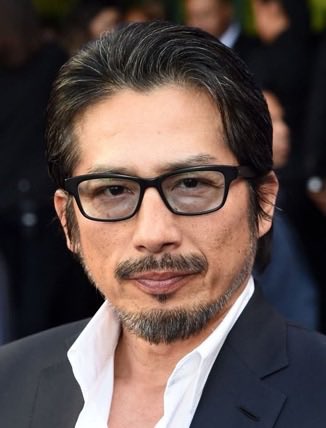
Japanese actor Hiroyuki Sanada spoke about the contradictions of human nature:
“Some people dream of having a swimming pool at home, while those who have one hardly ever use it. Those who have lost a loved one feel a profound sense of loss, while others often complain about their living relatives. Those without a partner long for one, while those who have one often don't appreciate it. The hungry would give anything for a meal, while the satiated complain about the taste of their food. Those without a car dream of owning one, while those who have a car are always looking for a better one.”
The key to happiness is gratitude: truly seeing and appreciating what we already have, and understanding that somewhere, someone would give anything for what we take for granted.
Jimmy Carr said something on Chris Williamson’s podcast that’s been rattling around in my head:
You can be a billionaire and miserable, or stuck in a boring office job and genuinely content. The difference usually isn’t your circumstances — it’s your disposition. That internal weather system you carry around every day.
No matter how connected you are, how great your family is, you’re still alone with your thoughts a lot. So how do you show up? Are you hunting for jokes, wearing rose-tinted glasses, or defaulting to grumpy?
Jimmy nailed it: gratitude is the thing that actually moves the dial. If you’re in a bad mood most of the time, you’re not “in a bad mood” — you’re just being an arsehole to the people around you. How you treat the waiter, how you react to a speeding ticket, how you handle the thousand little annoyances life throws — that’s who you really are.
In a noisy world full of comparisons and external chaos, your default disposition might be the quietest, most powerful lever you have. Changing the world is hard. Shifting how you see it? Often easier than we admit.
For me, putting myself in the hands of God and practicing gratitude for even the smallest things is what resets that grumpy default. The small stuff really is the big stuff.
What about you — would you say you mostly move through the world with a sunny disposition, or do you catch yourself defaulting to the negative more than you’d like?
Roald Dahl told kids that good thoughts shine out of your face like sunbeams. Forty-five years later, neuroscientists ran the experiments. He was basically right.
Charles Darwin had a version of this idea in 1872. He wrote a whole book about it called The Expression of the Emotions in Man and Animals. He thought that showing a feeling makes you feel it more, and that the expressions you wear every day eventually settle into your face.
A 2011 study at USC and Duke tested the first part on real people. They compared patients who got Botox to patients who got a different filler that doesn't paralyze the muscles. Then they showed both groups photos of strangers and asked them to guess the emotion on each face. The Botox group did worse. Your face and your brain are wired in a loop. Freeze one side and the other goes quiet too.
There's a body version of the same effect. Years of stress flood the body with cortisol. Cortisol breaks down the collagen and elastin that hold your skin together. A 2024 paper in the Journal of Cosmetic Dermatology measured this on actual people. Subjects with sustained moderate stress had visibly more wrinkles, thinner skin, and slower healing than the mild-stress group.
Years of furrowed brows etch the lines in. Years of clenched jaws change the shape of your cheek.
There's also a longevity study from the University of Kentucky, published in 2001. Researchers scored 180 women's handwritten autobiographies that they wrote at age 22. Sixty years later, the ones with the most positive emotion in their writing were dying at less than half the rate of the ones with the least. By age 80, 60% of the unhappy group had died. Only 25% of the happy group had.
And total strangers actually pick up on it. People can judge personality traits from a neutral photo of someone they've never met, with accuracy better than random guessing. The judgments aren't always fair. The face you've practiced for years still broadcasts something to a stranger in under a second.
Dahl called it sunbeams. The technical version is uglier but it's the same idea. The expressions you wear most often reshape the muscles you use to make them. Cortisol from chronic stress breaks down the skin around those muscles. And you partly read other people's emotions by mirroring their expressions on your own face, so a face that can't move can't mirror well either. Your face is a thirty-year diary of what you've been thinking about.
John Major speaks so much sense in this Newsnight interview. He had huge difficulties in his six and a half years as PM, but almost thirty years on from leaving office he's become the wisest of our nine living prime ministers.
Basit ve güzel bir anlatımla " tüm çokgenlerin dış açılarının toplamının neden 360 derce olduğunun ispatı. Hiç bir çocuk bu şekilde anlatıldığında bunu unutmaz.
I put my 15 y/o son to bed each night. Will be heartbroken when he outgrows it. He talks more at that time than any other time in the day. I feel sad already for the inevitable ending of it.
Nick Cave responding to a grieving mother who worries that she forsaw, or perhaps even willed, the death of her young child is one of the most beautiful things you will read today.