This would preference those with assets (stocks, real estate, etc) over those who rely on income and savings.
Asset-rich, income-poor economy.
Haven’t we had enough of that since post-2008?
This is called faux bois, meaning false wood in French.
Very specialized, it wasn't something you just asked your regular painter do. Most were European immigrants who carried it across the pond.
The irony here, it was still cheaper back then to hire the labor than to get the more expensive wood!
Quantifying the Future
This is what a $2 trillion economy will look like by 2040…
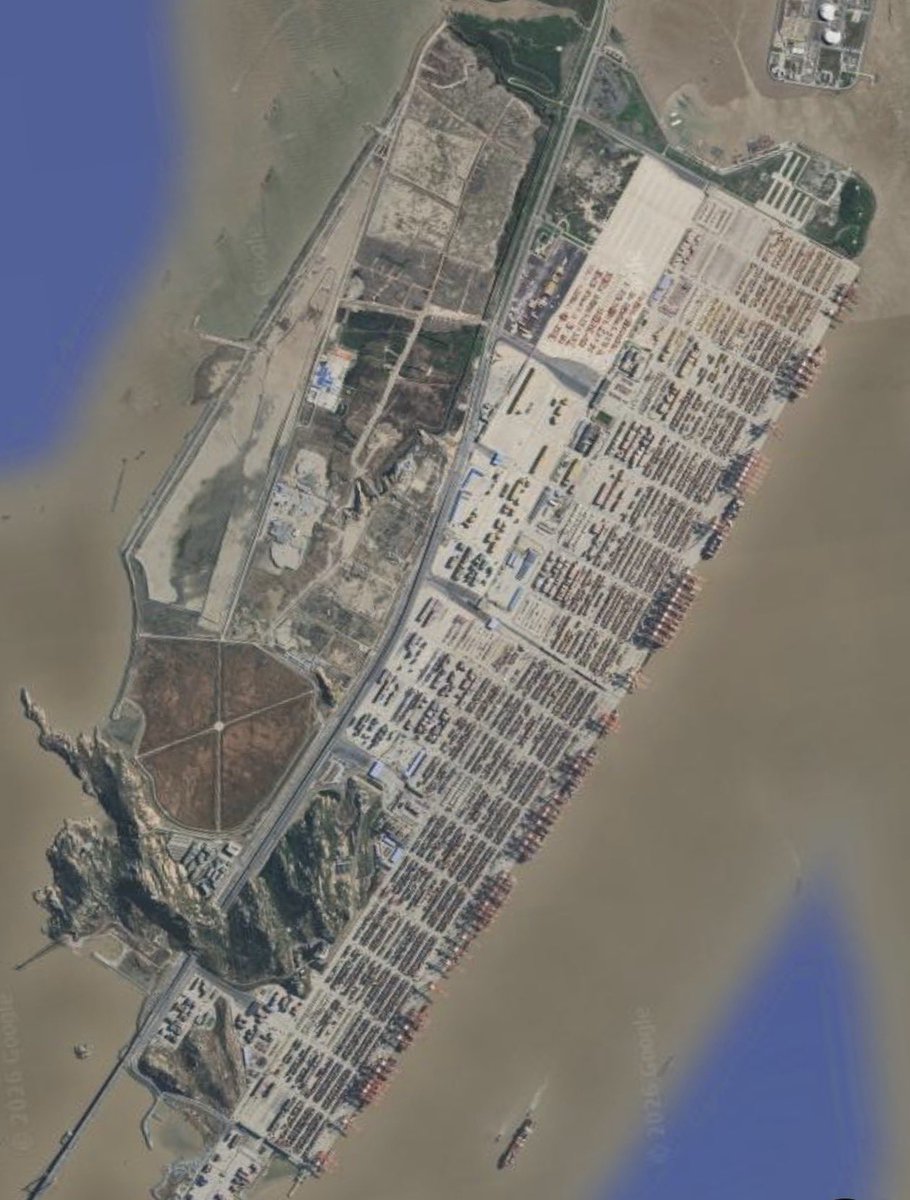
+ 1x port facility with 3x8km lay down area
+ 1x robot fab plant producing 100 bots / hr
+ 1x 1GW datacenter running inference
+ 1x 3GW nuclear power station
= 2 million robots labouring 24/7
We know enough today to model the thermodynamics and the market economics of such a site already. The numbers above are the ballpark numbers you end up with, feel free to challenge or change for your own assumptions.
Embodiment is the ceiling for both the thermodynamics and economics, as compute (and intelligence) pretty much trends towards zero under Moore’s Law.
Assuming a robot is 500W of Newtonian motion, as humanoids are, then 2,000,000 robots working 24/7 is 1GW of demand for the robots’ actuators.
Let’s also assume a 1GW datacenter is required for inference for 2m robots, supervised by a central monolithic superintelligence. That’s 2GW total.
Then for the sack of maintenance and replacement, we assume 500MW robot fab can produce 100 robots an hour (only ~ 5 ton of product / hr, below a car plant, but includes chips). That’s now 2.5GW site total.
For 2,000,000 robots to create $2T of value, each bot needs to add $1m of value each year
Seems a lot, but each robot is assumed to work 24/7 and only last ~2 years before it is defunct.
24x365 =8,760 hrs/yr
=>$114/hr
Seems high at first, but this is a hyper collaborative hive mind marshalled by 2040 superintelligence. $114/hr is what you pay for a car mechanic in 2026, and we are using 2026 dollars here.
We can even look at the thermo and economic density and the total footprint of this economy is just tiny.
3x8km is 24km^2 (about 6,000 acres).
= 83,000 robots / km^2 = 12m^2 per robot
Thermal dissipation
= 500W / 12m^2
= 41.7W/m^2 (just 2-3% of solar insolence)
Value add density
=$1m / 12m^2
=$83k / m^2 <- Wow!!
This is $2T GDP from just 8km of coastline
Or $500bn of GDP per km of dockside
The entire economy can be compressed into the 3km deep dockyard behind the dockside.
That’s an economy the size of Australia or Mexico in a land area the size of San Francisco Airport.
This is absolutely where the future economy is going, nothing can compete with the capital efficiency of this setup. Nothing.
Docks are also crucial as it’s simply not possible to handle the prerequisite volume of cargo and goods for such an economy using anything other than isomodal freight handling systems.
If your nation state is interested in adding $2 trillion to its tax base… my DMs are open.
I cannot let a steam engine analogy go by without bringing up John Wilkinson, perhaps the most underappreciated engineer of the Industrial Revolution.
Watt had figured out how to dramatically improve the steam engine, but he spent years struggling to actually manufacture one. The problem was embarrassingly simple: nobody could make a sufficiently round cylinder.
The casting and machining tolerances were atrocious. Watt complained that one 18-inch cylinder was out of round by as much as THREE-EIGHTHS OF AN INCH. Steam leaked past the piston. He tried packing the gaps with cork, oiled rags, paper, and apparently even old hats. Nothing worked particularly well.
Enter John Wilkinson, a British ironmaster whose immediate concern was manufacturing better cannons.
At the time, iron cannons were commonly cast around a core, introducing defects and misalignment that could make the barrels inaccurate or dangerously weak. Wilkinson developed a process for boring cannons from solid castings, and in 1774 patented a vastly improved boring machine.
The key innovation was almost comically mechanical: a massive, rigid boring bar, supported at both ends, that could cut a genuinely straight, circular hole instead of following the irregularities of the casting.
He adapted this technology to Watt's cylinders. By 1776, Matthew Boulton was boasting that Wilkinson had bored a FIFTY-INCH cylinder accurate to within the thickness of an old shilling.
Suddenly, the steam engine was a commercially viable machine.
And the story gets better. Wilkinson became one of Watt's first customers, buying an engine to drive the blast machinery at his own ironworks. The steam engine was now helping manufacture the iron that made more steam engines possible.
I find this whole episode absolutely extraordinary. The Industrial Revolution was, for a critical period, bottlenecked on the ability to make a sufficiently round hole.
We remember Watt, and rightly so. We remember the invention of the steam engine and the subsequent development of thermodynamics. But the man who made the machinery that made the whole thing possible is practically a footnote.
I think we consistently underestimate how much of scientific progress is actually downstream of advances in tooling, measurement, and manufacturing precision. It's not just that technology precedes theory. Sometimes the decisive breakthrough is that someone finally figures out how to build the thing the theorists have been talking about for twenty years.
Anyway, I think John Wilkinson deserves considerably more credit for modern civilization than he gets.
The elites of Victorian Britain got up late, drank ceaselessly, worked short hours, partied through the night, and knew nothing about science, technology or engineering. And yet, by their own lights, they were hugely effective.
https://t.co/TvbuWtaPRJ
The Victorians are often held up as a model against the supposedly soft, feckless, humanities-educated elites of today. But I argue that the genius of their system may have been its drastic weighting towards soft skills, team-building and intra-elite networking:
- A Victorian’s gentleman’s office hours typically began about 11am and finished about 5pm, including a multi-course lunch with wine.
- Upper-class Victorians drank ceaselessly. Conduct guides recommended four or five glasses of wine at dinner *for married women*. Port was often served in pints.
- Party culture was intense and nocturnal. Balls started at about 10pm, peaked after 1am, and continued till dawn. During the social season, bankers, judges and politicians might go to several balls per week.
- Elite Victorians learnt almost no STEM at school or university. At least half of class time was given over to ancient languages, often as much as 80 percent. One leading educationalist remarked that it was not worth teaching science to gentlemen because it does not involve ‘continued reasoning’.
- Sports and character formation were valued far above transmitting facts. A top headmaster described his school’s priorities as ‘First – character, second – physique, third – intelligence, fourth – manners, fifth – information’.
This cannot have made elite Victorians more productive individually, but maybe the dense social and emotional network it created helped them to work as a sort of extended team.
Perhaps we should think again about what makes groups of people effective.
We’re in the “phone phreaking” era right now for AI agents. AI agents are selling you on convenience; how they will actually work at scale is very different: a cautionary tale
Back in the 60s and 70s, some kids figured out you could use toy whistles and the like to control AT&T’s phone network. AT&T actually published the relevant frequencies in open literature; you could just look them up. AT&T did this for the benefit of telephone engineers; it never considered that the system could be hacked.
The system worked so long as no one took advantage of it. It was convenient. But once knowledge spread of *how* it worked, and how easy it was to reverse engineer, it broke down. AT&T shifted over to a different system, and phreaking came to an end
AI agents are doing the exact same thing. They’re taking advantage of a system that works on human trust, and also on the friction - the time cost - that having to call or chat to a customer service agent imposes. Everyone has made the calculation about whether or not it was “worth it” to make a complaint or request or to raise an issue. Often, it isn’t. So you just don’t say anything.
AI agents reduce the cost of complaints/requests to ~ zero. Anything free is consumed at much higher rates, so we should expect the total volume of this category to explode.
Further, today companies and their employees typically assume that the complaints or requests they receive have an actual person behind them. Once AI agents become a mainstream thing, this will no longer be true. Now the assumption will be reversed: that any given customer interaction is actually coming from a bot.
Just as early car ownership was liberating, but mass ownership represents a constraint on your freedom, the same will be true with AI agents.
People using these agents today are getting good responses from companies because they are benefiting from the (now unwarranted) assumption that these requests are coming from a person. They’ll
no longer think this in the near future. The ways they train their customer service people to deal with customer requests will change, too. You don’t have to be nice to an agent. And they won’t be. The return to AI agents will decline as companies build entirely new workflows to deal with the huge volume of automated requests they’ll be getting from bots in the near future
The system today works on trust: that there’s a real person behind each customer interaction, and that if somebody has reached out to you, they’re concerned or mad or scared or whatever enough to do so. The contact is a signal that some minimal threshold of importance has been met. The business model is built on this belief about customer behavior.
But that trust is broken by ubiquitous AI agents. None of the current assumptions will hold true in the future. Once the customer population is mostly bots, the nature of customer service (at least online) is fundamentally changed
Agents will make the online environment even worse. I’m very bearish on the category. All the tech guys seem excited by this new frictionless world of automated convenience where the agents are getting you automatic refunds and canceling your old subscriptions and getting you that free upgrade on your next flight
Please.
You’ve got to think non-linearly. All these new frictions will need to be introduced to keep the system working smoothly. Agents rely on deception; that there’s a person behind them. But that’s not a safe assumption anywhere. So the system will adjust, just as it did with the phreakers: from default open and trusting, to adversarial: prove you’re human
We take for granted so many beautiful phrases that became ordinary by repetition. At first ‘to sparkle’ only meant ‘to emit lots of sparks’; the first person to say a river sparkled, or a girl’s eyes, might have been a poet.
after a century of uninterrupted growth, for 15 years, between 2005 and 2020, America did not grow electrical generation. we completely forgot what it meant to grow industrial capacity. politicians constantly talked about "reindustrializing" and "bringing back high-paying blue collar jobs".
then AI actually did it. for the first time in 20 years we started reindustrializing America's heartland. creating a massive boom of skilled, high-paying blue collar labor. an enormous construction boom. a new industry emerged to finance the expansion of our aging grid. a grid that needed to grow anyway, if we were going to become a modern, highly electrified economy. and all of a sudden the tech companies and hyperscalers showed up with wads of cash, completely willing to pay for a massive grid expansion.
and all the politicians that talked so tough about "bringing back industry and blue collar jobs" panicked when the rubber hit the road. because the NIMBYists had become used to stagnation and freaked out when it came time to build a couple transmission lines. all that tough talk down the drain, because some boomers have AI anxiety and think a warehouse full of computers is unsightly next to a mattress warehouse and a vape shop. probably the most pathetic political episode I've ever witnessed.
the only question that really matters is: is it still possible to build anything at all in this country? or have we completely lost the political will?
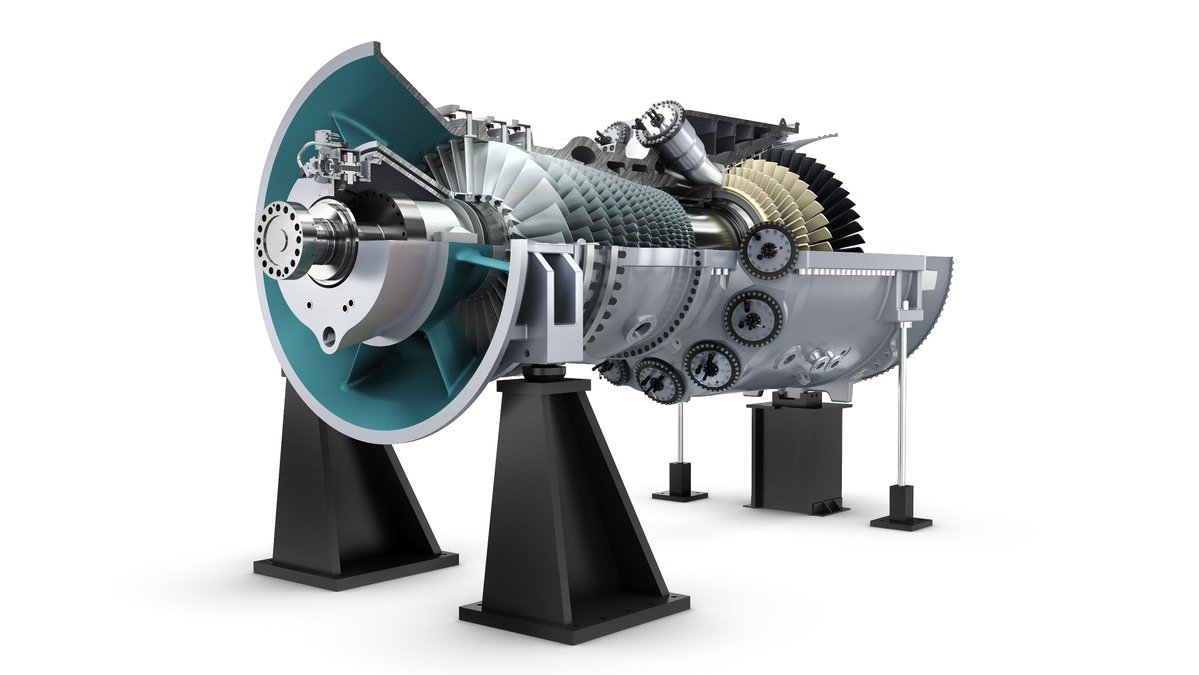
This is the most powerful single gas turbine engine ever built for electricity generation.
Siemens Energy's SGT5-9000HL weighs nearly 500 tonnes, spins at 3,000+ rpm and can produce 593 MW from a single machine.
Its exhaust leaves at around 670°C. Instead of wasting that energy, a combined cycle plant uses it to drive a second steam turbine, pushing total output to roughly 880 MW at over 64% efficiency, enough electricity for around 840,000+ homes.
Run it continuously for 24 hours and that's 21.1 GWh of electricity.
For perspective, to generate the same amount of electricity it would take roughly 1 million 600 W solar panels spread across 16 km² and would take around 6 average days to generate that much electricity.
Or 40 modern 15 MW offshore wind turbines would take roughly 3 average days.
This is the sheer scale and power density of modern gas-turbine engines, generating hundreds of megawatts, continuously, from a single rotating machine.
"Make cheap cars and homes deathtraps again" is unironically a gigachad-tier opinion.
Safety just isn't important enough to commit civilizational suicide over. We landed men on the moon just fine when cars didn't have seatbelts or crumple zones.
Nicknamed the “Starship,” this wildly futuristic private jet interior was created for Saudi billionaire Adnan Khashoggi in 1985
Design by Michael Reese & Company
When “the laptop” 1st dropped I saw a pic of Hunter Biden with a Chinese girl in black lingerie, she looked to be maybe 9 or 10. U can make Howling Mutant jokes if u want but that whole family is rotten to the core& I don’t think he should graduate to goofy Twitter acct