The Fil-C story is a very interesting one, I talked about it in my YouTube channel back then, but what is very intriguing is that if Rust was *really* about safety, the same community would adopt Fil-C massively. Together with Rust, likely, not in substitution, but massively.
The problem with the "if it works who cares what the code looks like" mindset for agentic work is that it assumes the agent has a perfect understanding of "works." Realistically, things are underspecified, agents make bad assumptions, etc.
To be fair, agents are pretty good at unit test coverage. They're pretty bad at designing human experiences (API, CLI flags, etc.), especially cohesive ones for future roadmap plans they may not have visibility into (unless your backlog is perfect and vision fully laid out, which I doubt). They're bad at knowing where performance matters and what type (CPU vs memory tradeoffs). They're bad at where compatibility matters and where it doesn't (and tend to err on the side of preserving it without further guidance). Etc.
Unless you have this ALL specified, you can't possibly claim "it works" without taking a look and thinking about it.
NVIDIA just released Nemotron 3 Ultra, a leading Hybrid Mamba-Transformer MoE open model for long-running agents.
I've been test driving it these past few days, letting it work on Pi issues and it performed amazingly well!
Update your https://t.co/TgG5bkXUdV and use it via @OpenRouter today!
Welp, that happened faster than I predicted. Thought it would be end of 2027, then early 2027, but agentic traffic growing so fast that bots have now passed human traffic online for the first time in the Internet's history. https://t.co/2zX5bHdhsa
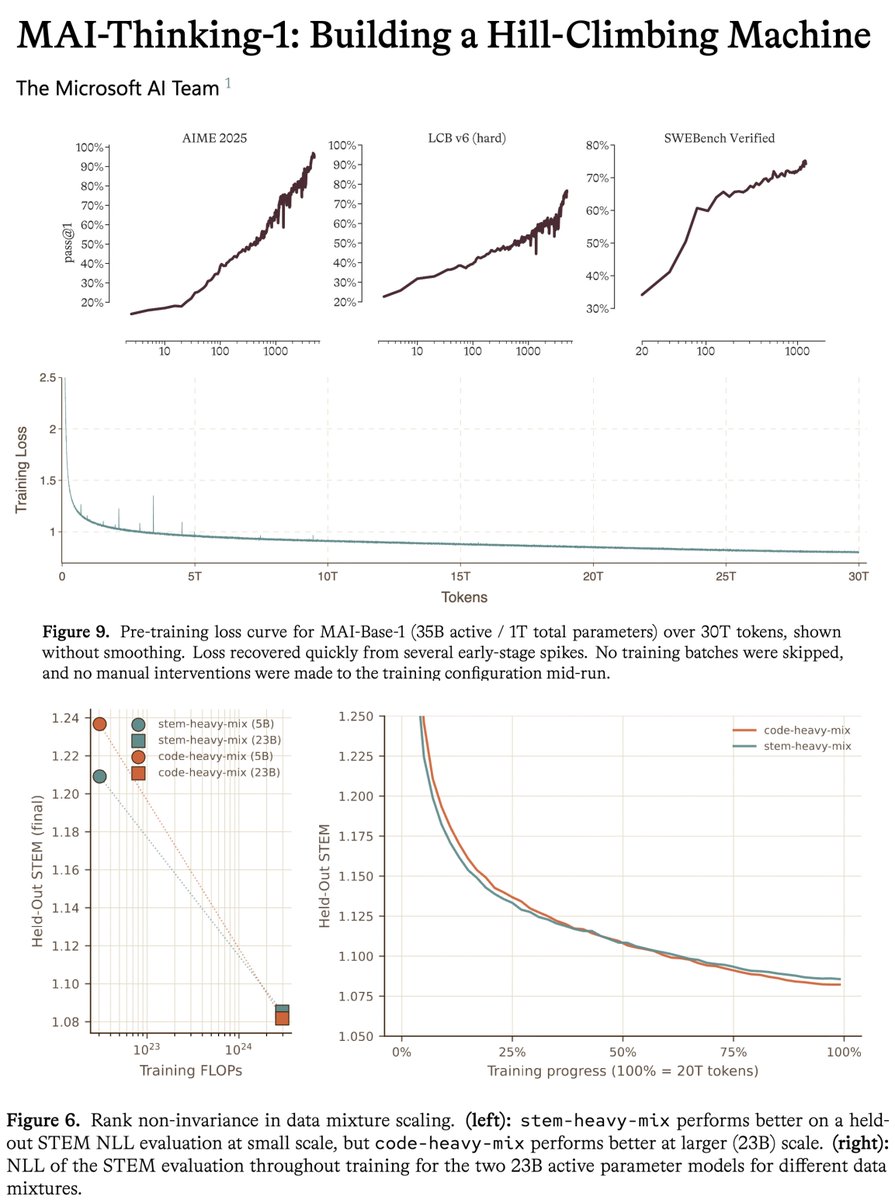
microsoft MAI tech report is a gold mine, one of the most transparent for a model at this scale.
this model uses zero synthetic data or distillation from previous models. this means reasoning, agentic behavior, tool use are all learned fully during post-training with no cold start. bold choice that makes it harder and requires more iterations to reach sota, but you get FULL control over your model series and it proves they are serious about being a frontier lab.
the tech report is insanely detailed and precise about numbers. to give an example, they give the exact MFU across all the iterations of the model, with the exact changes etc. they also share the full scaling ladder recipe, to my knowledge this is the first time i've seen this in a tech report at this scale
let's look at all of this in this likely very long thread 🧵
what a wonderful project: parakeet.cpp
https://t.co/idw7t2y106
GGML based parakeet inference pipeline that's 2x faster than my ONNX parakeet pipeline on Apple Silicon! (Needed a few local patches to get it going)
llama.cpp now has an official website: https://t.co/vztdUpdBWL
Our goal is to make local AI accessible to everyone, and improving the user experience is a big part of that. On the new landing page you’ll find a single-line cross-platform installer. The installation provides a single unified `llama` entrypoint which you can use to run/serve models and interface with 3rd-party agentic applications.
While oriented towards simplified user experience, the new `llama` application also provides all the advanced functionality of the existing llama.cpp tooling with which experienced users are already familiar. Also note that all GGUF models that you might have already downloaded with llama.cpp in the past will be automatically available to use without downloading again (they are stored in the common HF cache on your machine).
We have many improvements in the pipeline both at the UX and at the engine level and we plan to iteratively ship new things over the coming months. One of the main focuses will be seamless integration with local-friendly 3rd-party agents (such as Pi). In the meantime, we’ll continue to listen for feedback from the community and adjust accordingly, so keep letting us know what you think and need.
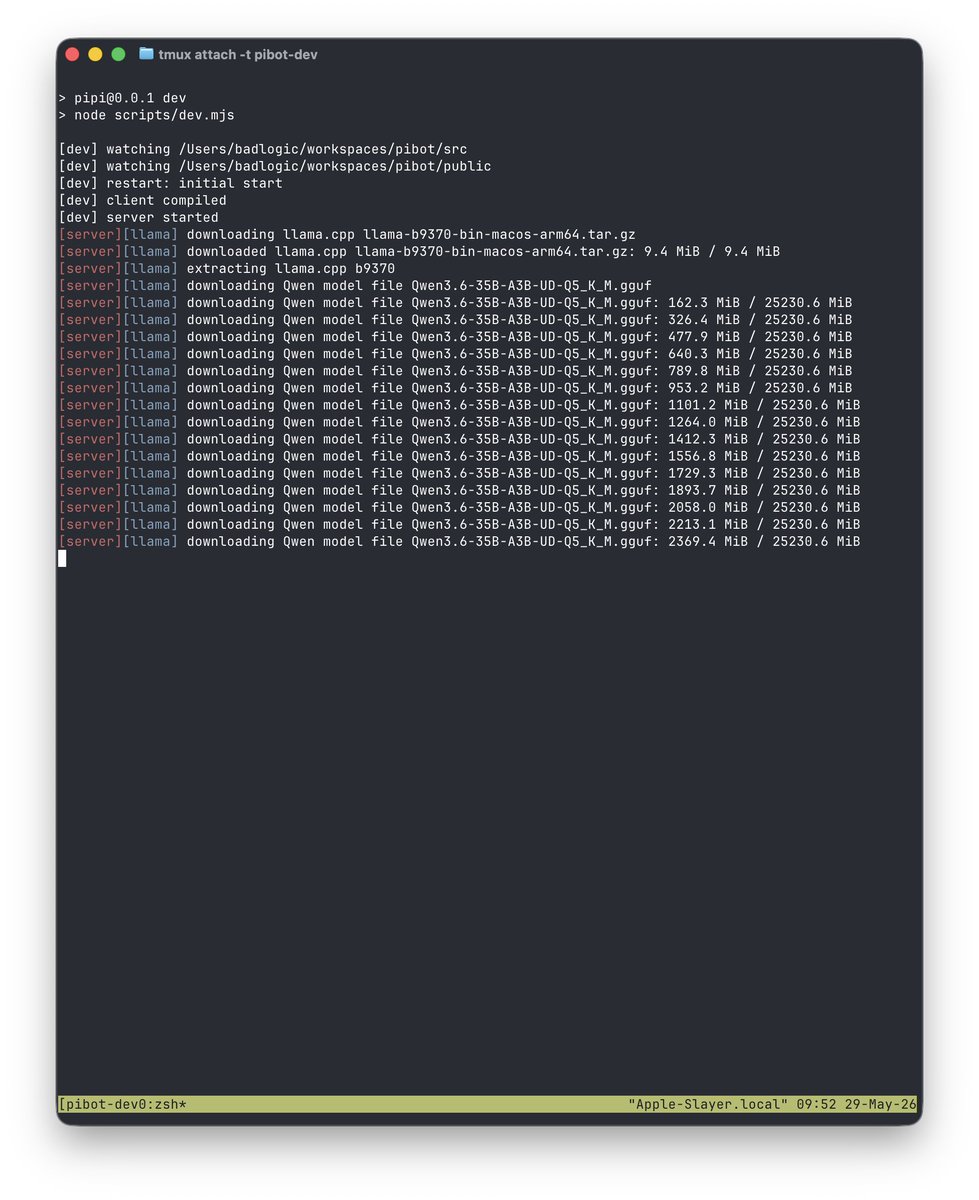
pibot is now running fully local, using parakeet for STT, qwen3-tts for TTS, and Qwen 3.6 as the local multi-modal LLM via llama.cpp.
The STT and TTS inference engines are Rust/mlx-c based. Ported from Python. So, zero Python dependencies :D
Flash-KMeans was only the beginning.
Today, from the Flash-KMeans team, we are releasing FlashLib — a GPU library for fast, predictable, agent-ready classical ML operators.
Up to 26× on KMeans, 19× on KNN, 40× on HDBSCAN, 208× on TruncatedSVD, 47× on PCA, 147× on exact t-SNE, and 49× on MultinomialNB over state-of-the-art (cuML).
Blog: https://t.co/P31SGl0cyT
Code: https://t.co/9nkO2hmeOl
A little secret. About 5% of our production traffic is on the Pi harness, about another 5% is on OpenCode. Reminder you can use your ChatGPT account in a flourishing set of other tools.
We’ll continue to make Codex awesome, but you have options.
The release candidate for MCP 2026-07-28 is out. The protocol is now stateless: no handshake, no session id, any request can hit any server instance. Plus extensions as first-class (MCP Apps, Tasks), auth hardening, and a proper deprecation policy so we don't have to do this again.
https://t.co/XRLTu1BSkB
I strongly believe there are entire companies right now under heavy AI psychosis and its impossible to have rational conversations about it with them. I can't name any specific people because they include personal friends I deeply respect, but I worry about how this plays out.
I lived through the great MTBF vs MTTR (mean-time-between-failure vs. mean-time-to-recovery) reckoning of infrastructure during the transition to cloud and cloud automation. All those arguments are rearing their ugly heads again but now its... the whole software development industry (maybe the whole world, really).
It's frightening, because the psychosis folks operate under an almost absolute "MTTR is all you need" mentality: "its fine to ship bugs because the agents will fix them so quickly and at a scale humans can't do!" We learned in infrastructure that MTTR is great but you can't yeet resilient systems entirely.
The main issue is I don't even know how to bring this up to people I know personally, because bringing this topic up leads to immediately dismissals like "no no, it has full test coverage" or "bug reports are going down" or something, which just don't paint the whole picture.
We already learned this lesson once in infrastructure: you can automate yourself into a very resilient catastrophe machine. Systems can appear healthy by local metrics while globally becoming incomprehensible. Bug reports can go down while latent risk explodes. Test coverage can rise while semantic understanding falls. Changes happens so fast that nobody notices the underlying architecture decaying.
I worry.
recommended reading. strongly recommended reading.
i really like the pain avoidance angle. slots into my "paon/friction is when you learn" angle. when combined > cognitive debt.
https://t.co/clzPIgXaSU
We open-sourced some amazing work on an experimental Rust compiler for GPU from my colleagues at @nvidia. It takes a slightly different approach to expose GPU programming concepts natively in Rust. Check it out https://t.co/xR4Ho2LUMR.
We're excited to publish new research on agentic search.
We found that nearly 50% of an agent's tool calls read and search for code and files. So then why does it take coding agents so long to find the right file?
We thought the bottleneck was slow code search. But after investigating 200,000 real world tool calls, we found the real problem.
Principal Engineer @evisdrenova explains the research and what really matters for agentic search:
https://t.co/OCRMYPwzd2
People of https://t.co/TgG5bkXUdV. Today we are:
- moving the pi GH repo to earendil-works org
- start publishing pi packages under the @earendil-works namespace, instead of @mariozechner
for the time being, extensions importing from the @mariozechner will continue to work, however, if you have type checking setup (you should), you should switch to @earendil-works as soon as the packages are in the NPM repo.
caveat: your extension will then no longer work in old pi versions after today's pi release. we need to rip this bandaid off. sorry.
Welcome to DS4, a specialized inference engine for DeepSeek v4 Flash. https://t.co/UrUJz5I2R1
This project would have been impossible without the existence of llama.cpp and GGML and the work of @ggerganov and all the other contributors. Thanks!
Hunk is very good. It has completely replaced any other local diff viewer for me. It looks good, its speedy, good keyboard shortcuts, good mouse support for fallback. Great software @bentlegen. https://t.co/6HH5DPO5mO