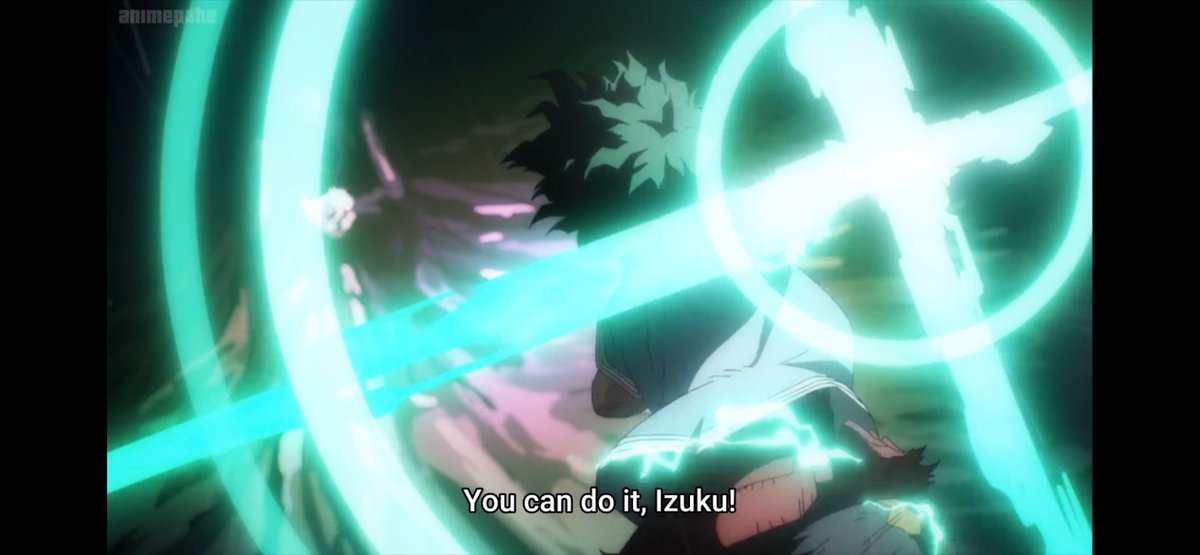
#MyHeroAcademia Final Season #08
"YOU CAN DO IT, IZUKU MIDORIYA",
🥹🔥🔥. This ep was absolute banger. Everyone was cheering on for Izuku.
Izuku is just an amazing and awesome character🔥🔥🔥🔥 THE GOAT🔥🔥
#GoDeku#MHA#がんばれ緑谷出久#頑張れ緑谷出久#ヒロアカ
【Your Understanding of Trading Is Expressed as “Consistency”】
No matter how complex the theories you study or the techniques you master, in the end you are expressed by one thing—consistency, and nothing else.
A trader’s true caliber reveals itself not in the volume of knowledge or the sophistication of technique, but in the form of consistency.
This article explains why consistency is the most important element in trading.
■A Strategy Without Consistency Means Nothing
Any strategy or trading approach is meaningless without consistency.
A profit on a single trade in front of you does not prove the strategy is superior.
Whether you can truly wield the strategy, whether you have genuinely built conviction, and whether your understanding of trading is free of misconceptions—all of that shows up as consistency.
If you cannot sustain consistency, you do not yet possess what a trader needs.
It simply means there is more work to do.
■True Consistency Is Tested by Losing Streaks and Drawdowns
Losing streaks and drawdowns are inseparable from consistency.
It is contradictory to try to preserve consistency while trying to avoid losing streaks.
Anyone can follow the rules when they are winning.
The real test comes in losing streaks and drawdowns.
What matters is whether you can change nothing and still follow your rules through a losing streak or a drawdown.
They are unavoidable—they will occur.
The key is whether you already accept them as part of the statistics and whether you can think in terms of a much larger sample size.
In other words, to “overcome” losing streaks or drawdowns is not to change something when they occur, but to frame your trading at a scale larger than the streak you are in.
■Sample Size Creates Conviction
To let probability do its work, you need a very large sample size.
Have you truly done the preparation required?
Ask yourself—rigorously.
If you test or judge only on small samples, randomness exerts an outsized influence and the strategy’s reliability declines.
Do not grant trust lightly.
Conviction is earned through sample size.
If you feel distrust, it is because you have not tested and trained the edge on a large sample, or because you are judging current results on a small sample size (a week of losses, a month in the red, and so on).
■Consistency Is a Skill
How fully you understand the trader’s job, how thoroughly you have prepared, and whether that work has produced the right mental state—these are expressed as “consistency.”
Consistency is not merely a matter of mindset.
Nor does it appear simply because you decide to be consistent.
Consistency is a skill.
It reflects the extent to which you have done the necessary preparation, truly understand probability, and know what you must do within a long‑term horizon.
The road is long—keep going.
If this post was helpful, my book will take your probabilistic thinking to the next level.
📚 Get your copy here👇
https://t.co/tMFssKR6Oz
【For Traders Who Lose Confidence at Entry】
Over the weekend, when you analyze charts, you feel calm and confident.
Come Monday, confronted with a live market, that confidence suddenly evaporates and your finger trembles over the entry button.
This phenomenon, common to many traders, does not mean you are weak.
If anything, that anxiety is an important signal that you are ready to take the next step as a trader.
■What Exactly Is Driving Your Anxiety?
The anxiety you feel before entry is a prime opportunity to identify what you are currently missing.
To trace its root, start by asking yourself two questions.
1. Are you anxious because you’re thinking, “I might lose on this trade”?
2. Or are you anxious because you’re thinking, “Is this truly according to my rules, and should I take it?”
Depending on which of these your anxiety resembles, the causes and remedies differ substantially.
■Identify the Root Cause of Your Anxiety and Address It
If your anxiety is about the first point—the outcome—the cause may be a lack of probabilistic thinking or a lack of trust in your strategy’s statistical edge.
It may also stem from the mistaken belief that places too much weight on each single trade’s win or loss.
If, on the other hand, your anxiety is about the second point—the process—the cause is clearer.
Your entry criteria may be ambiguously defined, you may not have built scenarios in advance, or you may not be prepared to simply wait.
Emotions are inseparable from your thinking.
Trying to strip away anxiety without fixing the underlying thought process and preparation does not work.
All the deep breathing in the world will not help if your strategy lacks statistical edge, and your trading will not succeed over the long run.
■Emotions Aren’t Erased—They Evolve
You may think, “We’re human, so we can’t reduce emotions to zero.”
You’re right.
And there is no need to eliminate them.
The aim is not to delete emotions, but to let the way they manifest change naturally as your thinking matures.
The anxiety you feel in trading is not a primary, hard‑wired fear like being afraid of the dark.
It is a secondary emotion that arises from your understanding, perception, and reasoning.
・Truly understand that the outcome of any single trade is random
・Know how probability operates and how edge is realized
・See any one trade as a component of a long‑term undertaking
・Do the necessary preparation and genuinely trust your strategy
・Pre‑script scenarios and be able to simply wait
When these sound thought processes and preparations are in place, the feelings you experience at entry will naturally shift from anxiety and fear to focus and a quiet, steady confidence.
■Summary: Turn Anxiety Into Fuel for Growth
Weekend confidence and weekday anxiety.
This gap is commonplace among traders, and it is also valuable feedback that points to what you should be doing right now—things you may not yet have noticed.
Don’t look away from that anxiety.
Use it as a teacher that reveals your weak spots.
Do that, and the same anxiety will lift you another rung higher as a trader.
If this post was helpful, my book will take your probabilistic thinking to the next level.
📚 Get your copy here👇
https://t.co/tMFssKR6Oz
The market doesn't defeat you.
You defeat yourself when you abandon your system during a drawdown.
A drawdown is not a sign of failure.
It's a test of your conviction.
The edge you're seeking lives on the other side of that pain.
Good night 😴
The desire to “make money” is what makes you overly concerned with your P&L in the moment, leaving you vulnerable to the influence of recent streaks of wins or losses.
Since everyone enters trading with the goal of making money, we all begin in a state where results inevitably affect us.
But as you come to understand the uncertainty of trading, you must cultivate probabilistic thinking and a long-term perspective, allowing your purpose to shift toward “executing the process faithfully” and “staying consistent.”
How well you can transform your “wanting to make money” into a commitment to consistent, disciplined process execution is absolutely crucial on your trading journey.
Revisit my “Trading Psychology.”
It’s all written there.
Good night 😴
E-book 👇
https://t.co/tMFssKR6Oz
Do not hesitate.
Hesitation at entry makes you judge by one outcome whether you should have taken that trade, pushes you into short-term focus, and erodes consistency.
Set clear rules that preempt hesitation.
If you still hesitate, one rule: "If you hesitate, skip the trade."
Don't confuse 'learn from failure' with 'learn from losses.'
A loss isn't failure.
Choosing not to 'learn from losses' is an advanced skill.
It isn't neglecting learning; it shows you've already learned and accept every rule-conforming loss as an expected, necessary cost.
You regret “missing out” only when the skipped trade wins.
Had it lost, you’d be glad you stayed out.
The real issue is inconsistent entries—no clear criteria, just ambiguity.
And the core problem is short-term thinking that seeks that answer in one immediate outcome.
Whether you’re brimming with confidence or have none at all, if your rules tell you to take the trade, you must take it.
If you can’t grasp this, you probably won’t be able to trade with probabilistic thinking.
You’ll keep prioritizing your own opinions, and you’ll keep suffering from the wins and losses unfolding right in front of you.
Good night 😴
Trading is extremely difficult.
It demands consistency and discipline to let probability work, the ability to avoid fixating on short-term outcomes, and—most importantly—an unshakable trust in long-term results built from experience.
In this sense, it’s similar to earning a living as an athlete in sports; it is not like being an employee where everyone receives a paycheck.
If you’re not willing to put in the effort and preparation it requires, trading will only make you miserable.
Good night 😴
1. Failure to cut losses.
2. Taking profits too early.
3. Setting position size based on emotion.
As long as you keep doing these, you will never succeed.
The reason is simple: these are essential parts of any rule designed to hold a positive expectancy.
When you trade, you will “always” lose money.
If you don’t want to lose any money at all, you shouldn’t trade.
Trading is about making profits while losing money along the way.
You need to truly understand this—and that very understanding must form part of your strategy.
Good night 😴