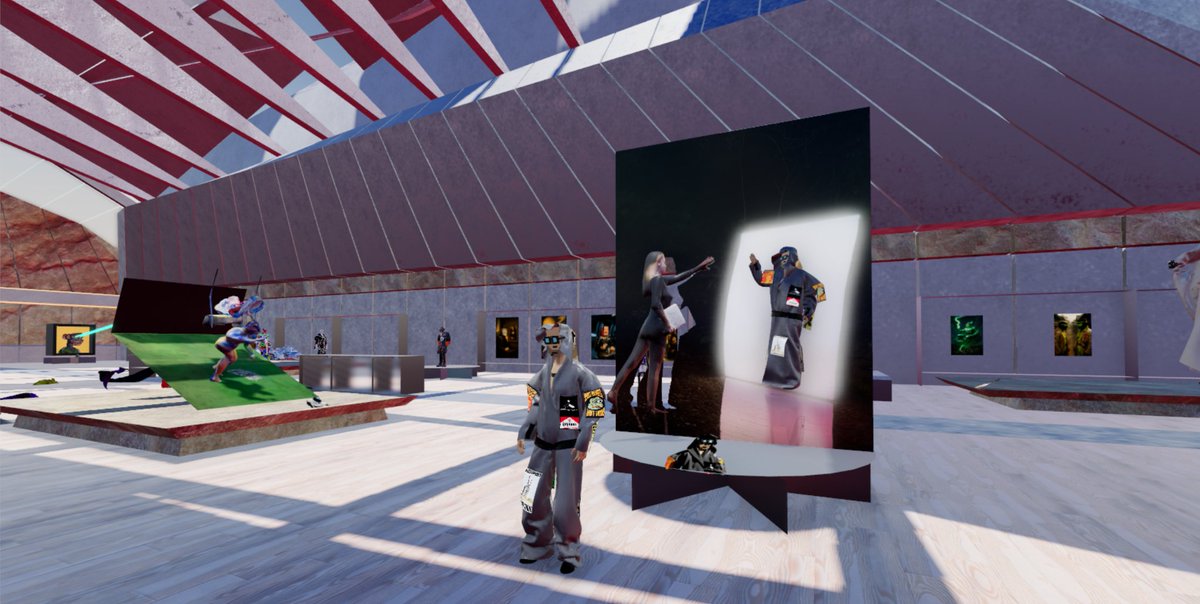
I've been working on this website and studio for some considerable time: Virtually Ever After, our architect-led creative studio. And with its website, we wanted to try our shot at awwwards.🏆
We made its portfolio a real-time WebGL building with monochrome wireframe architectural aesthetics we like a lot. Scroll moves you along a single path through the rooms; drag to look around, then interact with the screens hanging on the walls to open a project. Each work category becomes a corridor, with films playing inside the space. WebAudio gives every room its own chord, while the sound of wind responds to how fast you move. The site adjusts the 3D experience to your device, and you can switch to an editorial view to browse the same work as a page.
It’s now nominated on Awwwards, and voting ends tomorrow. If you have a moment to explore it and like what we built, we’d really appreciate your vote! Thanks in advance🙏
link below
From sketch to home, built in 3D with Claude Opus 5.5 using Three.js + TSL. The architecture evolves through four stages: first lines, massing, detail, and finished home.
A pivotal moment for real estate! 🏡
Capturing a property in 3D used to mean a $5,000 LiDAR scanner. This house was scanned with a $500 @insta360 X5 - a consumer 360 camera.
And best of all? All of the software is free and open source! It's based on a technique called 3D Gaussian splatting:
🪄 Splat creation: Spirula Studio
🖼️ Splat rendering: @PlayCanvas
So for $500, you can present any property online and let prospective purchasers freely explore as if it was a videogame. 🎮
[1/3]
Just uploaded a ton of nature assets. These were all originally made for my game, but I'm sharing on my site.
Every one of these is actually a plant species found in my own yard and neighborhood.
I hope you can use them in your own game or other projects!
Architects are going to hate this.
Someone just open sourced a full 3D building editor that runs entirely in your browser.
No AutoCAD. No Revit. No $5,000/year licenses.
It's called Pascal Editor.
Built with React Three Fiber and WebGPU -- meaning it renders directly on your GPU at near-native speed.
Here's what's inside this thing:
→ A full building/level/wall/zone hierarchy you can edit in real time
→ An ECS-style architecture where every object updates through GPU-powered systems
→ Zustand state management with full undo/redo built in
→ Next.js frontend so it deploys as a web app, not a desktop install
→ Dirty node tracking -- only re-renders what changed, not the whole scene
Here's the wildest part:
You can stack, explode, or solo individual building levels. Select a zone, drag a wall, reshape a slab -- all in 3D, all in the browser.
Architecture firms pay $50K+ per seat for BIM software that does this workflow.
This is free.
100% Open Source.
The jump from GPT-5.6 to GPT-6 Astra for world generation is honestly monstrous. This result genuinely surprised me.
My first prompt was simply:
“Create a cozy lake with a fisherman’s cabin on the marshy shore. Put a small island in the middle of the water, with an abandoned house hidden among the trees. Add a fishing boat beside the cabin, lily pads, reeds, jumping fish, typical wetland wildlife, a small beach, one path leading to the beach and cabin, another path returning into the forest, and a tree line around the entire scene.”
I gave that description to Astra through my prompting workflow. It transformed the idea into a complete production prompt covering the semantic layout, terrain, Blender assets, GLB exports, Three.js assembly, animations, mobile controls and multi-view validation.
I then gave that second prompt back to GPT-6 Astra, and this is the result.
The improvement over GPT-5.6 is massive. Astra preserved the full composition, from the cabin and fishing boat to the central island and its hidden abandoned house, while handling the complete Blender-to-Three.js workflow with a level of coherence I genuinely wasn’t expecting.
Made a 3D construction simulation where an autonomous site erects a five storey building component by component, with crane lifts, material deliveries, fastening robots and structural validation. Built with Three.js, WebGPU and Rapier. Showed main stages to keep the video short.
So many memories and amazing worlds built on the OG https://t.co/GIMTRRvPwA platform (v1).
I really didn’t want to shut it down but GKS was costing me roughly $500/mo due to kubernetes and agones infra.
I decided to hand it over to Fable 5 and he moved the entire platform to a single $30/mo server 🎉
I actually have no idea how it works, i didn’t look, all i know is that it’s safe now 🤣
I still remember spending over 4 months building that k8s infra and was super proud of it. Fable made it better and cheaper in less than an hour of work. It’s probably not perfect but it’s better than shutting down.
Long live hyperfy v1!
HTML isn't just markup anymore.
For AI agents, it's becoming the best visualization layer.
Made with @HyperFrames_
Shoutout to @equinusocio for the css mask inspo
🔊 Don't mute this