As some others have already pointed out, these prices were there before open access; they were just baked into subscriptions. The second best thing OA did was to make these numbers evident to everyone, not just to the libraries footing the bill.
Science publishing is NOT a pyramid scheme. NOBODY is being scammed. We all KNOW what's going on and yet we DELIBERATELY continue to participate in the theft of billions of dollars of public funds and the crippling of science.
Our article 'Open access research outputs receive more diverse citations' has been published in @Scientometrics. Bottom line: OA = greater diversity* in researchers using and citing research. *countries, regions & disciplines. https://t.co/bjOXhVwfHf
This week is the International Open Access Week! Join us on October 25th, 1:30-4:30 pm, at Room G26 Murray Library for an afternoon filled with games, prizes, and fun activities. Learn more about the scary prices we pay to access and publish research: https://t.co/nlAIhLInNO
This week is the International Open Access Week! Join us on October 25th, 1:30-4:30 pm, at Room G26 Murray Library for an afternoon filled with games, prizes, and fun activities. Learn more about the scary prices we pay to access and publish research: https://t.co/nlAIhLInNO
"The rights belong to the author and it should stay that way. No researcher should have to give them away, and certainly not be asked to pay $2,500 to get them back." 👏👏👏
What’s behind the new zero-embargo policy by @ACSPublications?
@SallyRumsey1 takes a closer look at it and explains how such an increasingly outdated stance hinders authors from retaining their rights.
✍️https://t.co/JTA1p9Pali #AcademicPublishing#RetainYourRights#OpenAccess
OPEN CALL for our upcoming series on #TenureAndPromotion! Co-edited by @OpenAccessElder & @juancommander, we ask "How can we better reflect the scope of work happening across and beyond academia in our recognition models?"
Submit your ideas by Sept 11. https://t.co/7LX0T6oKja
Loving this piece by Moumita Koley in @ISC.
"With exorbitant subscription fees, restrictive copyright policies, and limited access to research data, commercial publishers have long controlled academic publishing." https://t.co/JPYRJ88CFE
Share your Research through USask’s Digital Repository: HARVEST.
Find out more about HARVEST here: https://t.co/SqkaLddlTE
Visit HARVEST to get started: https://t.co/Yy83gqBu1i
Although funder mandates for embargo-free OA are good in theory, in practice, I fear it will simply further entrench the APC and TA models ...and further enrich legacy profit-driven publishers.
Coming by end of 2025, a new Tri-Agency OA Policy requiring NO EMBARGO #openaccess of peer reviewed articles:
The presidents of Canada's federal research granting agencies announce a review of the Tri-Agency Open Access Policy on Publications https://t.co/hWxPJhZWZ2
"Libraries will find it difficult to take risks if they do not detect any broad appetite in their communities for these risks to be taken... Research committees need to proactively endorse a course of action rather than wait to be consulted upon a negotiation."
by @tweeterbarr
With more than two billion dollars in annual revenue, Elsevier’s profit margin approaches 40 percent—rivaling that of Apple and Google. Public money and federal grants are being drained by exorbitant publishing fees.
https://t.co/eag7T2jIST
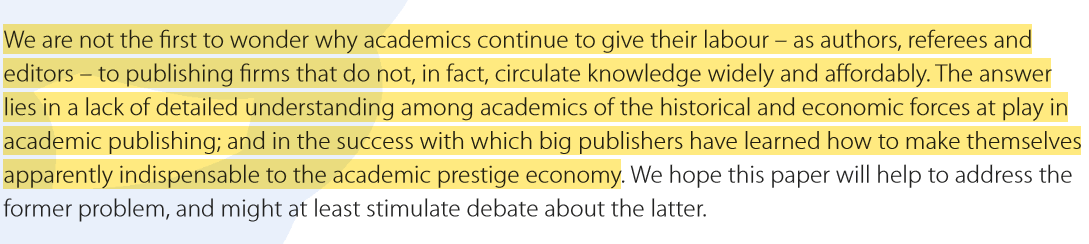
@_DaniBeck You might like this paper on the history of academic publishing, explaining how we got into this mess: Untangling Academic Publishing: A history of the relationship between commercial interests, academic prestige and the circulation of research. Zenodo. https://t.co/voH4iO1LBJ
@RyanKBrook Ryan, we do have current access to this journal, and no need to go to campus. I'm at home and was just able to download the pdf.
When in doubt, access through library catalogue: https://t.co/2XkXupbHv0
@VirginiaPrimary @usasklibrary