Apple silicon is quietly becoming real AI infra. Agents need Macs. Computer-use RL, macOS sandboxes, long-running agents and cheaper open-model inference on M-series.
I co-led Mount Thor’s first two rounds because nobody was running this at datacenter scale and @petervoell was the right founder to take this on. Six months since founding, we're live with many customers across multiple sites.
If you need Apple silicon at scale for AI workloads, DM me. Happy to intro.
i'm proud to back @xonaspace's $250M Series D alongside Future Ventures. I've long admired @FutureJurvetson and i'm excited to work with him on Xona. He's arguably the most successful space investor ever, having been very early at SpaceX (still on the BOD!) and Planet.
GPS is some of the most important infrastructure on earth, but it was designed decades ago for a world of human users. the next wave of autonomy (robots, drones, self-driving vehicles) needs positioning and timing that's far more precise and harder to jam.
Xona is rebuilding it ground up. Move satellites to LEO, design spacecraft, signal and ground systems together, and build the satellites in-house so the network keeps improving.
Early results: sub-2cm accuracy, compatibility with existing receivers via firmware upgrades, first-of-its-kind FCC spectrum authorization, and the commercial constellation now going up, with customer service starting in 2027.
congrats Brian (@FoundTheSpace) and the whole team. this is foundational infrastructure for the physical AI era.
https://t.co/eRBtmpsp4d
AI knows the world's common knowledge. But you are not common.
Ask "build an app in React" and it nails it. But ask "what's blocking the launch?" and it falls flat.
$17.8M raised from @gv, @dropalltables, @bondcap partners, and more to give your model/agent/app a living mind.
Stord Raises a $250 Million Series F at a $3 Billion Valuation
Eight years ago, I met a 20-year-old Georgia Tech dropout in Atlanta who told me he was going to build an Amazon Prime-like fulfillment network for every brand. It was ambitious yet easy to understand. I led the seed round and have served as a board observer ever since.
Today, Stord announced a $250 million Series F at a $3 billion valuation, doubling the company’s valuation in just twelve months.
Sean Henry and Jacob Boudreau have built a great business. However it wasn't easy. We navigated two significant supply chain disruptions in covid and tariffs. But the north star has stayed the same: allow every brand to deliver the kind of consumer experience that used to require Amazon-scale infrastructure.
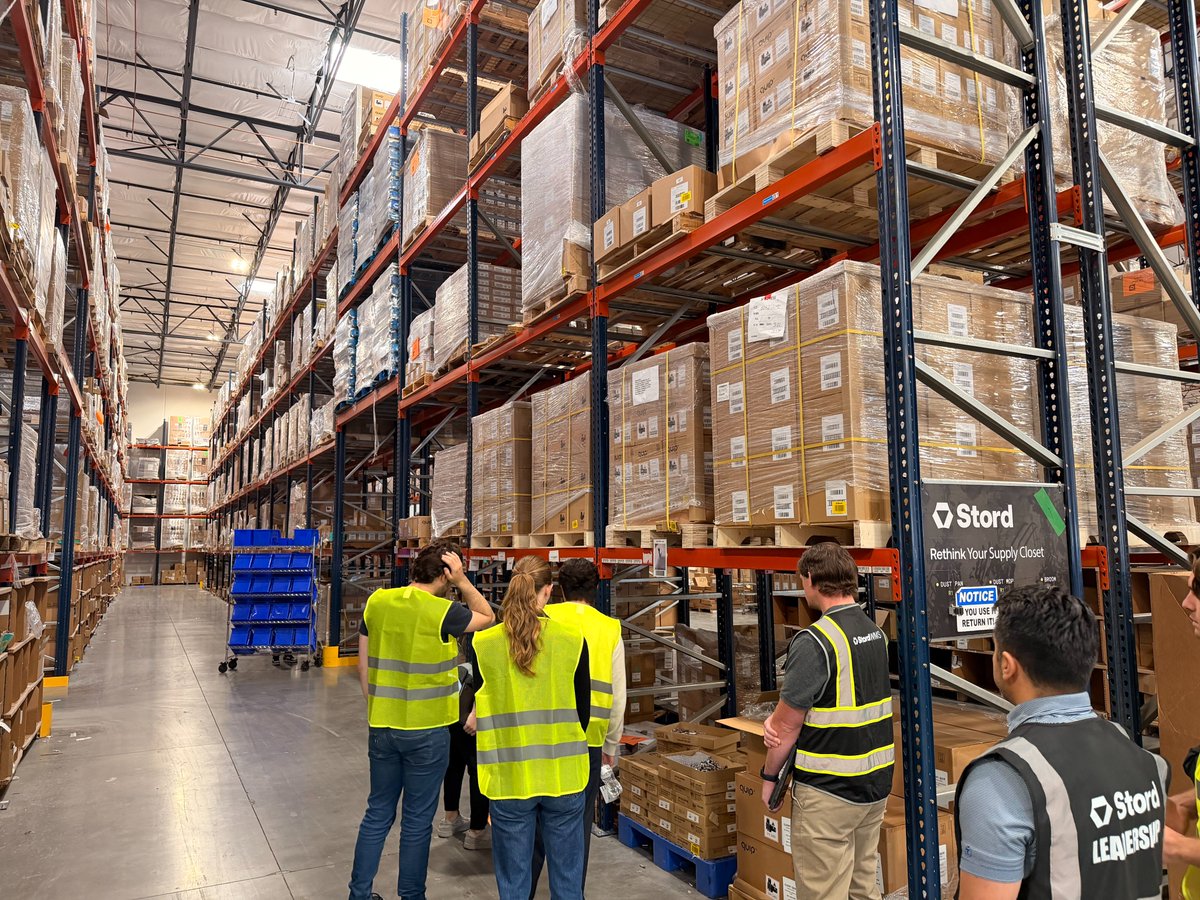
In a world of AI, where software becomes increasingly easy to build, businesses like Stord that deeply integrate bits and atoms are more defensible than ever. Today, Stord delivers packages to 20% of US addresses, powered by a network of physical assets tied together with powerful custom-built software. If you step into a Stord 1P warehouse, as I did last week, the operational complexity will amaze you. That’s both the challenge and the moat.
Along the way, we introduced Sean to our friends at Kleiner Perkins, Founders Fund and Bond Capital, who joined us for the journey. It’s been a career highlight for me to work with this team and I’m excited to see what we can accomplish in the next eight years and beyond.
For more than 50 years, Kleiner Perkins has partnered with founders at moments of inflection. AI is reshaping every industry from the ground up, faster than anything we've seen before. This is the moment to build.
Today, we're proud to announce KP22, our twenty-second venture fund: $1 billion to back early-stage companies, alongside $2.5 billion in growth funds to back high-inflection, category-defining businesses.
A moment like this is where the most enduring companies take root. Deep founder relationships and hands-on support matter more than ever, and we believe in lean investment and portfolio operating teams that work on founder time to deliver exactly that.
We're so grateful to the founders and LPs who have trusted us over the years. We couldn't be more excited to partner with the next generation of history-making companies.
Read more: https://t.co/R7XmcTxOzv
Susa co @askchapter raised $100m at ~$3B.
We have ~15% of Susa III dollars invested in Chapter. 3x-5x more than a typical fund would have in a single company.
It's very easy for investors to claim they have high conviction in a company, but the truth is always in the data. How concentrated are they in that single name?
We led the seed and have invested in every round. When you work with founders like Cobi and the team he's built around him, you go all in.
h/t @SethGB
https://t.co/k497tW0viC
We raised a $27M Series A to replace the spreadsheets and human duct tape behind $100 trillion in global assets.
Fund administration is the invisible backbone of private equity and venture capital - and it’s broken.
Why?
Financial data is scattered, stale, and locked inside legacy providers. Books take forever to close. Basic questions about your own fund take days to answer.
So we rebuilt the general ledger, waterfall engine, investor portal, and portfolio management from scratch.
One single source of truth for your firm.
Our AI agents read emails, propose journal entries, and extract portfolio updates in seconds. Our CPAs review every output.
Today, we administer $15 billion in assets - and we’re just getting started.
Every fund CFO keeps getting asked: how will you adopt AI?
Now you have an answer.
Run your firm in real-time with @hanoverpark.
–-
Excited to partner with Jake Saper at @emergencecap@peterjhebert at Lux, @chadbyers/@pratyushbuddiga at Susa and CFOs at the largest private equity firms to forge this future.
At 26, @chadbyers invested $250k into Robinhood after everyone passed.
That bet turned into $400M+.
Before he wrote the check, two experts told him: “This was tried in the 2000s. It will never work.” He still wrote the check.
Later, an expert warned him off Plaid. He listened and missed out on millions.
Chad’s takeaway is not “ignore experts.”
It is this: experts explain how the system works today. They are worse at seeing when the system is about to change.
In this week’s episode of The Library of Minds, the co-founder of @SusaVentures breaks down the full Robinhood story, his unicorn filter, the new data moat, and what comes after AI.
1:45 - To make money, don’t listen to the experts
2:50 - Inventing the “data moat” thesis
5:05 - How to Find “Spiky” People
8:10 - Why 48-Hour Deal Cycles are a Mistake
10:40 - The crumbling SaaS moat
16:55 - “Oh shit, oh fuck” is the real startup journey
18:00 - How Chad raised Fund I with no track record
22:50 - When to act on your conviction
25:39 - How living w Neuralink founders shaped his diligence
27:50 - What comes after the AI wave