🚨 New paper alert🧵
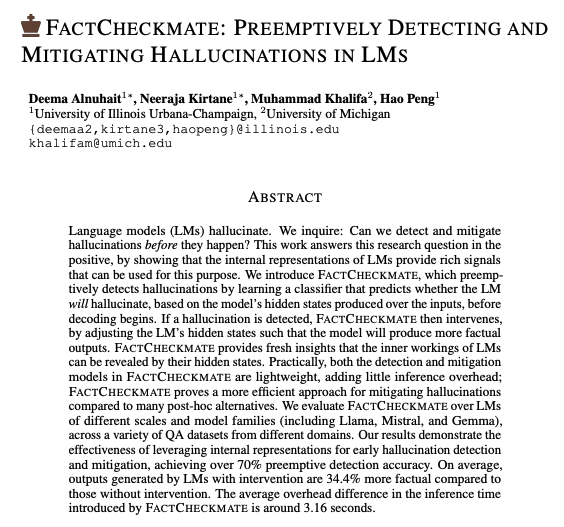
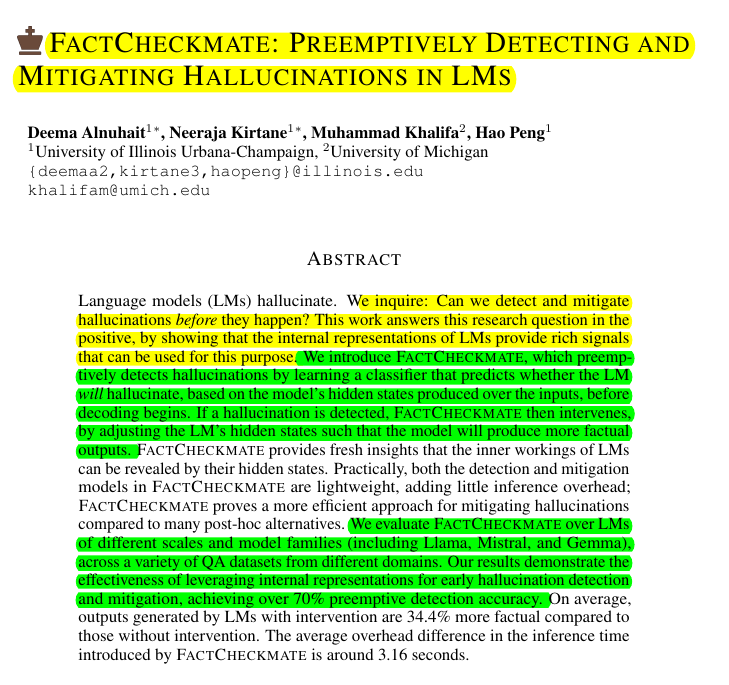
Can we detect and mitigate LLMs’ hallucinations before they happen? 🤔
🚀 Introducing FactCheckmate ♔— a lightweight framework for preemptive hallucination detection and mitigation in LMs using LMs' internal representations ✨
Paper: https://t.co/IFWiXiQs8j
> Be AI PhD student
> Submit paper to conference
> LLM slop reviews
> Rejected
> Concurrent paper with same method accepted
> Resubmit to next conference
> Reviewer points to concurrent paper which was accepted by last conference
> Lack of novelty
> Rejected
Can we detect and mitigate hallucinations before they happen?
Internal neural patterns reveal hallucination risks before LLMs generate false outputs.
Basically Neural networks leak early warning signals when they're about to hallucinate
Original Problem 🔍:
LLMs frequently generate false or misleading information (hallucinations). Current solutions only detect hallucinations after they occur, adding significant overhead and missing opportunities to understand why they happen.
-----
Solution in this Paper ⚡:
• FactCheckMATE: A system that detects and prevents hallucinations before they occur
• Uses lightweight binary classifier analyzing model's hidden states from middle transformer layers
The system uses a lightweight binary classifier that takes the LM's hidden states as input and predicts hallucination probability. It averages the hidden states from middle transformer layers and passes them through a ReLU-MLP followed by a sigmoid function.
• When hallucination detected, adjusts hidden states using intervention model
• Works across multiple model families (Llama, Mistral, Gemma)
• Requires minimal computational overhead (3.16 seconds per inference)
-----
Key Insights from this Paper 💡:
• LLMs' internal representations contain predictive signals for hallucinations
• Middle layers of transformers show strongest hallucination detection capability
• Preemptive intervention is more efficient than post-hoc correction
• Hidden states can be steered to produce more factual outputs
-----
Results 📊:
• Over 70% preemptive detection accuracy across QA datasets
• 34.4% improvement in factual output generation after intervention
• Tested on multiple datasets: NQ-open (Wikipedia), MMLU (STEM), MedMCQA (medical)
• Consistent performance across different model sizes (7B to 13B parameters)
• Average inference overhead: 3.16 seconds
The question that a reviewer should ask themselves is: Does this paper take a gradient step in a promising direction? Is the community better off with this paper published? If the answer is yes, then the recommendation should be to accept.
🚨 New paper alert🧵
Can we detect and mitigate LLMs’ hallucinations before they happen? 🤔
🚀 Introducing FactCheckmate ♔— a lightweight framework for preemptive hallucination detection and mitigation in LMs using LMs' internal representations ✨
Paper: https://t.co/IFWiXiQs8j
Excited to share our new work, FactCheckmate ♔: a lightweight framework for preemptive hallucination detection and mitigation in LMs using their internal representations. Huge thanks to collaborators @deema_cs@MKhalifaaaa and advisor @haopeng_nlp
Paper: https://t.co/kLvlaW5xwf
With FactCheckmate ♔, we aim to open new avenues for understanding LMs by studying their internal workings and providing tools to create more reliable and truthful outputs.