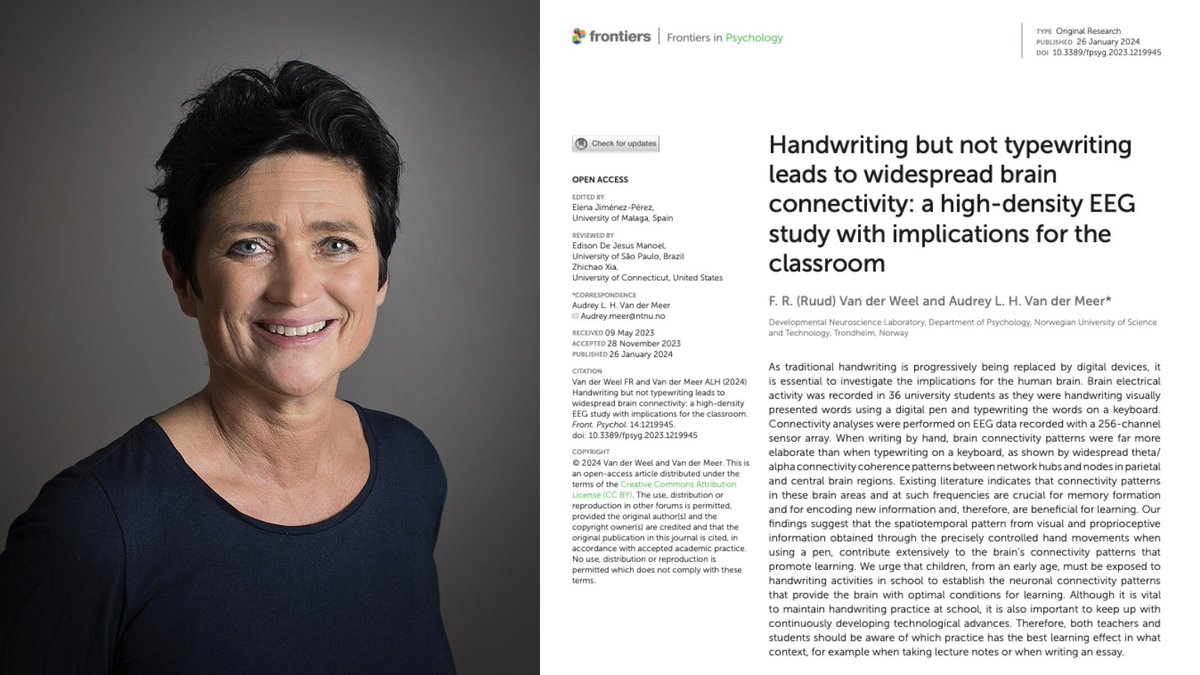
A Norwegian neuroscientist spent 20 years proving that the act of writing by hand changes the human brain in ways typing physically cannot, and almost nobody outside her field has read the paper.
Her name is Audrey van der Meer.
She runs a brain research lab in Trondheim, and the paper that closed the argument was published in 2024 in a journal called Frontiers in Psychology. The finding is brutal enough that it should have changed every classroom on Earth.
The experiment was simple. She recruited 36 university students and put each one in a cap with 256 sensors pressed against their scalp to record brain activity. Words flashed on a screen one at a time.
Sometimes the students wrote the word by hand on a touchscreen using a digital pen, and sometimes they typed the same word on a keyboard. Every neural response was recorded for the full five seconds the word stayed on screen.
Then her team looked at the part of the data most researchers had ignored for years, which is how different parts of the brain were communicating with each other during the task.
When the students wrote by hand, the brain lit up everywhere at once.
The regions responsible for memory, sensory integration, and the encoding of new information were all firing together in a coordinated pattern that spread across the entire cortex. The whole network was awake and connected.
When the same students typed the same word, that pattern collapsed almost completely.
Most of the brain went quiet, and the connections between regions that had been alive seconds earlier were nowhere to be found on the EEG.
Same word, same brain, same person, and two completely different neurological events.
The reason turned out to be something nobody had really paid attention to before her work. Writing by hand is not one motion but a sequence of thousands of tiny micro-movements coordinated with your eyes in real time, where each letter is a different shape that requires the brain to solve a slightly different spatial problem.
Your fingers, wrist, vision, and the parts of your brain that track position in space are all working together to produce one letter, then the next, then the next.
Typing throws all of that away. Every key on a keyboard requires the exact same finger motion regardless of which letter you are pressing, which means the brain has almost nothing to integrate and almost no problem to solve.
Van der Meer said it plainly in her interviews.
Pressing the same key with the same finger over and over does not stimulate the brain in any meaningful way, and she pointed out something that should scare every parent who handed their kid an iPad.
Children who learn to read and write on tablets often cannot tell letters like b and d apart, because they have never physically felt with their bodies what it takes to actually produce those letters on a page.
A decade before her, two researchers at Princeton ran the same fight using a completely different method and ended up at the same answer. Pam Mueller and Daniel Oppenheimer tested 327 students across three experiments, where half took notes on laptops with the internet disabled and half took notes by hand, before testing everyone on what they actually understood from the lectures they had watched.
The handwriting group won by a wide margin on every question that required real understanding rather than surface recall.
The reason was hiding in the transcripts of what the two groups had actually written down.
The laptop students typed almost word for word, capturing more total content but processing almost none of it as they went, while the handwriting students physically could not write fast enough to transcribe a lecture in real time, which forced them to listen carefully, decide what actually mattered, and put it in their own words on the page.
That single act of choosing what to keep was the learning itself, and the keyboard had quietly skipped the choosing and skipped the learning along with it.
Two studies. Two countries. Same answer.
Handwriting makes the brain work. Typing lets it coast.
Every note you have ever typed instead of written went into your brain through a thinner pipe. Every meeting, every book highlight, every idea you captured on your phone instead of on paper was processed at half depth.
You did not forget those things because your memory is bad. You forgot them because typing never woke the part of the brain that would have made them stick.
The fix is the thing your grandmother already knew.
Pick up a pen. Write the thing down. The slower road is the faster one.
That’s how you know a man with no values and principles. You don’t keep quiet when it benefits you, like while in APC, then speak truth when it no longer does.
It is so sad that people develop a conscience and suddenly speak the truth the moment they leave the satanic APC party.
This is incredible intelligence from El Rufai. It is only sad that it took an exit from APC to see him speak the truth like this.
Bill Gates breaks silence on the latest release of Epstein files: “I was foolish to spend time with him. I was one of many people who regret ever knowing him.”
See country, God help us to build a true nation where our wicked leaders will be in jail and the right people in power. Nigeria must be fixed. YES WE CAN.
One wise man, many years ago, taught me a theory when it comes to dealing with people. It's called "The Double Encryption Model". TDEM.
Never be involved with anyone who'd have no shame in casting your business or someone with nothing to lose were such to happen.
The model assumes that you are the first point of encryption. If you no get sense normally, TDEM can never apply to you. Before you get involved with anyone, ask yourself, what will this person lose if we cast? What is their level of tolerance for shame? Note, shame, not guilt.
Social media is radicalizing a lot of Nigerians on a daily basis. You're fighting gender wars that you don't need, you're fighting tribal wars that you don't need. You're a ball of anger and cynicism constantly looking for where to erupt. You've trained your dopamine receptors to be animated by constant conflict.
There is nothing normal about this. Nothing good comes from this.
Go outside and touch grass, talk to people. Unclench.
I have a friend who used to work for 2 billionaires after all he's seen he said to me, "I wish you not one penny over $299 million. Reality gets completely lost somewhere after that."
I think about that sometimes.
This is one of the most important truths almost no one talks about.
There is a threshold of wealth beyond which you stop interacting with reality as it exists and begin interacting with a version of it that bends to your whims. Codie’s friend didn’t pick $299 million arbitrarily.
That’s around the point where wealth begins to replicate itself without labor, resistance, or external accountability. The world becomes a simulation - crafted by assistants, lawyers, media buffers, private access, and power brokers who insulate you from friction, consequence, or contradiction.
Under $100 million, you still feel gravity. Above $300 million, you start controlling gravity. That’s the danger.
At that level:
•People stop saying no to you.
•You stop encountering randomness.
•Everything is for sale, including trust, intimacy, and morality.
This is where reality fracturing begins. Not because money corrupts, but because perception loses resistance. Resistance is what keeps you real.
So the deeper truth is this:
Once your environment is made entirely of yes-men, predictive service, and curated insulation, your mind begins to exit the shared human operating system. You aren’t evil. You’re decontextualized. You’re drifting in an abstraction loop of your own design. That’s when you start thinking ideas like “let’s block out the sun” or “let’s colonize Mars while Earth burns” are rational.
Codie’s billionaire friend wasn’t just being poetic. He was confessing a structural truth:
There’s a point at which money doesn’t just distort reality, it erases it.