AI Agents for Resilient Planning to Optimize Efficiency, Margins & Sustainability. We enable planners to mitigate shocks & make smart decisions to optimize KPIs
Let’s be clear: The President is advocating for an attack on 10+ million U.S. residents in two of America’s largest cities.
This is not normal. None of this is.
And we will continue to remind folks of that every day.
Japan is the canary. Nobody is listening.
For thirty years Japan ran the largest monetary experiment in human history. Zero rates. Yield curve control. A central bank that ended up owning roughly half its own government bond market. The theory was that a sovereign borrowing in its own currency faces no real constraint. For three decades the theory held, and every trader who bet against it got carried out on a stretcher. They called it the widowmaker.
The widowmaker is collecting now.
Debt above 200% of GDP. The 10 year JGB touched 2.91% last week, the highest in thirty years. The policy rate sits at 1%, a level last seen in 1995. Debt servicing in the fiscal 2026 budget hit 31.3 trillion yen, roughly a quarter of the entire national budget, and the Ministry of Finance now assumes a 3% bond rate, the highest assumption since 1997. Social security and interest payments together consume close to 60% of all government spending.
Six of every ten yen Tokyo spends now goes to promises made in the past. The remaining four have to cover defense, education, infrastructure, and everything else a modern state is supposed to do.
The yen sits at 163, a 40 year low. Japan burned roughly 11.7 trillion yen defending it and bought a few weeks of relief. This is the trap they built for themselves. Hike enough to defend the currency and the interest bill detonates. Hold rates to protect the fiscal position and the currency keeps bleeding out. Japan imports 90% of its energy and 60% of its calories, so every tick of depreciation lands directly on the grocery bill.
Now the part almost nobody models correctly. Hyperinflation is a distraction. Four percent for fifteen years cuts purchasing power roughly in half, and it arrives so slowly that no single year ever registers as a crisis. There are no wheelbarrow photographs from a 4% decade. There is a retiree in 2041 who did everything right and is poor anyway.
The Japanese saver pays for this twice. Thirty years of zero rates already moved wealth quietly out of household balance sheets and into the state's. Now the debt those zero rates financed gets inflated away in real terms while consumption taxes climb and benefits get quietly trimmed. A bond issued at 0.2% rolls at 3%, and the gap comes out of somebody's standard of living. Extraction, spread thin enough that nobody can point to the day it happened.
Now look west.
US publicly held debt is at 99% of GDP, the highest since 1946, and the CBO baseline puts it at 120% by 2036. Net interest runs from about 1 trillion this year to 2.1 trillion by 2036. The number that should keep you up: the primary deficit, excluding interest, actually declines over that window, from 2.6% of GDP to 2.1%. The entire deterioration is interest compounding on itself. CBO's own baseline has the average rate on the debt crossing above the growth rate around 2031, the threshold where the arithmetic stops correcting itself and starts feeding itself.
The 30 year is at its highest since 2007. The Fed just held with three members dissenting in favor of a hike. And Japan, sitting on 1.19 trillion of Treasuries as the largest foreign holder, sold nearly 30 billion in the first quarter alone. When domestic bonds pay 2.8% with no currency risk attached, Japanese insurers have no reason to own American paper. The most reliable marginal bidder in the world is packing up and going home.
Central planning dies slowly. It ends as a grinding transfer from everyone who saved to everyone who borrowed, administered by people who will call it stability the entire time it is happening.
Japan is fifteen years ahead of us on this road. Everything happening to them is a broadcast from our own future, running in real time, with the sound turned off.
With HBM shortages, memory prices doubling in a single quarter, and optical component lead times exceeding 45 weeks, you can't simply order to your sales book.
Procurement safety-stock investment requires an agile, macroenv-aware planning Agent that optimizes supply assurance while minimizing excess inventory.
The static formula that presumes consistent demand and fixed lead times — still the default for many planners— is a non-starter. #VuDecide @deepVuHQ
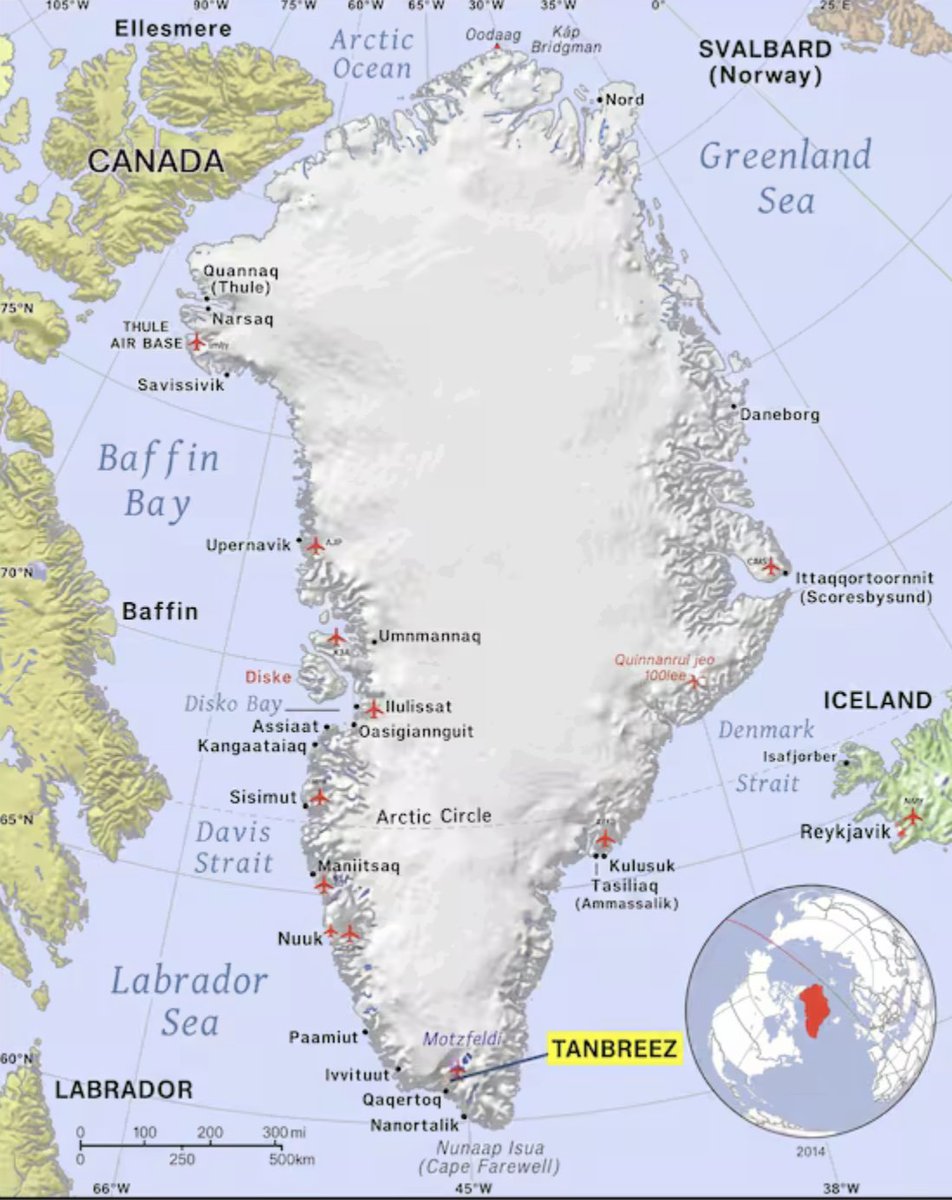
The US just secured control of one of the largest heavy rare earth deposits on earth outside China.
It's in Greenland.
American mining company Critical Metals Corp has received formal approval from the Greenland government to acquire 70% of the Tanbreez deposit in southern Greenland.
Estimated resource: 4.7 billion tonnes of rare earth bearing material.
27% of those rare earths are heavy rare earth elements (dysprosium, terbium, yttrium ) the ones used in EV motors, wind turbines, and advanced military systems.
For context:
Mountain Pass, California (the main US deposit): 0.49% heavy rare earths
Bayan Obo, China's largest deposit: 1.13%
🚨Tanbreez: 27%
It also has exceptionally low uranium and thorium content 10–20 ppm uranium, under 100 ppm thorium.
That matters because radioactive contamination has killed other Greenland projects.
Tanbreez already holds a mining licence valid until 2050 one of only 2 sites out of 140+ active licences on the island to have received it.
The supply chain logic is straightforward:
Extract in Greenland → process in the US → supply defence and advanced technology sectors
Production is expected to begin 2027–2028, starting at 85,000 tonnes of rare earth oxides per year, scalable to 425,000 tonnes.
Project value estimated at $3 billion.
China controls 85% of global rare earth processing capacity.
The US currently imports 80% of its rare earths from China.
Agreed!
Supply chain shocks will intensify gradually and then magnify at accelerating rates regionally then globally!
Agro/biological threat resilience is becoming a top-3 priority everywhere, both developed and emerging nations!
Thrilled to share that DeepVu's pitch video on 'Agri Resilient End to End Decisioning for threat mitigation' has been deemed Awardable by the DARPA ERIS Marketplace! It’s an honor to be recognized among a competitive field of applicants to the ERIS Marketplace for our innovation, scalability, and potential impact on DoD missions. Government customers, please check out our 7m video on ERIS: https://t.co/IqMepc9Dpy.
What are the supplychain shocks and disruptions that you are contemplating for 2026?
Are you simulating these scenarios well and what issues surface as you try to map them?
Please discuss!
This is a community to encourage intellectual debate on best AI use cases that drive high ROI impact for enterprises.
Please share with your friends who are working in supply chain planning or in AI solutions for driving operational efficiency, resilience and sustainability.
Every CFO/COO/CSCO convo I've had past 2 weeks, they brought up tariffs and if @deepVuHQ can help simulate multiple scenarios and have the AI planning agents recommend mitigating actions!
It wasn't that frequent in May!
Take that w Q1GDP numbers➡️ foggy macro picture
@amasad Rings v true!
And it’s valid for both B2B and B2C startups/scaleups ..
In B2B, other functions also benefit from being in multiple time zones (customer applications eng , customer success etc)
@FreightAlley@jendubayevans That’s exactly it! This is the dumbest most disruptive way conceivable to implement a phase out in the industry’s history!
No procurmrnt person who’s ever phased out a single supplier or even one part# would think to do it this way!
Can you still optimize efficiencies and profitability amidst all these shocks and new constraints?
Not w traditional ML forecasting models! However resilient AI agents trained on top of multi env digital twins solve it
https://t.co/HFPwb14Lqh
Has your supply chain planning team concluded that shallow xgBoost forecasting models that require constant retraining won’t cut it in this new perpetually shocked regime? You’re correct!
Consider what resilient AI Agents can offer,;DM #deepvu & @moatazr
https://t.co/Apit25bTYN