Every company can show you pipeline.
Far fewer can tell you how much of it is truly real.
That is the difference between reporting growth
and actually being able to rely on it.
#Revenue#0to100xEngineer
@levie Very relevant take. If you want agents work like employees you need to provide them access to tools and data that are required for that specific employee. Just like the boss don’t share their personal work methodology to their sub-ordinates, the agent wouldn’t get access as well.
Forward deployed engineers, or equivalent, are about to become one of the most in-demand jobs in tech. And one of the most important functions for AI rollouts.
Deploying agents is far more technical of a task than most people realize, often far more involved than deploying software. Software generally works the same way every time, and generally for the past few decades has been updated versions of an existing technology or concept (which basically means easier for the enterprise to update their workflows on a newer system).
With agents, you’re actually deploying the equivalent of work output within the enterprise. The customer is effectively using you as a professional services provider for a task, which they expect to get solved nearly end-to-end now. This means you need to actually deeply understand the business process as a vendor, and get the customer from the current to the end state seamlessly.
Companies need help figuring out which models will work best for their workflows, they need extensive evals setup often, they need change management support for workflows, they need to get their data setup for the agents, and constant tuning of the agentic system for their process.
Massive role in tech now. And another example of the kind of highly technical work that AI is creating.
For startups, the moat question is:
“What compounds after the first use?”
For enterprises, it is:
“Which parts of our moat are real, and which are just friction?”
In the #AI era, defensibility is not what protects you today. It is what still compounds tomorrow
#0to100xEngineer
The dashboard is not the moat.
The workflow is.
The database is not the moat.
The proprietary intelligence built on top of it is.
The product is not the moat.
The trust, habit, data, distribution, and ecosystem around it are.
That is the #AI-era moat test.
#0to100xEngineer
#AI will not kill every moat. But it will expose fake ones
For years, companies confused friction with defensibility: painful migration, complex processes, trapped data, trained users, scarce expertise
Some of that was a moat. Much of it was inertia
#Strategy#0to100xEngineer
#AI makes #code easier to write, products easier to launch, and ideas easier to copy.
So the hard question is no longer:
“Can we build this?”
It is:
“What will make this hard to replace?”
That is the real test of a #moat.
#CompetitiveAdvantage#0to100xEngineer
#ASML’s #moat is deep technology, decades of know-how, supplier depth, and customer dependence.
#Costco’s moat is operating discipline, scale, trust, and membership economics.
Different companies. Different moats. Same lesson:
Moats are systems, not features.
#0to100xEngineer
When a CEO says “no one is coming for us,” the real question isn’t whether the company is powerful.
It is: what kind of moat makes that confidence possible?
In the AI era, building is easier. Defensibility is harder.
#BusinessStrategy#AI#0to100xEngineer
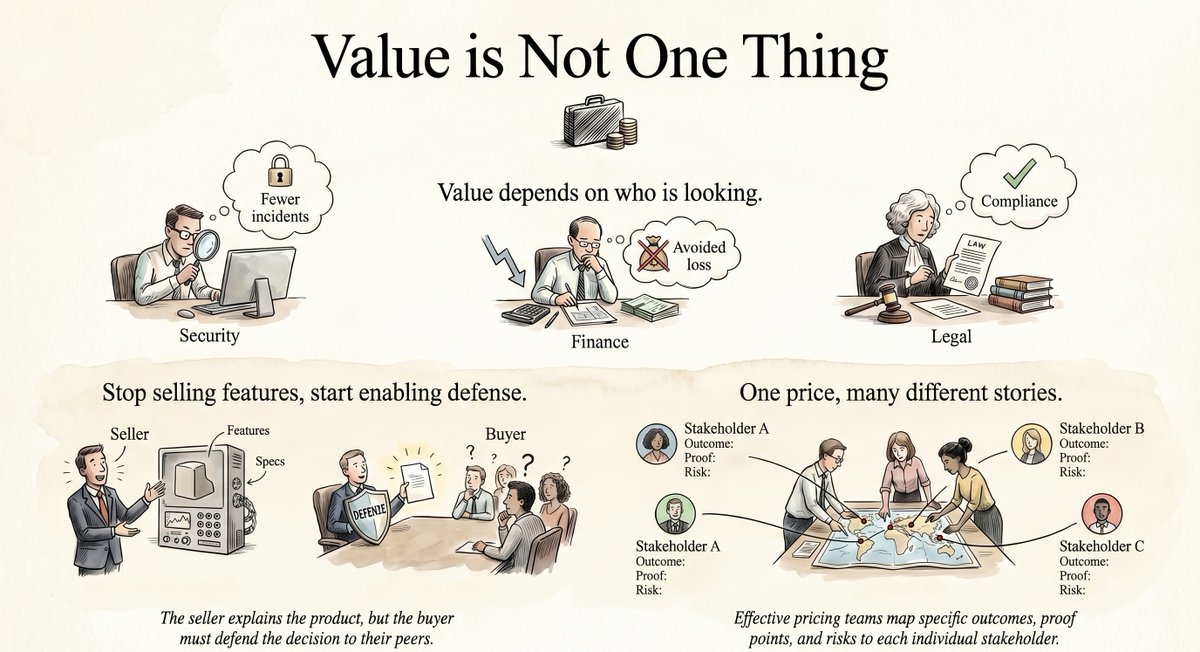
Great sellers do not just explain value.
They make value defensible.
They give the buyer the language, proof, and confidence to justify the decision internally.
That is how pricing moves from negotiation to value.
#0to100xEngineer#AgenticAI#RevenueAI
Pricing without value communication is like walking into a courtroom with evidence, but no argument.
You may have the facts. You may even be right. But if the buyer cannot defend the value internally, price becomes the battlefield.
#0to100xEngineer#PricingStrategy#B2BSales
Value-based pricing is not just about saying “our product creates ROI.”
The real work is mapping value by stakeholder:
who cares about what,
what proof they need,
what risk they want reduced,
and which value story should anchor the price.
#0to100xEngineer#AgenticAI#Pricing
Most people freeze at selling because they think it’s about convincing someone to buy what they don’t want.
The best salespeople know the truth:
Selling = helping people solve problems they already have.
#SellingTips#Sales#Revenue
How do you #price a product when every stakeholder values it differently?
Security may value fewer incidents
#Finance may value avoided loss
Legal may value compliance
#Leadership may value reputation
Price may be a number
But the value case is rarely one story
#0to100xEngineer
Customers rarely pay only for the product or the effort.
They pay for the problem removed, risk reduced, time saved, confidence created, or outcome improved.
That is why value-based pricing can unlock far more than cost-based pricing.
#0to100xEngineer#PricingStrategy#AI
One of the easiest ways to underprice anything is to start with what it costs you, instead of what it is worth to the customer
#Cost tells you what to protect
#Value tells you what the customer can justify
That gap is where #pricing power lives
#0to100xEngineer#B2BPricing