Met a German founder this week and asked him if all the stories one reads about the challenges of startups in Germany are exaggerated. "No, they're understated." Proceeded to describe spending a full day having a 90-page investment contract read to him (mandatory under German law; § 13 BeurkG) by a notary that then charged €30,000. That was for his first company. His second company, needless to say, was not incorporated in Germany.
In Alzheimer’s imaging, there are some things you just can’t forget!
New Alzheimer’s treatments are changing the way we look at these scans!
Removal of amyloid beta proteins from vessel walls by anti-amyloid antibodies leads increased vascular permeability.
This can cause edema or hemorrhage, called ARIA (Amyloid Related Imaging Abnormalities)
Grading of the degree of ARIA is important bc it can change management. Asymptomatic ARIA is usually treated by pausing treatment if it’s moderate to severe
For ARIA-E (edema) or ARIA-H (microhemorrhage), if the edema measure > 5 cm or number of microhemorrhages are >5, it is moderate
For superficial siderosis, 2 regions is considered moderate.
Remember it by this little rhyme:
--If ARIA findings are great than 5, then the medication deprive
--Or if siderosis is 2, then medication break for you!
Hopefully, now the grading of ARIA will stay in your memory!!
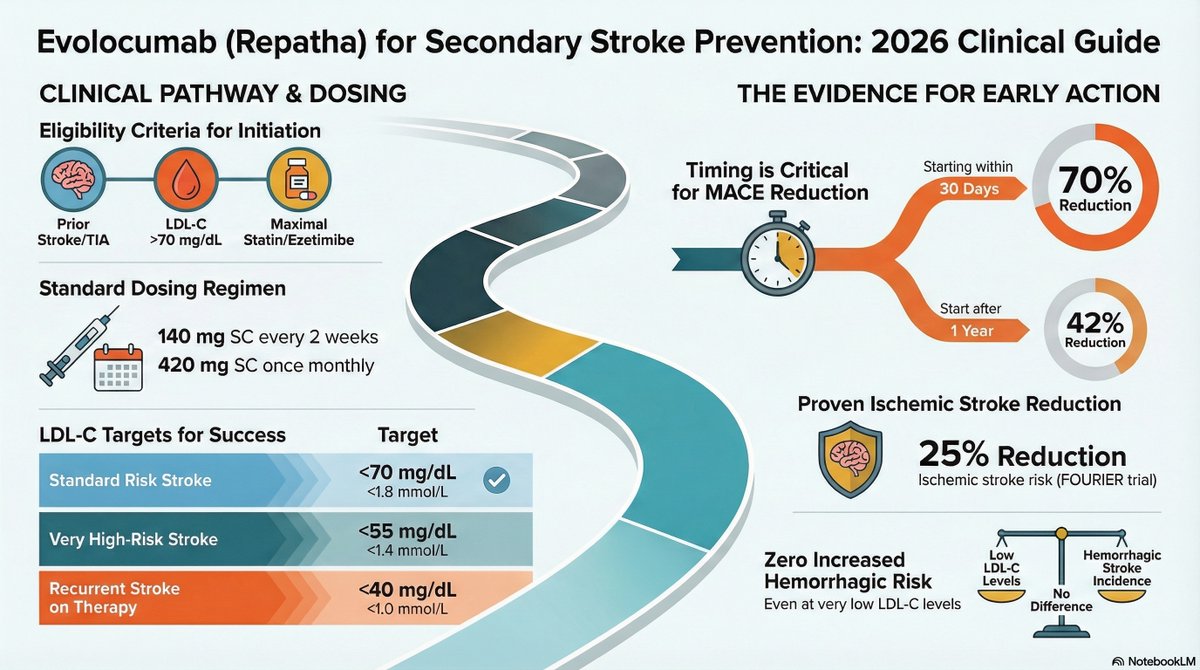
Your stroke patient on maximal statin + ezetimibe still has LDL-C >70 mg/dL.
Adding evolocumab prevents:
✅ 25% ↓ ischemic strokes
✅ DOUBLE the events vs first-event analysis
✅ Progressive benefit over time (16% Year 1 → 25% Year 2+)
Here's the evidence...
#Neurology #StrokePrevention #Neurotwitter
Very much looking forward to participating in upcoming symposia on FXIa inhibition for secondary stroke prevention with my colleagues at the American Heart Association #ISC2026 in New Orleans.
📢 Join us at #ISC2026! Don't miss the S:VIN Journal Session:
🗓 Feb 4, 2026
⏰ 2:30–3:30 PM
📍 Topic: Novel Technologies in Neuro-Intervention
https://t.co/b9LnFcNT0f
I ranked #1 on the Whova leaderboard at Integrity in the Concept and Determination of Brain Death: Recent Challenges in Medicine, Law, and Ethics! - via #Whova event app
The concept of #CodeICH is already having a huge impact!
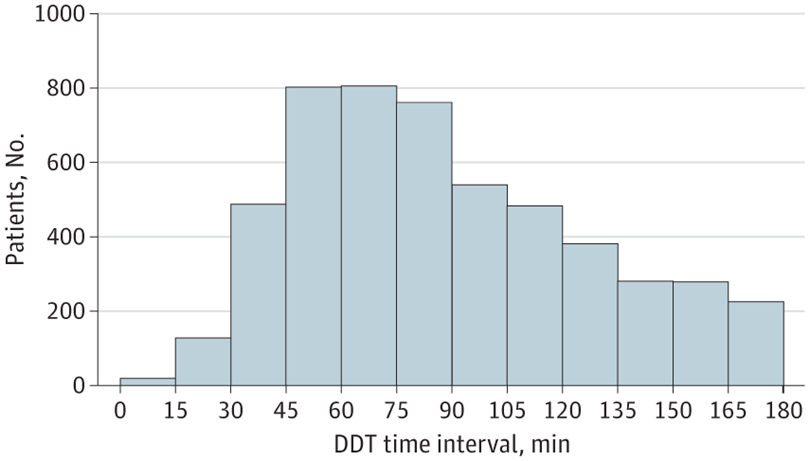
Here's a brilliant paper by @sheth_kevin using the @StrokeAHA_ASA GWTG database, looking at >9,000 patients with anticoagulation-associated #ICH. Massive.
Median DTN time 82 minutes. (Not bad, actually, better than I would have guessed).
Door-to-needle <60 minutes = lower mortality.
Time = brain, especially for ICH!
How good is your center? Please share if you are trying to get ICH time metrics going at your stroke center. Let's learn from each other.
@ClaudeHemphill@JoshGoldsteinMD@sashkind
https://t.co/V5b72rpzRC
Early EVD (<24 hours) is associated with better 6 month outcomes after moderate-to-severe #TBI
What about #ICH and #SAH?
#curingcoma
https://t.co/hNF0sz8c0e
“Ghost Core” is a catchy term.
The infarct core using RAPID software is estimated by identifying the volume of all pixels that are <30% of maximal cerebral blood volume.
We were taught that this brain tissue is irreversibly infarcted, but by looking at final infarct at 24 hours this is not the case — 10% of the time this volume exceeds final infarct volume by >10 ml.
Early complete recanalization predicts the ghost core phenomenon — better rescue of hypovolemic brain tissue. Be aware of this when excluding younger LVO pts imaged very early after onset.
Nice work @mayank_G0 !!
https://t.co/lDxtMTK27n