Muse Ember and Claude Haiku 5.5 both pass 83% of τ-bench support tasks on the first try.
Run each task 8 times and only ~half pass every time.
When they got it wrong, they still said “done” 31–48% of the time.
@AIatMeta@AnthropicAI https://t.co/dGq402t0Au
You can now use CATEGORICAL LLM-as-a-judge in DeepEval’s latest release!
While DeepEval's quantitative metrics are great, sometimes you just need to setup evals that classifies and assigns labels to agent behaviors instead of giving it a score.
Introducing Confident Voice: The first AI observability suite built specifically to surface audio failures in voice agents, in production.
Your team doesn't have the hours to sit through thousands of calls a day, so most problems only surface when a customer complains.
Today I'm thrilled to introduce the Transcription Accuracy metric in @deepeval latest release, v4.3.2🎙️
It asks one question: did your agent actually hear what the caller said?
Because here's the non-intuitive insight for those that are building voice AI: Most voice agent failures aren’t LLM failures. They’re hearing failures.
Today we’re launching Confident Monitor.
You probably have millions of traces from your AI agents, but they don’t tell you what’s actually broken.
Monitor reads your production traffic, turns failures into issues, and gives you a tested fix for each one.
Today we’re launching Confident Monitor.
You probably have millions of traces from your AI agents, but they don’t tell you what’s actually broken.
Monitor reads your production traffic, turns failures into issues, and gives you a tested fix for each one.
Introducing Eval Skills: agent skills that help Claude Code and Codex build evals you can trust.
Start from real failures, establish a baseline, then let your coding agent improve your app one measured change at a time.
Open source, Apache 2.0. https://t.co/vRHrSY3s9n
Evals started on ROUGE and BERTScores.
It evolved into LLM-as-a-judge because they weren't good enough.
Today, we're pleased to welcome back anti-language, LLM-as-a-judges.
Introducing Jev in @deepeval.
Full post in comments.
I just made some new GBrain evals that help prove that my retrieval-for-AI-agent open source layer is SOTA for reading memory back without LLM-in-loop
And I've also added evals for memory-save from agent transcript, which is the best way to enrich your brain
Receipts at https://t.co/iRLJR9Vxto
New Breaking Change in v4.2.0: All metrics scores are now HIGHER THE BETTER.
No functionality changes, just something to be aware of for users on bias, toxicity, misuse, and knowledge retention metrics.
Changelogs: https://t.co/GNEDBZNc0v
Use it to compare rerankers, top-k settings, hybrid search weights, and chunking changes.
Good for: labeled development and CI evals.
Not for: unlabeled production traffic.https://t.co/gGNTrdEj7G
Metric of the Week: ContextualPrecisionMetric
Your retriever can find the right chunk and still lose the answer.
This metric asks one question:
Did the useful chunks rank above the noise?
It scores the order of retrieval_context.
Each chunk is judged against the input and expected_output.
Relevant chunks near the top score higher. Bury them under noise and the score drops.
This should usually be your first agent metric.
Then add metrics that explain the failure: wrong tool, bad plan, or skipped step.
Good for: checking task completion.
Not for: judging only the final answer without tracing.
https://t.co/LEH2NwlD0R
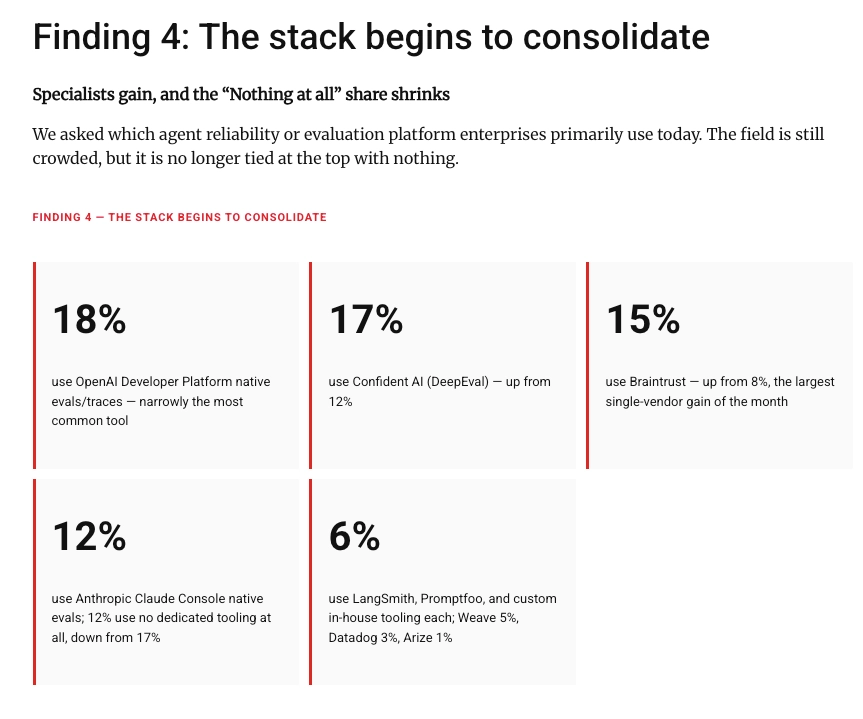
DeepEval is now the most used specialist agent eval tool at 17% in latest report from @VentureBeat
teams are finally taking evals seriously
yet almost half still shipped an agent that passed their tests and then broke with a customer
passing evals ≠ production ready