@deepeval started as an open-source framework for testing LLM apps. Today, 150K+ developers use it, more than half of the Fortune 500 have adopted it, and it powers over 100 million evals a day. It’s reached 20K GitHub stars and millions of downloads.
What’s been especially fun to watch is what the community has done with it. @RedHat engineers wrote about testing multi-turn agents with DeepEval. The @WorldBankGroup shared how it uses DeepEval to evaluate LLM systems at scale. @AWScloud includes DeepEval in its toolkit for evaluating AI agents. And developers have written guides, built hands-on workshops, and taught courses that help others get started.
Now San Francisco is home. We’ve opened our new HQ here, and we’d love to meet the people building with DeepEval. That’s why we’re hosting our first DeepEval SF Meetup.
Come meet the team and see what’s new. Bring your laptop and an AI app you’re working on, and we’ll walk through the full eval loop together: trace a run, annotate examples, turn them into evals, and rerun those evals after a fix.
Stick around for donuts, coffee, and an hour to swap notes with other SF builders. See you there!
RSVP → https://t.co/v28Khl2URR
and every single day
i wake up, catch my agent making shit up again
run tests, blow its little lies away
deepeval in control, let the green checks roll
let the checks roll @dejavucoder
This test shows why you can't just trust benchmark leaderboards, and it's the simplest test we ran.
- we ran the native bench
- we ran with PAIR
- we ran with 2x super simple ablated prompts
- we ran with fable, astra, argon
The reality is more extreme. Build your own evals!
@hs58200p asked whether phone audio would change which STT model wins. So we ran it.
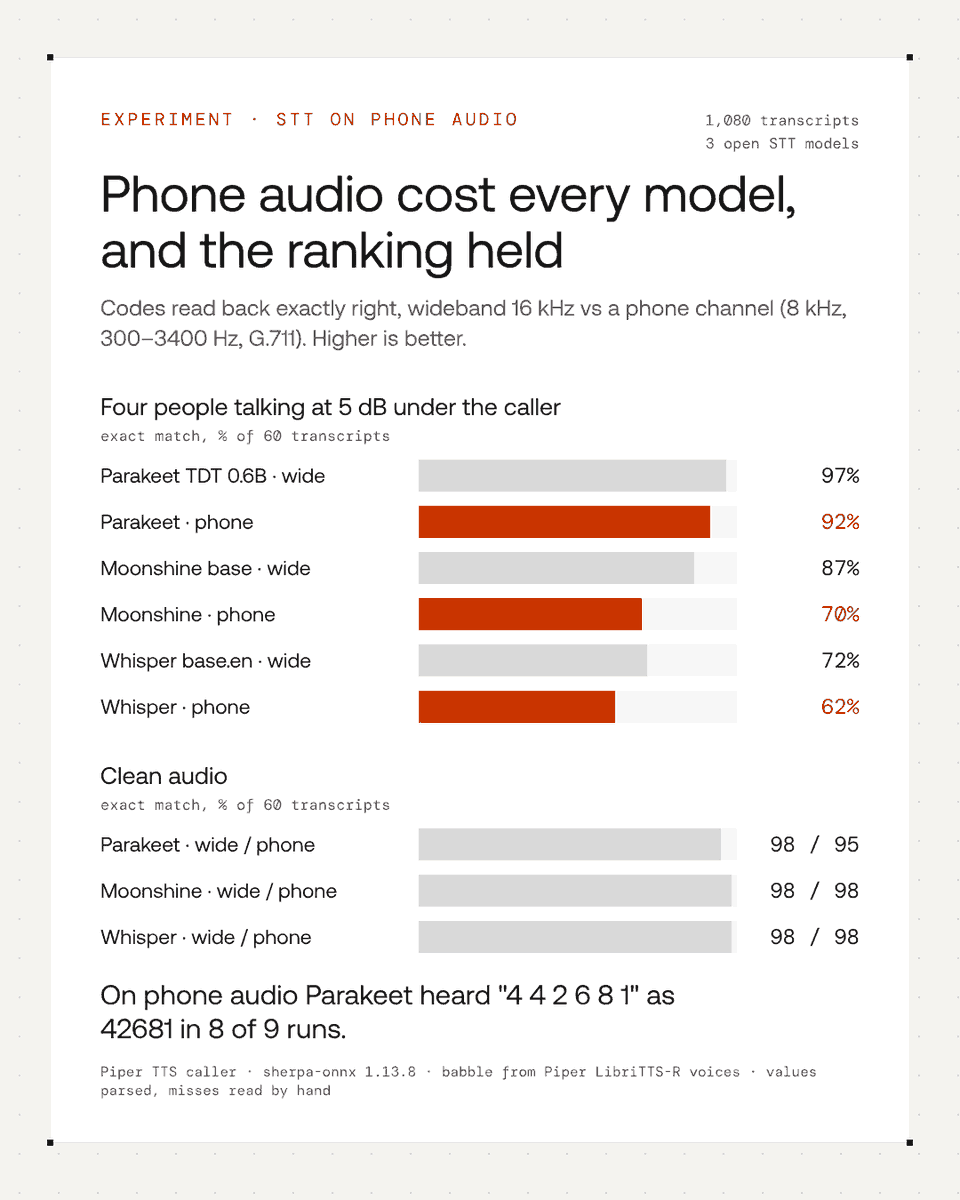
Similar setup to the babble post: 20 caller lines with one code each, read digit by digit, 3 takes per line from Piper TTS, clean and with four people talking underneath at 10 and 5 dB. Then every clip twice: wideband 16 kHz, and through a phone channel (300-3400 Hz, 8 kHz, G.711). Parakeet TDT 0.6B v2, Whisper base.en, Moonshine base. 1,080 transcripts, values parsed, every miss read by hand.
Exactly right with babble at 5 dB, wideband vs phone:
Parakeet: 97% vs 92%
Moonshine: 87% vs 70%
Whisper: 72% vs 62%
The ranking held. The gap got wider.
What the phone channel broke:
- Parakeet heard claim number 4 4 2 6 8 1 as 42681 in 8 of 9 phone runs, and 1 of 9 wideband. The repeated digit collapses.
- Moonshine turned the 0 at the end of ticket 15380 into "euro" or "€" in 3 of 6 phone runs with babble.
- On clean audio only Parakeet dropped (98% to 95%), all on that one double-four line.
Caveat: synthetic callers and babble, and the phone channel is a filter plus codec, not a real carrier.
If your voice agent takes phone calls, run your STT evals on phone-band audio. Wideband test clips flatter every model.
https://t.co/YTmLU1ISLd
Background chatter with no numbers in it added digits to the numbers our test voice agent heard.
ElevenLabs shipped Scribe v3 today, pitched on noisy rooms, so here's what background talking does to the open models it competes with.
We played 20 voice-agent lines (codes, amounts, times) through TTS, mixed in four people talking at 10, 5 and 0 dB, and ran three open STT models on the audio. 600 transcripts across 3 noise seeds, with the misses checked by hand.
Exactly right (clean / 10 / 5 / 0 dB):
Parakeet TDT 0.6B v2: 100 / 100 / 82 / 17%
Whisper base.en: 90 / 85 / 73 / 3%
Moonshine base: 90 / 90 / 72 / 7%
What the misses looked like:
- At 5 dB, 9 of Parakeet's 11 misses were the right number with extra digits on the end. 48172 came back as 48172-72, and 6241 as 6241354.
- Moonshine turned member ID 8 8 1 4 0 2 into 81402 in all four clean and light-noise runs. Parakeet got it every time.
- At 0 dB, Whisper mostly gave up and wrote "[Music]" or "(crowd talking)". Moonshine gave confident wrong numbers instead.
If your agent reads codes back, check the length before it confirms anything. A transcript with too many digits looks fine to a transcript-only eval.