@datavorous_ For example, your inference runtime for the sarvam model. How’d you decide that topic for pursuing as well as build up your knowledge to that point. Hope this is making sense
@datavorous_ As a first year myself I was impressed with the depth of knowledge you’ve applied in your projects. Despite my interest in ml i am far from that level. On providing a new topic, my question was also about how you decide which topics to delve into when learning something new.
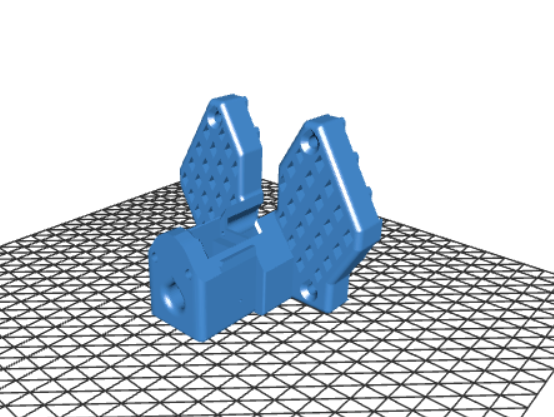
After watching @BroganPratt's assembly video of the S100 arm I've figured out how the motor is supposed to be inserted, now to redesign such that it the MG996R servo can also fit into the base model.
https://t.co/htdt55coiY
I am going to build a 6 DOF robotic arm, the goal is to simultaneously learn the basics of 3d printing, the mathematics of the movement of such designs and perhaps even some reinforcement learning down the line. Since then I've made some changes to the plan so here's a thread:🧵
I will reconfigure the SO100 arm to fit my MG996R servos my changing each joint of the original model to fit my requirements. This will help me understand the design of the SO100 arms and at the same time I get to find my way through Fusion 360.
Observation 2. This is, however, a major downgrade to the quality of the arm. The MG996R will not provide the same smooth movements, precision, or feedback that STS3215 does. But for the time being I will have to live with that.
Observation 1. SO100 and SO101 arms are designed for STS3215 serial bus servo motors, they are much more expensive and I don't believe they are necessary for a beginner level project. Hence I've decided to move to MG996R servo motors.
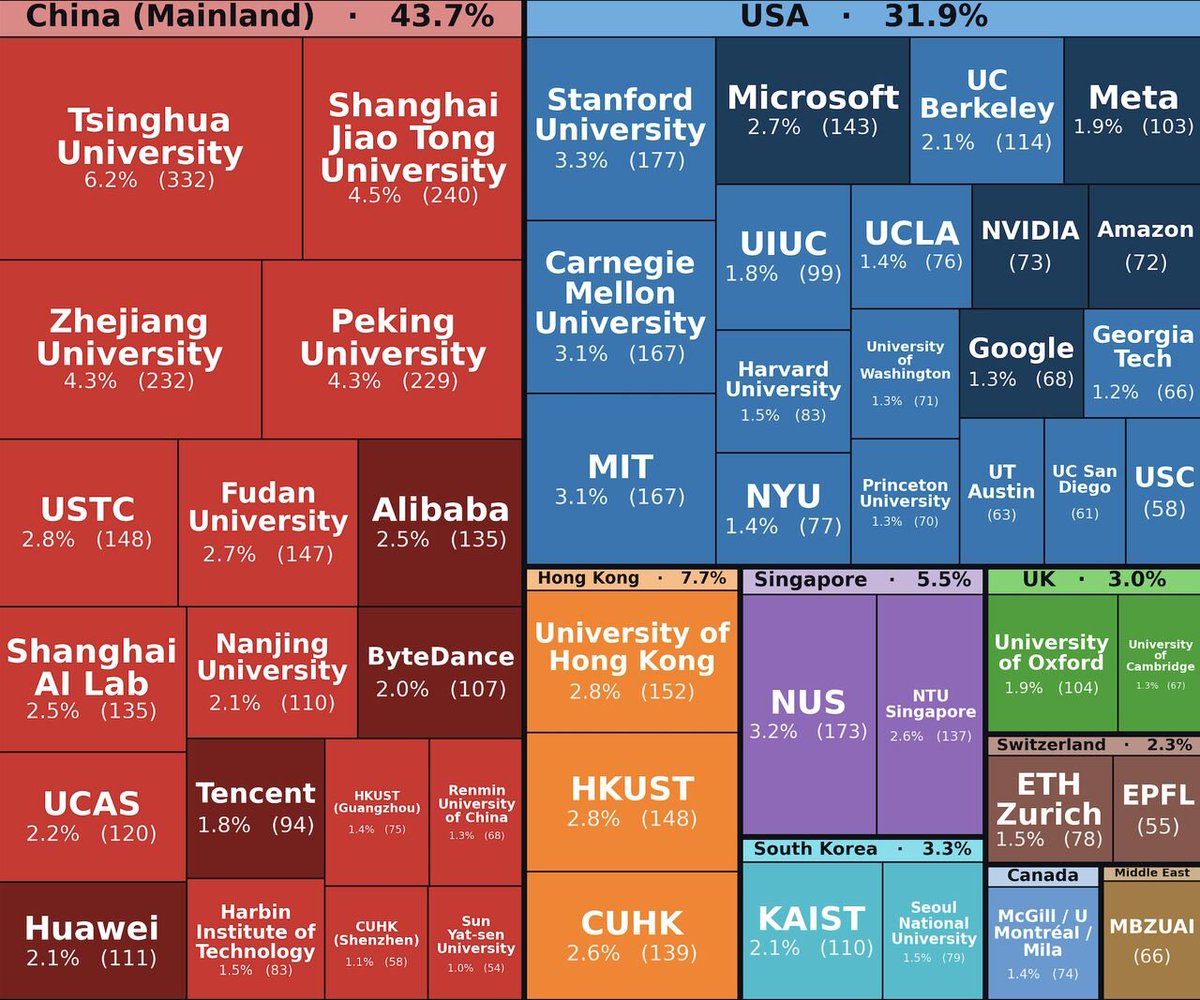
someone analyzed all 5000+ accepted papers at ICLR 2026, and it's a good signal who's pushing the research of AI:
> China has surpassed the US with 43.7% of the papers
> Europe's contribution is surprisingly small (5.3% including UK)
Where are India’s Nobel Prizes?
Before independence, a few Indian scientists did some really great work with minimal infrastructure.
Today, our research baseline has improved- we’ve done some really great work, yet world-changing breakthroughs have slowed. Why?
There are three reasons:
> Our brightest minds are choosing corporate jobs or civil services over scientific research.
> Modern science requires far more infrastructure & computation.
> And India spends just ~0.6% of GDP on science & technology compared to the US and China.
If we want to build a truly tech-forward nation, we need more quality students in science, and we must bridge this infrastructure gap.
Robots aren’t just the future — they’re already reshaping our world.
At IIT Madras, the new https://t.co/uYYy0SVLH6 in Robotics, offered under the Department of Engineering Design, is building the brains behind tomorrow’s intelligent machines. From motion planning and control to AI/ML and hands-on labs, this two-year program blends cutting-edge research with real-world industry relevance — powered by a strong robotics faculty team and a legacy of interdisciplinary innovation.
Rooted in the success of the Inter-Disciplinary Dual Degree (IDDD) Robotics program, this two-year program brings together expert faculty members and a powerful blend of theory and hands-on learning.
From robot design and analysis to motion planning, control systems, and AI/ML, students dive deep into the science and engineering behind next-generation robotic systems. Add immersive lab work and cutting-edge projects, and you have a curriculum that’s as practical as it is pioneering.
Manufacturing, healthcare, logistics, and defence — robotics is reshaping them all. This program is about building the minds that will lead to that transformation.
If the future runs on robots, it starts here.
For more details visit: https://t.co/Ajb1KQBBR2
@iitmadras