Facts below (1/5):
In 2025, average earnings per hour (EPH), excluding tips, for a delivery partner on Zomato were ₹102.
In 2024, this number was ₹92. That’s a ~10.9% year-on-year increase. Over a longer horizon also, EPH has shown steady growth.
Most delivery partners work for a few hours and only a few days in a month. But if someone were to work for 10 hours/day, 26 days/month, this translates to ~₹26,500/month in gross earnings. After accounting for fuel and maintenance (~20%), the net earnings for the partner are ~₹21,000/month.
Note: Earnings per hour are calculated on total hours logged in, including the time when the partner might be waiting to receive an order. Earnings per “busy hour” will be higher but that’s not the right metric to look at.
On top of this - delivery partners earn 100% of tips given by customers. The average tip per hour in 2025 on Zomato was INR 2.6 and in 2024 was INR 2.4 per hour. Tips are transferred instantly, with zero deductions. We absorb the payment gateway processing cost ourselves. About 5% of the orders get tipped on Zomato; 2.5% on Blinkit.
One more thing. Our 10 minute delivery promise is enabled by the density of stores around your homes. It’s not enabled by asking delivery partners to drive fast. Delivery partners don’t even have a timer on their app to indicate what was the original time promised to the customer.
After you place your order on Blinkit, it is picked and packed within 2.5 minutes. And then the rider drives an average of under 2kms in about 8 minutes. That's an average of 15kmph.
I understand why everybody thinks why 10 minutes must be risking lives, because it is indeed hard to imagine the sheer complexity of the system design which enables quick deliveries.
Also, if you've ever wanted to know why millions of Indians voluntarily take up platform work and sometimes even prefer it to regular jobs, JUST ASK any rider partner when you get your next food or grocery order.
You will be humbled by how rational and honest they will be with you.
Having said that, no system is perfect, and we are all for making it better than today. However, it is far from what it is being portrayed on social media by people who don't understand how our system works and why.
If I were outside the system, I would also believe that gig workers are being exploited, but that's not true.
Agree. And literally everyone who has a job wants to get paid more. Everyone thinks they deserve better. At the end of the day, market forces decide how much does someone get paid.
Companies reliant on gig economy compete very brutally with each other. Demand is more than the supply, which results in gig incomes being more than what many formal entry level jobs in India pay.
Agree.
I repeat – gig workers is one of the largest organised job creation engines in India. And we provide insurance, fair, timely and predictable wages.
Gig doesn’t need more regulation, it needs less regulation. It will bring more people into the fold, who will be able to earn some money, upskill themselves and later join India’s organised workforce. Not to mention, consistently send their kids to school - which will fundamentally change the fabric of our nation one generation later.
I am all for peaceful protests against anything and everything. But violent protests and stopping others who want to work from working is not okay (proof attached).
Here’s what we know – a number of these protestors were not even our delivery partners. They were agents of political interests, piggybacking on the narrative to gain political mileage.
Last one on this topic, and I have been holding this in myself for a while.
For centuries, class divides kept the labor of the poor invisible to the rich. Factory workers toiled behind walls, farmers in distant fields, domestic help in backrooms. The wealthy consumed the fruits of that labor without ever seeing the faces or the fatigue behind it. No direct encounter, no personal guilt.
The gig economy shattered that invisibility, at unprecedented scale.
Suddenly, the poor aren't hidden away. They're at your doorstep: the delivery partner handing over your ₹1000+ biryani, late-night groceries, or quick-commerce essentials. You see them in the rain, heat, traffic, often on borrowed bikes, working 8–10 hours for earnings that give them sustenance. You see their exhaustion, their polite smile masking frustration with life in general.
This is the first time in history at this scale that the working class and consuming class interact face-to-face, transaction after transaction. And that discomfort with our own selves is why we are uncomfortable about the gig economy. We want these people to look our part, so that the guilt we feel while taking orders from them feels less.
We aren't just debating economics. We are confronting guilt. That ₹800 order might equal their entire day's earnings after fuel, bike rent, and app cuts. We tip awkwardly, or avoid eye contact, because the inequality is no longer abstract. It's personal.
Pre-gig era, the rich could enjoy luxury without moral discomfort. Labor was out of sight. Now, every doorbell ring is a reminder of systemic inequality. That's why debates explode. It's not just policy. It's emotional reckoning. Some defend the system (“they choose it”), others demand change (“this isn't progress, its exploitation”).
And here’s the uncomfortable twist: the unsaid ask of clumsy ‘solutions’ isn’t dignity. It is about returning to invisibility.
Ban gig work and you don’t solve inequality. You remove livelihoods. These jobs don’t magically reappear as formal, protected employment the next day. They disappear, or they get pushed back into the informal economy where there are even fewer protections and even less accountability. Over-regulate it until the model breaks, and you achieve the same outcome through paperwork instead of slogans: the work evaporates, prices rise, demand collapses, and the people we claim to protect are the first to lose income.
And then what happens?
The rich get their old comfort back. Convenience returns without faces. Guilt dissolves. We go back to clean abstractions and moral posturing from a distance. The poor don’t become safer, they become invisible again: back in cash economies, back in backrooms, back in shadows where regulation rarely reaches and dignity isn’t even debated.
The gig economy just exposed the reality of inequality to the people who previously had the luxury of not seeing it. The doorbell is not the problem. The question is what we do after opening the door.
Visibility is the price of progress. We can either use this discomfort to build something better (which we keep doing continuously as delivery partners are our backbone), or we can ban and over-regulate our way back into ignorance. One of those choices improves lives. The other simply helps the consuming class feel virtuous in the dark.
This isn't an ad. It’s a belief in effort over everything else.
Every day, millions of Indians tap ‘Place Order’ on @zomato in between their routines, responsibilities and dreams. Some are building startups. Some are raising kids. Some are taking a break.
Different stories, one thing in common: Consistent effort.
We’re not here to celebrate the stars, but the fire that built them. The fire each one of us carries inside — while food is just the fuel.
To everyone chasing something they care deeply about and showing up for it — we're glad to be a small part of your journey ❤️
Introducing Bistro - Blinkit’s new 10 minute food offering. Bistro is a new app, outside of Blinkit and Zomato. This service is currently live across a few locations in Gurugram to help us find product market fit.
With @bistrobyblinkit we will offer our customers high quality, canteen type food, delivered hot in 10 minutes. We believe high quality food that is more accessible has the potential to induct more customers into “outside of home” food consumption. To achieve this, we are innovating on the entire food supply chain with Bistro. At Bistro, no preservatives or food processors are used in preparing the food, nor is it microwaved processed food. Instead we are investing in infrastructure and R&D to create tasty dishes within 5 minutes or less.
We have partnered with a number of companies innovating in the food industry to make this happen and will continue to support the ecosystem.
A cool new update for everyone –
You can now see the LIVE order count on @zomato for the day, right after you place your order. I just placed an order at around 11am, and the count was already over 250,000.
Have fun!
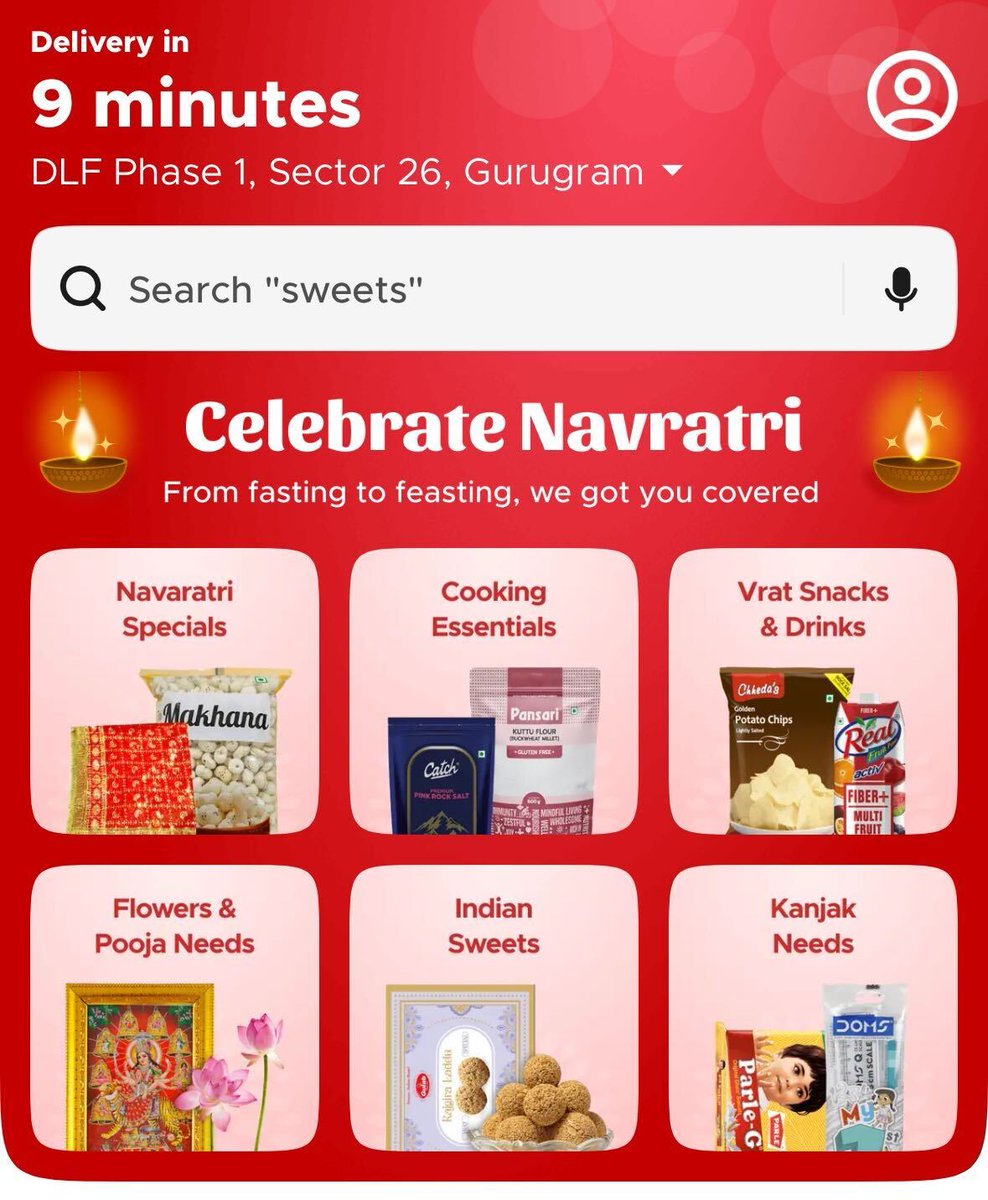
Happy Navratri, Gudi Padwa and Ugadi to everyone celebrating 🙌
Seeing a good uptick in the sales of pooja needs, fasting items, lotus flowers, neem leaves and cow dung cakes since 7:30 AM.
Happy to be a part of all the festivities 💛
The average of the maximum temperatures recorded at #Bengaluru City #IMD observatory is 30.3c (2.2c above normal) making it one of the warmest Augusts in recent times. Three out of the top 5 hottest days in August were recorded this August alone!
#Monsoon2023#Karnataka
Out now - Our Q1FY24 Report: https://t.co/C7AScxXN3A
If you have any further questions or feedback, please email us at [email protected]. Always listening!
Quick snapshots of how we’re powering India’s changing lifestyles 🧵
Thank you so so much sir. Means a lot coming from you.
We are proud to continue building Zomato in the service of our nation.
We aim to make profit to build better services, not build services to make profit.
#MadeInIndia
In the 8th episode of Blinkit Pitstop @albinder spoke to Blinkit store owners Kiran & Anil Gangwa, who are helping us build a new kind of e-commerce - powered by our communities.
Watch now: https://t.co/wmZ7Dcl2D8
#podcast#blinkit#entrepreneurship#blinkitpitstop
Zomato Feeding India’s mission is to “Make India Malnutrition Free”. Awareness campaigns play an important role in bringing long-term behavioural change – in the past #SwachhBharat#BetiBachao and #GlobalCitizen have been able to make a real dent. (1/5)