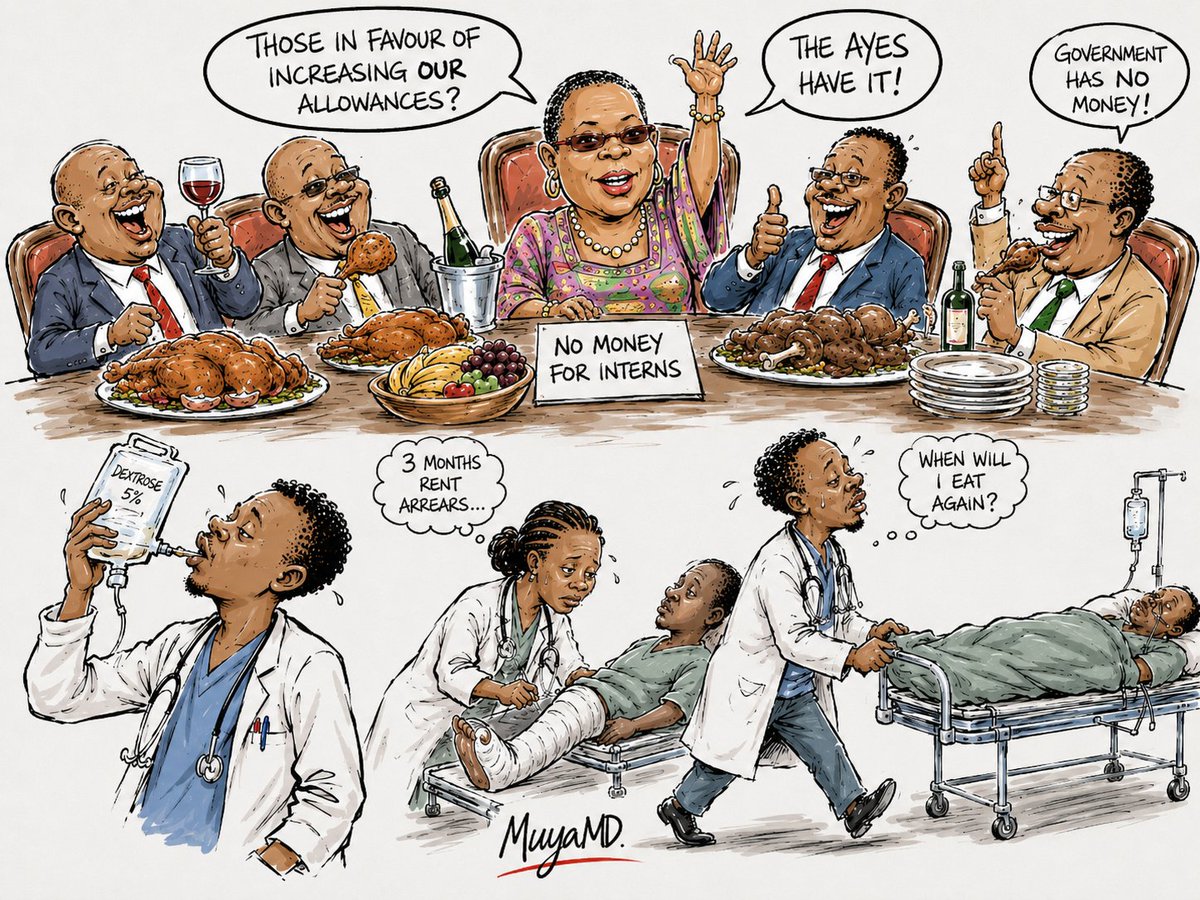
Let us be honest: the issue is not that medical interns are too many.
It is not that Uganda has no money.
It is that medical interns are not being treated as a priority.
Consider the choices being made:
• Parliament keeps growing.
Parliament’s budget reportedly doubled to about 𝗦𝗵𝘀 𝟭. 𝟮 𝘁𝗿𝗶𝗹𝗹𝗶𝗼𝗻. The money going to 529 MPs rose from about 𝗦𝗵𝘀 𝟰𝟬𝟬𝗯 in 2020/21 to 𝗦𝗵𝘀 𝟳𝟰𝟰.𝟰𝗯 in 2026/27, an increase of about 𝗦𝗵𝘀 𝟯𝟰𝟰.𝟰𝗯.
What direct return does this give the common Ugandan in a crowded hospital?
• Two offices alone tell the story.
The Speaker and Deputy Speaker offices had about 𝗦𝗵𝘀 𝟳.𝟭𝗯 combined in 2020/21. In 2026/27, they stand at about 𝗦𝗵𝘀 𝟱𝟬.𝟮𝗯 , an increase of about 𝗦𝗵𝘀 𝟰𝟯.𝟭𝗯 for only two offices.
That increase alone can pay 𝟯𝟬𝟬𝟬 interns 𝗦𝗵𝘀 𝟭𝗺 𝗽𝗲𝗿 𝗺𝗼𝗻𝘁𝗵 𝗳𝗼𝗿 𝗮 𝗳𝘂𝗹𝗹 𝘆𝗲𝗮𝗿, with money left.
• Questionable spending continues.
In 2025/26, selected Speaker’s office lines reportedly included 𝗦𝗵𝘀 𝟮.𝟰𝗯 for foreign travel, 𝗦𝗵𝘀 𝟵𝟲𝟲𝗺 for fuel, 𝗦𝗵𝘀 𝟰.𝟴𝗯 for incapacity, death benefits and funeral expenses, and 𝗦𝗵𝘀 𝟱.𝟮𝗯 for donations. Total: about 𝗦𝗵𝘀 𝟭𝟰.𝟮𝗯. What lasting public health return does this produce compared with doctors on wards?
• RDC structures are being funded.
Uganda reportedly has 146 RDCs, 170 Deputy RDCs and 432 Assistant RDCs, total 748 officials. Their proposed salary enhancement requires an extra 𝗦𝗵𝘀 𝟮𝟵.𝟬𝟳𝟵𝗯 every year.
Add the reported 𝗦𝗵𝘀 𝟯𝟬𝗯 for LC I to LC V political leader facilitation, and that is about 𝗦𝗵𝘀 𝟱𝟵𝗯. In what way does this benefit the common Ugandan?
• Donations are funded.
State House donations reportedly consumed 𝗦𝗵𝘀 𝟳𝟱𝟭𝗯 over seven financial years. In 2023/24 alone, donations were budgeted at 𝗦𝗵𝘀 𝟭𝟴.𝟭𝗯, but actual spending reached 𝗦𝗵𝘀 𝟴𝟬.𝟭𝟴𝗯. If tens and hundreds of billions can be found for donations, how does 𝗦𝗵𝘀 𝟮𝟰𝗯 to 𝗦𝗵𝘀 𝟯𝟲𝗯 for over 2,000 medical interns become impossible?
• Health was not protected with the same urgency.
The Ministry of Health vote fell from about 𝗦𝗵𝘀 𝟭. 𝟲𝟵𝟯 𝘁𝗿𝗶𝗹𝗹𝗶𝗼𝗻 in FY2023/24 to about 𝗦𝗵𝘀 𝟭. 𝟯𝟰𝟰 𝘁𝗿𝗶𝗹𝗹𝗶𝗼𝗻 in FY2024/25, a reduction of about 𝗦𝗵𝘀 𝟯𝟰𝟵𝗯. Even the 2025/26 estimate of 𝗦𝗵𝘀 𝟭.𝟱𝟲𝟰 𝘁𝗿𝗶𝗹𝗹𝗶𝗼𝗻 remains below the 2023/24 level. Yet health is the sector that directly touches mothers in labour, accident victims, children with malaria, emergency patients and families in public hospitals.
Now compare:
• 2,000 interns × Shs1m × 12 months = 𝗦𝗵𝘀 𝟮𝟰𝗯 per year
• 2,500 interns × Shs1m × 12 months = 𝗦𝗵𝘀 𝟯𝟬𝗯 per year
• 3,000 interns × Shs1m × 12 months = 𝗦𝗵𝘀 𝟯𝟲𝗯 per year
Even using the Ministry of Health’s own gross figure of Shs15.6m per intern per year, the reported 2,706 eligible interns would require about Shs42.2b. That is still small compared with what is being found for political comfort and administrative expansion.
That money is not a handout.
✨ It avails doctors on wards.
✨ It keeps emergency units covered.
✨ It supports maternity care.
✨ It fills staffing gaps in regional referrals.
✨ It protects patients.
So let us stop pretending.
This is not a numbers problem.
This is not a money problem.
It is a priority problem.
Medical interns are doctors under apprenticeship, not free labour!
#InternsNotSlaves
A grandmother in Senegal speaks Wolof. Her granddaughter married a Tanzanian and moved to Dar es Salaam. The granddaughter's children speak Swahili. The grandmother and her grandchildren have never been able to write to each other without someone in the middle translating.
Until today.
Daraja's Bridge is live. Any language to any language. Wolof to Swahili. Lingala to Yoruba. Hausa to Zulu. Creole to Amharic. 23 languages across Africa, Europe, Middle East and Asia.
Africa has the most countries, the most borders, and the most languages of any continent. Technology has treated that diversity as a problem.
We built it as a feature.
The bridge is open. Everyone crosses.
https://t.co/ntzi8nreC8 | API: https://t.co/HtIJtCuoOY
https://t.co/HtIJtCuoOY
#AIforAfrica
What he said 🙂
Here’s how to subscribe to Monitor Website Prime Content
1. Visit https://t.co/ZJCIUY5Wfy and log in
2. If you’re not registered, sign up here: https://t.co/iTHf9d7wqW
3. When you click on content marked “PRIME,” the system will prompt you to subscribe/pay.
4. Follow the steps to choose your preferred payment method- Credit card or Mobile Money.
#MonitorUpdates
@URAuganda How can I block or transfer a vehicle from my TIN when I sold it years ago but never changed ownership? I no longer have the buyer’s details, the sale agreement, or the car, yet it’s still under my TIN, and I want to avoid liability.
@MoWT_Uganda
Uganda you have been amazing 🇺🇬 Thank you for such amazing hospitality, thank you for sharing your culture with us, thank you for showering us with so much love and thank you for hosting us in your warm and beautiful country ♥️ To the entire team that put this together, to Mr Amos Wekesa and the entire @rwenzorimarathon Team, the high commission of Uganda in Pretoria, his excellency Mr Paul Omara and his entire Team, THANK YOU🙏🏽 To the people of Uganda, I say WEEBALE NNYO🇺🇬 I’ll see you guys soon! ……..Next stop 🇱🇸
Except that you are wrong. There is no Vehicle with the right of way. Here is what the Rules of Road Regulations say: Regulation 5(2) The driver of a car of the President, Vice President, Chief Justice, Speaker to Parliament or the Prime Minister or a police vehicle or other emergency vehicle or a vehicle in a State Motorcade is allowed, in case of emergency or in
other cases as prescribed, to deviate from the regulations. They are allowed to deviate from the rules of the road in an emergency. A driver gives them the right of way to pass, but it is not always by default.
You are mistaken in stating that an ambulance without a patient cannot be operated as an emergency vehicle. The Traffic and Road Safety Act, 1998, explicitly categorises ambulances, along with the Police Fire Brigade, as authorised emergency motor vehicles. The President is not included in the Act itself but rather in the Regulations, along with those other officials. Additionally, the traffic and road safety law does not mandate stopping and parking on the side specifically for the President's Lead Car—it applies to all motor vehicles that a driver identifies as emergency vehicles.
No matter what an ambulance is carrying, it remains an emergency motor vehicle—whether it’s transporting a patient or even something unexpected like charcoal. The priority is ensuring it reaches its designated hospital as swiftly as possible. If there is concern about ambulance misuse, the appropriate action is to contact the hospital directly. Under no circumstances should an ambulance ever be stopped or obstructed.
The Bank of Uganda applied for permission to enable their Bullion Vans to be driven as emergency motor vehicles in 2016 or 2017 but never got it unless it has been granted recently. I also know that there are other officials who applied for the same permission and they were granted that permission by the Hon. MoWT. Probably the IGG and the Deputies. Please check with the Ministry for a list.
Also, Section 123(3) of the Traffic and Road Safety Act 1998 says: This section does not relieve the driver of an authorised emergency motor vehicle, trailer, or engineering plant from the duty to drive with due regard and care for the safety of persons or property, nor protect the driver from the consequences of his or her disregard for the safety of such persons or property.
SO IT IS POSSIBLE TO HAVE THE PERMISSION TO BE DRIVEN AS AN EMERGENCY MOTOR VEHICLE. HOWEVER, THE DRIVER CAN STILL BE HELD ACCOUNTABLE FOR DISREGARDING THE SAFETY OF OTHER ROAD USERS.
It's important to inform road users and traffic police officers that pick-up trucks carrying police officers assigned to guard officials are not lead cars—they serve a security function, not an escort role. When these vehicles attempt to clear the way for the officials they are protecting, it can inadvertently compromise security by separating them from the individuals they are meant to safeguard. Positioned ahead of the Principal’s vehicle, they lose the ability to assess potential threats properly. Lead cars are like the ones used by the President, Speaker, and Chief Justice.
@Akeda4@ROSACUg @PAFRfOWS_UG @Parliament_Ug@PoliceUg@percy_mulamba@BrianOdamah@RSAIKenya@roadsensekenya@roadsafetypros@uganda_drivers@stassuganda@MoWT_Uganda@SecurityUganda
Did you know that the maximum speed limit on most roads Kampala is 30km/hr?
Yeah, this is mainly for the safety of pedestrians, cyclists and other vulnerable road users.
Before the government turns ON the automated speed limit enforcement, have we told motorists which roads are 30km/hr or 50km/hr?
I took a 30km walk around Kampala looking for 30s and 50s and this is what I saw.
Safe Roads Save Lives
@iamsapex@CanalBoxUG Welcome to the @CanalBoxUG world
This is today tv situation. I missed 9pm news due to very poor network despite speedtest showing 50 ⬆️ 10mbps ⬇️.
@CanalBoxUG internet has been buffering & too slow for the last 1.5 weeks.
Getting Tired of this lousy govt & @mtnug like service.
"My call to young judicial officers,we are going to be in this Uganda for a long time. Don't be misled by the class of 1986 which is on its way out. In Kenya after Moi and South Africa after apartheid, there was a moment of reckoning for judicial officers. A few years down the road, judicial officers who are doing things either in favor or fear, they will have to account to Ugandans."~@bkabumba warning young judicial officers
Someone in Kyanja or its poorer cousin, Najjeera, inspired a few friends in Kasese to set up this for the Kampalan diaspora working and living in Kasese and other fellows that live for soccer.
When in Kasese, look for the Savanna Sports Arena.
There's a hotel by the same group, Tropical Savanna Guest House. Clean. Tidy. Affordable. In town.