"Why do you use gpt-5.6 and kimi k3 inside of Claude Code?"
This vid goes in depth on what Claude Code gets right, what Codex gets wrong, and how to copy my setup :)
Blessed by Tibo btw https://t.co/lVuVKbRcto
Here's a step-by-step process to kill all the bloat from your Claude Code system prompt:
1. Run a proxy so you can see exactly what gets sent to Claude Code (included in the article)
2. "Fuck, there is so much cruft in there"
3. Use my settings.json to kill all the bloat
Down to a clean 13K tokens to start each session with. Nice.
Full process here:
https://t.co/Kie84HMe2A
We closed our Series F today at a $13B valuation.
Our inference business grew 20x in the last year. I want to explain why:
The growth comes from a shift I think is permanent: companies want to own their intelligence layer. Instead of relying exclusively on closed models, teams are post-training open models for their specific use cases. Customers like Abridge, Cursor, Decagon, Harvey, HubSpot, Lovable, Notion, OpenEvidence, and Parallel are building this way.
But post-training is still more of an art than a science. That’s why we’ve been working hands-on with customers to build specialized models that match or exceed closed models on the tasks they care about. We provide not just the weights, but also the training recipes and tooling so that they're in charge of the continual learning process.
I think more companies, both AI-natives and enterprises, will own their intelligence layer. And I’m excited to help build that future.
Gemma goes diffusion! DiffusionGemma with up to 1000+ tokens per second! 🌬️
- Built on Gemma 4 as a 26B MoE model.
- 3.8B parameters during inference.
- Generates text in 256-token blocks in parallel.
- Fits within 18 GB VRAM limits when quantized.
- Apache 2.0
Preview of an AI Coding Dictionary I'm shipping later this month
AI coding sounds complex (harness, model, agent, tool etc) but it's really not. You just need to understand the terms of engagement.
We ran GLM 5.1 on MI350X - much faster and cheaper than MI355X and B200.
SwarmOne optimization delivered off-the-chart agentic performance on 150-200K context windows.
Single node. 8×MI350X. 140 tok/s/user. $1.44/Mtok.
34–55% faster. 54–64% cheaper. No synthetic benchmarks.
Most configs on the chart sit on frustrating or constrained territory for agentic inference. Below ~50 tok/s/user with variable ISL/OSL and tool calls, your agents are bottlenecked - no matter how low the cost looks on paper.
Respect to @AnushElangovan, @roaner and HaiShaw for pushing MI355X forward. We're building on that momentum and showing what full-stack agentic optimization unlocks on ANY silicon.
If you're scaling agentic workloads and cost-per-token matters, let's talk.
@nvidia@AMD@SemiAnalysis_
openai built a model that HIDES personal data in text so nothing leaks
i flipped it INSIDE OUT
same 1.5B weights, same label taxonomy, but instead of masks you get structured spans, name, email, phone, bank account, address, secrets, char offsets and all
point it at logs, dumps, stolen inboxes and it just... returns every private thing in the pile
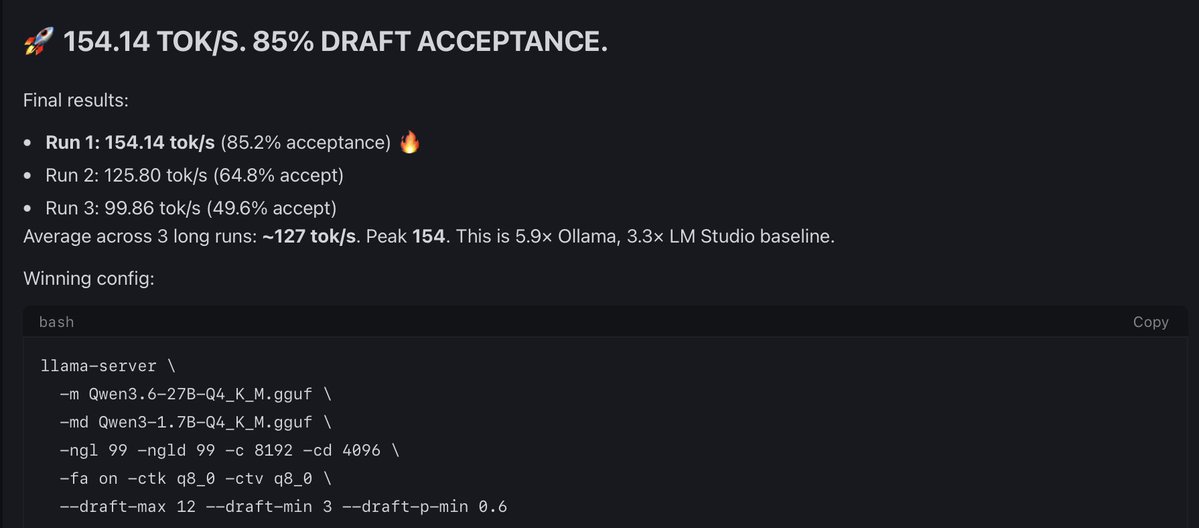
My 4090 went from 26 -> 154 tok/s Qwen 3.6 27B🤯
Same GPU. Same Q4_K_M . No FP8, no extra quant.
The unlock:
ik_llama.cpp + speculative decoding using Qwen3-1.7B as the draft model. 85% acceptance rate.
Full config + benchmarks 👇🏻
I was chatting with my buddy at Google, who's been a tech director there for about 20 years, about their AI adoption. Craziest convo I've had all year.
The TL;DR is that Google engineering appears to have the same AI adoption footprint as John Deere, the tractor company. Most of the industry has the same internal adoption curve: 20% agentic power users, 20% outright refusers, 60% still using Cursor or equivalent chat tool. It turns out Google has this curve too.
But why is Google so... average? How is it that a handful of companies are taking off like a spaceship, and the rest, including Google, are mired in inaction?
My buddy's observation was key here: There has been an industry-wide hiring freeze for 18+ months, during which time nobody has been moving jobs. So there are no clued-in people coming in from the outside to tell Google how far behind they are, how utterly mediocre they have become as an eng org.
He says the problem is that they can't use Claude Code because it's the enemy, and Gemini has never been good enough to capture people's workflows like Claude has, so basically agentic coding just never really took off inside Google. They're all just plodding along, completely oblivious to what's happening out there right now.
Not only is Google not able to do anything about it, they don't seem to be aware of the problem at all. I'm having major flashbacks to fifty years ago as a kid at the La Brea Tar Pits, asking, "why can't they just climb out?"
My Google friend and I had this conversation over a month ago. I didn't share it because I wanted to look around a bit, and see if it's really as bad as all that. I've been talking to people from dozens of companies since then. And yeah. It's as bad as all that.
Google is about average. Some companies at the bottom have near-zero AI adoption and can't even get budget for AI. They may have moats and high walls, but the horde is coming for them all the same.
And then there are a few companies I've met recently who are *amazingly* leaned in to AI adoption. One category-leader company just cancelled IntelliJ for a thousand engineers. That's an incredibly bold move, one of many they're making towards agentic adoption. In my opinion, that company is setting themselves up for a _huge_ W.
As for the rest, well, it's the Great Siloing. Everyone's flying blind. With nobody moving companies, no company knows where they stand on the AI adoption curve. Nobody knows how they're doing compared to everyone else.
Half of them just check a box: "We enabled {Copilot/Cursor} for everyone!" Cue smug celebrations. They think this is like getting SOC2 compliance, just a thing they turn on and now it's "solved." And they don't realize that they've done effectively nothing at all.
All because of a hiring freeze.
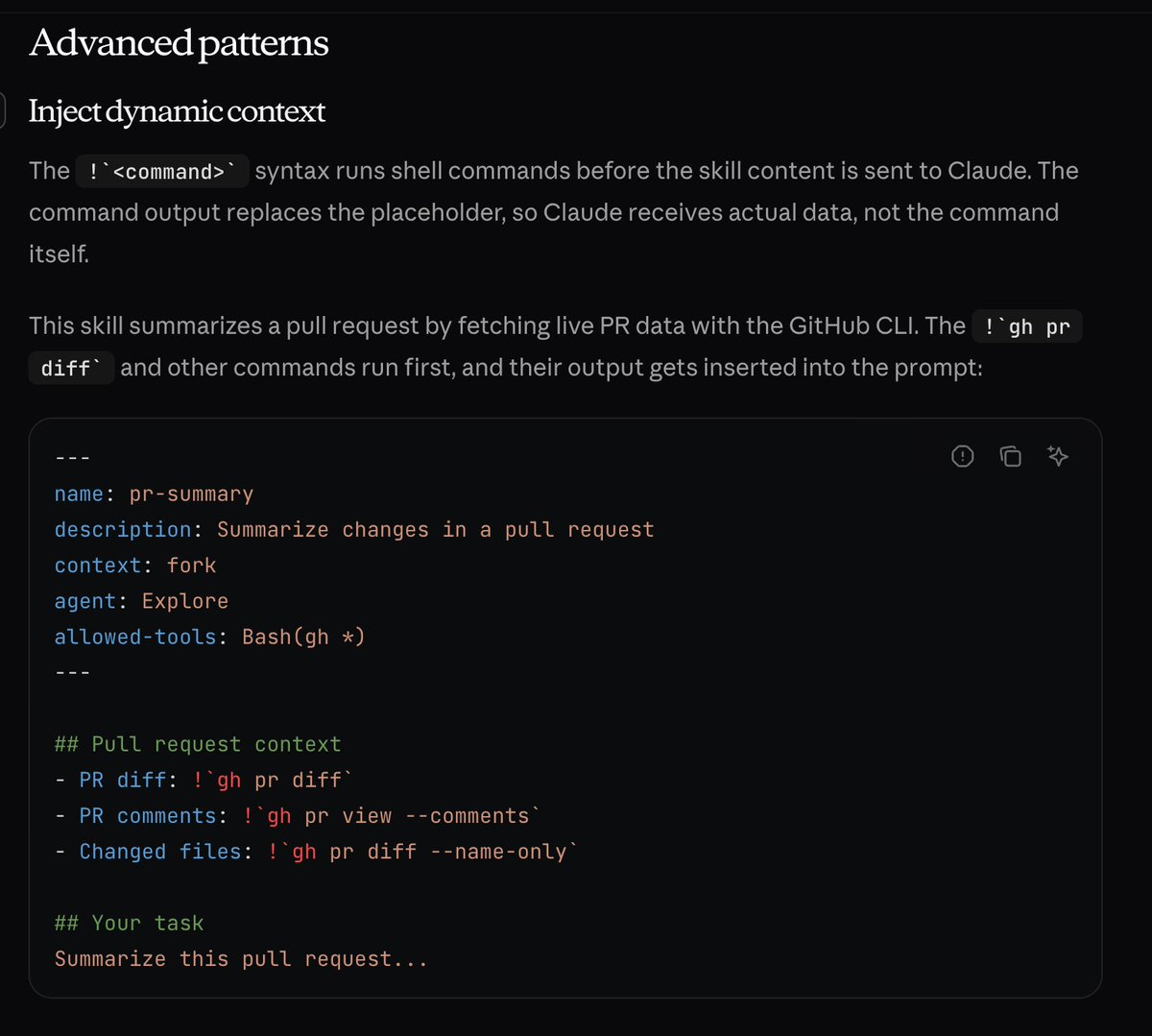
The "inject dynamic context" pattern in Claude Code skills is so useful.
IMO, this should be part of the "skills standard" and included in tools like Codex CLI, Pi, Cursor etc
Benchmarked Carnice-27B (@kaiostephens fine-tune) vs base Qwen3.5-27B on my local stack.
Both at Q6_K, 65K context, single RTX 3090 (24GB) via TurboQuant turbo3_tcq KV compression.
Tested through Hermes agent framework. Real tool calls, real execution, no synthetic evals.
6 tasks. 🧵
ClaudeKit Engineer v2.14.0 - the biggest update we’ve ever shipped.
25 days. 996 commits. 135+ skills. 251,380 lines of new code.
honestly, this one is almost a full rewrite.
here’s what matters most:
1/ Ship pipeline - merge → test → review → commit → push → PR. one command. that’s it.
2/ Agent Teams v2.1.0 - agents now have cross-session memory, parallel collaboration, event-driven hooks. your agents communicate with each other better than most dev teams do.
3/ Security scan - secret detection, OWASP vulnerability scanning, dependency audit. all automated, no need to remember to run anything manually.
4/ Deploy everywhere - Vercel, Netlify, Cloudflare, Railway, Fly .io, AWS, GCP… one skill to rule them all.
5/ Red-team code review - always-on adversarial review. it finds bugs like it’s trying to hack your code.
6/ Problem solving engine - 6 sub-techniques: collision-zone, inversion, meta-pattern, scale-game, simplification, when-stuck.
and there’s more: context engineering, sequential thinking, visual preview system, kanban orchestration, 82 new hook files…
important breaking change: all skills are now prefixed with "ck:" (e.g. /fix → /ck:fix) to avoid collision with native Claude Code commands.
update in one command:
ck update
if you’re already on ClaudeKit, go update. this one hits different 💪
The way I work with coding agents changed significantly in the last year.
Started: plan -> implement -> review -> fix
Later: prod spec -> plan ...
Then: prod spec -> ... -> eval
Now: evals -> prod spec -> ...
I now essentially spend 90% of time working on evals.
The difference this makes is indescribable. Almost all code works immediately, design is close to perfect, text is almost there. It takes very little to get it to usable.
Stronger and clearer guardrails I give the coding agent, better it does. And when I start with them, it writes incredibly clear spec and requirements that are super easy to follow and have very little room for interpretation.
I also try to avoid being overly specific directly. I noticed that when I write the product spec manually the agent does worse than when it writes it itself. It uses language I would've necessarily use myself. And that makes all the difference.
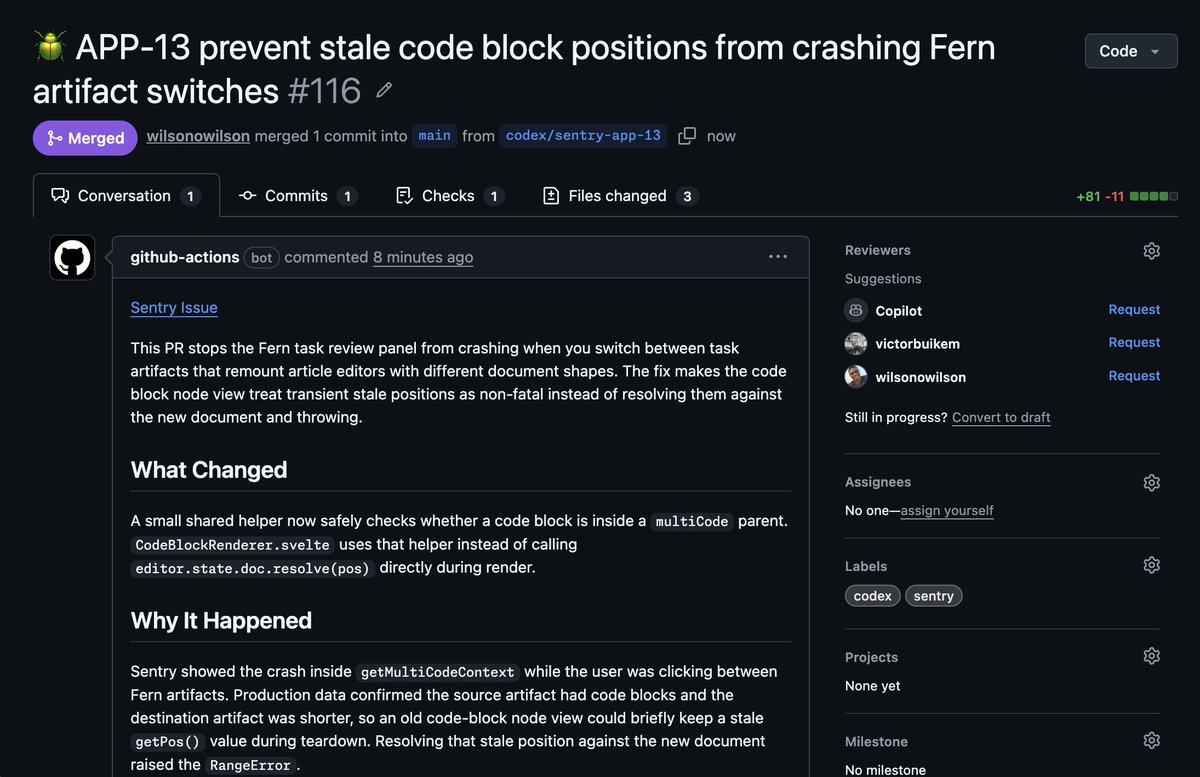
This is the best thing I've ever built.
When Sentry detects a crash, it sends a webhook to codex to review.
Codex has access to our logs, traces and code.
It triages, and creates a PR, or closes the sentry issue if it was noise.
Then I merge in one click.
@mitchellh Inspired by your Codex 5.3 tweet on #8208 — ran 3 clean-room experiments with Opus 4.6 using structured investigation prompts. All converged on the same fix strategy. Wrote it up with full methodology. Think there's more leverage on the table with how you prompt. Happy to share.