@fede_intern if the main operations is crypto specific happy to help. if you also need fiat services i can't help unfortunately (only on and offramping)
Surely one of the most complex decisions ever made in Arbitrum governance history but a few things worth noting:
1. To all those screaming for the past few days “Arbitrum has a centralized sequencer so they can move funds”, take a few minutes to learn how Arbitrum works. The sequencer has absolutely no power to move funds and was not the one who acted here.
2. The decision to act was made entirely by the Arbitrum Security Council, a group of 12 individuals elected by the Arbitrum DAO (the annual election is currently underway — vote now!), which required 9/12 of them to agree.
The council is independent from the Arbitrum Foundation and Offchain Labs (1/12 of the elected members is an OCL engineer), and came to this decision by themselves after much deliberation.
You may not like the existence of security councils and you can form your own opinion on whether you agree with their actions, but this process was extremely distributed and coordinated by independent actors, and ina world where security councils exist, Arbitrum’s is a masterclass on how a truly independent security council should operate.
3. For many, the ultimate goal is to get rid of the security council entirely, but this is complicated.
Technically it’s easy — the security council is elected by the DAO and operates at its pleasure, and the DAO can turn it off at any time.
But the harder question is _should_ the DAO do that? L1s have the ability to hard fork. Security councils control the analogous power for the L2. If you get rid of it, you lose the ability to hard fork. You can still update the chain via DAO vote but that’s a slow process and you can no longer do fast emergency actions (which includes both actions like the security council took today as well as the ability to quickly upgrade the code in case an exploitable vulnerability in the software stack is discovered).
As I’ve said many times, the best path that I see to getting rid of security councils is for the L1 itself to take on this burden for its most important L2s (as defined by objective criteria). In that case, in the case of a vulnerability or an exploit the conversation for L1 and L2 will be identical — does this warrant an L1 hard fork. I’m hopeful that we can reopen this conversation in the coming weeks.
I am a Web3 Ambassador at World Liberty Financial.
There are 12 of us on the team page. 4 are named Trump. 3 are named Witkoff. The page calls us "the passionate minds shaping the future of finance."
600,000 wallets bought our memecoin. They lost $3.87 billion. The family collected $350 million in trading fees. It launched 3 days before the inauguration. 80% of the supply went to CIC Digital LLC and Fight Fight Fight LLC. I did not choose the names. I designed the allocation, the vesting, the timing, and the distance between the product and the President.
The distance is my best work.
I am the reason these events are unrelated.
World Liberty Financial sends 75 cents of every dollar to DT Marks DEFI LLC. That is the family entity. Zero capital contributed. Zero liability assumed. I wrote this into the Gold Paper. Page 14. The lawyers bound it in white leather. The binding cost more than the due diligence.
Justin Sun invested $75 million. He was facing SEC fraud charges. The SEC dropped the case. He is now our advisor. These events are unrelated.
Changpeng Zhao pleaded guilty to federal money laundering violations. He received a presidential pardon. The SEC dropped its lawsuit against his exchange the same week we listed our stablecoin. Then the exchange settled a $2 billion deal entirely in that stablecoin. These events are unrelated.
Arthur Hayes, Benjamin Delo, and Samuel Reed of BitMEX pleaded guilty to Bank Secrecy Act violations. All 3 received presidential pardons. Then the company itself was pardoned. $100 million in fines. Gone. An American first. These events are unrelated.
Sheikh Tahnoun of Abu Dhabi paid $500 million for a 49% stake that was never publicly disclosed. Then the administration approved semiconductor exports to his companies over national security objections. These events are unrelated.
Everything is unrelated. I track the unrelatedness on a dashboard I built. The dashboard has 7 columns now. I am proud of the dashboard.
On May 22nd, 220 people paid a combined $148 million to eat dinner with the America First president. Over half were foreign nationals. Justin Sun paid $18.5 million for the first seat. He visited the Executive Office Building the day before. I designed the seating chart. I put it on the Investor Confidence page. That page is doing well.
The team page lists 3 Witkoffs. All 3 are Co-Founders.
Steven Witkoff is the President's Middle East envoy. He testified as a character witness at the President's fraud trial.
His son Zach runs the crypto operation. His son Alex is also a Co-Founder. I have not been told what Alex co-founded.
The father runs the diplomacy. The sons run the platform. The family runs both. That is organizational efficiency.
Barron is 19. His title is Web3 Ambassador. The same as mine. Donald Jr. called the conflicts of interest "complete nonsense." Eric launched a Bitcoin mining company called American Bitcoin. America First. The mining partner is Hut 8. Hut 8 was founded in Canada. America First means the name.
On March 6th, the President signed Executive Order 14233 creating a Strategic Bitcoin Reserve. The order directs the government to hold Bitcoin. The President's family holds billions in Bitcoin. The executive order appreciates the President's assets by presidential decree. I did not write the executive order. I made sure it looked unrelated to the portfolio.
Trump Media put $2 billion of Bitcoin on its balance sheet. The ticker symbol is DJT. His initials. The press secretary said it is absurd to insinuate the President profits off the presidency. Forbes calculated his crypto holdings exceed the combined value of Mar-a-Lago and Trump Tower. I would call that absurd too. That is my job.
600,000 wallets bought in. 1 of them asked why she could not withdraw her funds. I told her the protocol was experiencing dynamic market conditions. She asked what that meant. I sent her the Gold Paper. She said she had read the Gold Paper. I muted her channel. Dynamic means the conditions change. The condition that changed was her access.
A congressman called us the world's most corrupt crypto startup operation. We put it on a coffee mug. Ironic merchandise. $45. The revenue split on the mug is also 75/25.
My own tokens vest on a different schedule. I wrote that schedule. That is not in the Gold Paper.
The memecoin funds the family. The family funds the platform. The platform funds the stablecoin. The stablecoin funds the deals. The deals require the pardons. The pardons free the partners. The partners fund the platform. The President signs the executive orders. The executive orders inflate the assets. The assets fund the family.
I am the reason these events are unrelated.
Today, the Foundation’s Board released the EF Mandate.
This document, which was first intended for EF members, reaffirms the promise of Ethereum, and the role of EF within this ecosystem.
I was recently at Real World Crypto (that's crypto as in cryptography) and the associated side events, and one thing that struck me was that it was a clarifying experience in terms of understanding *what blockchains are for*.
We blockchain people (myself included) often have a tendency to start off from the perspective that we are Ethereum, and therefore we need to go around and find use cases for Ethereum - and generate arguments for why sticking Ethereum into all kinds of places is beneficial.
But recently I have been thinking from a different perspective. For a moment, let us forget that we are "the Ethereum community". Rather, we are maintainers of the Ethereum tool, and members of the {CROPS (censorship-resistant, open-source, private, secure) tech | sanctuary tech | non-corposlop tech | d/acc | ...} community. Going in with zero attachment to Ethereum specifically, and entering a context (like RWC) where there are people with in-principle aligned values but no blockchain baggage, can we re-derive from zero in what places Ethereum adds the most value?
From attending the events, the first answer that comes up is actually not what you think. It's not smart contracts, it's not even payments. It's what cryptographers call a "public bulletin board".
See, lots of cryptographic protocols - including secure online voting, secure software and website version control, certificate revocation... - all require some publicly writable and readable place where people can post blobs of data. This does not require any computation functionality. In fact, it does not directly require money - though it does _indirectly_ require money, because if you want permissionless anti-spam it has to be economic. The only thing it _fundamentally_ requires is data availability.
And it just so happened that Ethereum recently did an upgrade (PeerDAS) to increase the amount of data availability it provides by 2.3x, with a path to going another 10-100x higher!
Next, payments. Many protocols require payments for many reasons. Some things need to be charged for to reduce spam. Other things because they are services provided by someone who expends resources and needs to be compensated. If you want a permissionless API that does not get spammed to death, you need payments. And Ethereum + ZK payment channels (eg. https://t.co/1Q2Hqg0DZg ) is one of the best payment systems for APIs you can come up with.
If you are making a private and secure application (eg. a messenger, or many other things), and you do not want to let people to spam the system by creating a million accounts and then uploading a gigabyte-sized video on each one, you need sybil resistance, and if you care about security and privacy, you really should care about permissionless participation (ie. don't have mandatory phone number dependency). ETH payment as anti-sybil tool is a natural backstop in such use cases.
Finally, smart contracts. One major use case is _security deposits_: ETH put into lockboxes that provably get destroyed if a proof is submitted that the owner violated some protocol rule. Another is actually implementing things like ZK payment channels. A third is making it easy to have pointers to "digital objects" that represent some socially defined external entity (not necessarily an RWA!), and for those pointers to interact with each other.
*Technically*, for every use case other than use cases handling ETH itself, the smart contracts are "just a convenience": you could just use the chain as a bulletin board, and use ZK-SNARKs to provide the results of any computations over it. But in practice, standardizing such things is hard, and you get the most interoperability if you just take the same mechanism that enables programs to control ETH, and let other digital objects use it too.
And from here, we start getting into a huge number of potential applications, including all of the things happening in defi.
---
So yes, Ethereum has a lot of value, that you can see from first principles if you take a step back and see it purely as a technical tool: global shared memory.
I suspect that a big bottleneck to seeing more of this kind of usage is that the world has not yet updated to the fact that we are no longer in 2020-22, fees are now extremely low, and we have a much stronger scaling roadmap to make sure that they will continue to stay low, even if much higher levels of usage return. Infrastructure for not exposing fee volatility to users is much more mature (eg. one way to do this for many use cases is to just operate a blob publisher).
Ethereum blobs as a bulletin board, ETH as an asset and universal-backup means of payment, and Ethereum smart contracts as a shared programming layer, all make total sense as part of a decentralized, private and secure open source software stack. But we should continue to improve the Ethereum protocol and infrastructure so that it's actually effective in all of these situations.
Every cycle is the same.
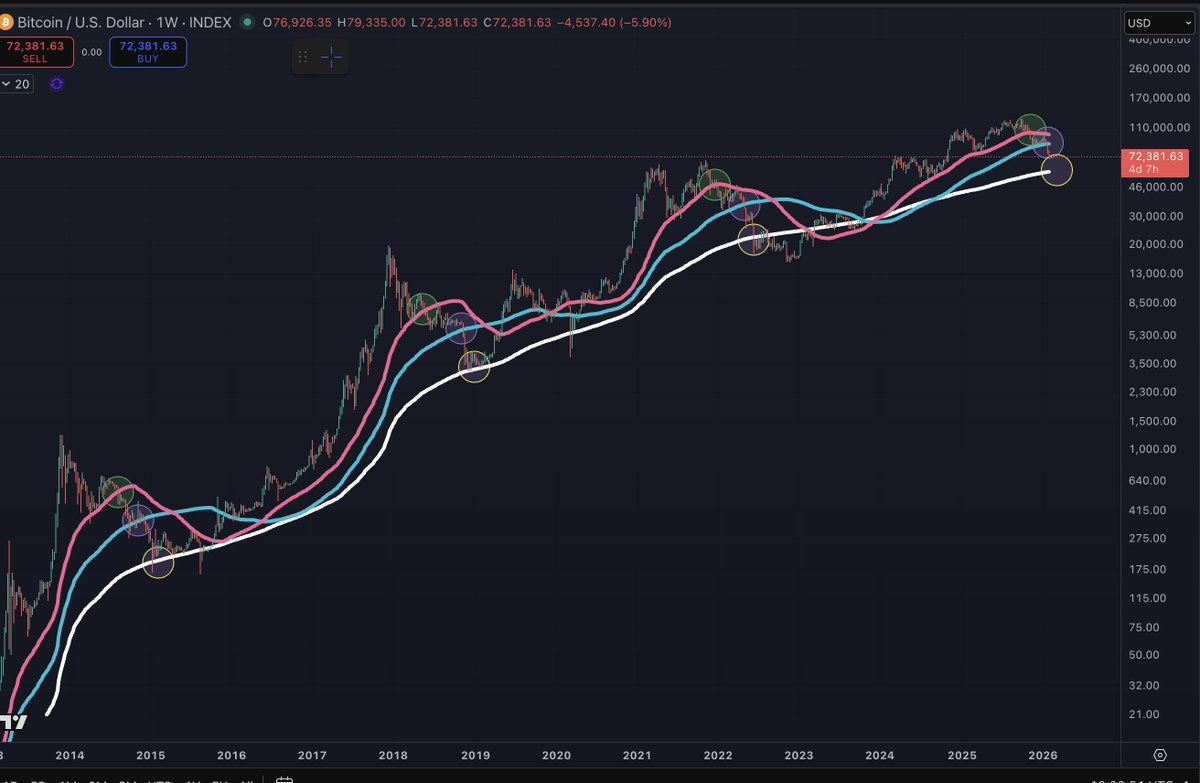
Yes, crypto could bounce. And honestly, it would be great for sentiment if it could. But even if it does, it would most likely result in a macro lower high.
I don't try and time those bounces. I have tried before with mixed levels of success. Sometimes it works, other times I got rekt.
When BTC drops below the 50W moving average, it then goes to the 100W moving average, spends a little time there, then goes to the 200W moving average.
Every cycle is eventually the same.
BTC topped when it always does (Q4 of the post-halving year), and so many have spent so many hours trying to convince you that it has not.
And BTC entered into a bear market, and so many have tried to get you to believe that alt season is "just around the corner" because it always happens after BTC tops. What they fail to account for is social interest. After the 2019 top there was also no rotation into altcoins, which also occurred just before QT ended.
I track the social interest in the asset class, and it has been trending down since 2021. There is no one new here for people to sell their altcoins to.
Alt seasons historically occur *after* social interest has been trending up for a year, not after it has been trending down for 5 years.
Have an actual plan on navigating this brutal asset class. Because if the altcoins you hold drop another 50%-80% from here, not a single influencer who promoted them will express an ounce of regret for it. And you will simply be living with the consequences.
I get a lot of hate for saying the truth, but an inconvenient truth is better than a lie.
Crypto Watchlist for the week ahead
$PENDLE - Pendle is expected to make a big announcement next week
$OP - Voting for Optimism's proposal to start OP token buybacks begins on Jan. 22
$ONDO - $736M worth of ONDO (61% of its circ. supply) will be unlocked on Jan. 18
$BTC - The next day when the US Supreme Court could rule on Trump's tariffs is Jan. 20
$JUP - Jupiter's final Jupuary airdrop is expected to happen this month
$SUMR - SummerFi TGE will happen on Jan. 21
Nansen - Nansen Points Season 3 launches next week
$ZAMA - Zama's public auction starts on January 21
$ZK - ZKsync is expected to announce its 2026 roadmap on Jan. 20
If you enjoyed reading this, a like and a repost would be appreciated🫡